
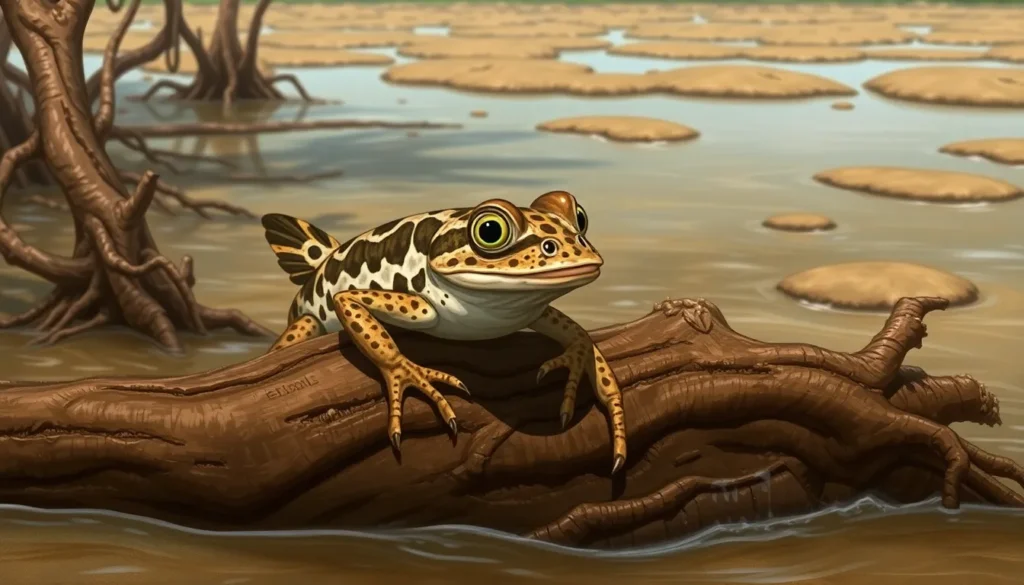
Short Answer
21 Facts About Mudskippers
- Amphibious Fish: Mudskippers are fish that can live both in water and on land, an uncommon trait among fish species.
- Unique Locomotion: They use their pectoral fins to walk and climb on mudflats and mangrove roots.
- Air Breathing: Mudskippers breathe through their skin and the lining of their mouth and throat, which must remain moist to facilitate gas exchange.
- Habitat: They are primarily found in intertidal zones such as mangroves, estuaries, and tidal mudflats in the Indo-Pacific region.
- Territorial Behavior: Male mudskippers are territorial and often engage in displays and fights to defend their burrows.
- Burrow Construction: They dig burrows in the mud which serve as refuges from predators and places to lay eggs.
- Vision Adaptations: Mudskippers have eyes located on top of their heads, providing a wide field of vision both in and out of water.
- Communication: They use visual signals such as fin displays and body postures to communicate, especially during mating or territorial disputes.
- Diet: Mudskippers are omnivores, feeding on algae, small invertebrates, and detritus found on mud surfaces.
- Reproduction: Females lay eggs inside burrows where the oxygen levels are controlled by males through water movement.
- Adaptation to Salinity: Mudskippers can tolerate a wide range of salinities, allowing them to inhabit estuarine environments.
- Survival Strategy: They can survive out of water for extended periods by maintaining moisture and utilizing their specialized respiratory system.
- Predator Avoidance: Mudskippers quickly retreat to their burrows or water when threatened by predators.
- Size Variation: Different species vary in size, generally ranging from 10 to 30 centimeters in length.
- Social Structure: Some species exhibit social hierarchies within their populations, particularly among males during breeding season.
- Environmental Indicators: Because they rely on healthy mangrove and mudflat ecosystems, mudskippers can be indicators of environmental health.
- Evolutionary Significance: Their amphibious lifestyle provides insights into the evolutionary transition from aquatic to terrestrial life in vertebrates.
- Burrow Oxygenation: Males actively maintain oxygen levels in their burrows by moving water in and out to support egg development.
- Temperature Regulation: They use their burrows and mudflats to regulate body temperature in varying environmental conditions.
- Global Distribution: Mudskippers are predominantly found in tropical and subtropical regions of the Indian and Pacific Oceans.
- Species Diversity: There are approximately 30 recognized species of mudskippers, each with specific adaptations to their habitats.
Habitat and Behavior
Mudskippers inhabit intertidal zones where they experience fluctuating tides, often living in mangroves, estuaries, and mudflats. These environments provide both the aquatic and terrestrial habitats necessary for their survival. Their behavior is characterized by their ability to move on land using their strong pectoral fins and their capacity to breathe air through their skin and mucous membranes. They dig burrows in the mud, which serve as protective refuges and breeding sites. During low tide, mudskippers are active on mudflats, feeding and interacting socially, while retreating to water or burrows when threatened or during high tide. Their territorial and mating behaviors include visual displays and fights among males to secure breeding sites.
Why This Animal Matters
Mudskippers play an important ecological role in their habitats by contributing to nutrient cycling and aeration of the mud through their burrowing activities. They are indicators of healthy mangrove and estuarine ecosystems, which are crucial for biodiversity and coastal protection. Their unique amphibious adaptations provide valuable insight into evolutionary biology, particularly the transition of vertebrate life from water to land. Additionally, mudskippers hold cultural significance in some coastal communities where they are part of local folklore and sometimes used in traditional fishing practices. Conservation of mudskipper habitats is important due to increasing threats from coastal development, pollution, and habitat loss.
Common Misconceptions
Misconception: Mudskippers are amphibians like frogs.
Correction: Despite their amphibious lifestyle, mudskippers are true fish, belonging to the family Gobiidae, and not amphibians.
Misconception: Mudskippers can survive indefinitely out of water.
Correction: Mudskippers require moist conditions to breathe through their skin and mucosa; they cannot survive permanently out of water.
Misconception: Mudskippers are a single species.
Correction: There are around 30 species of mudskippers, each adapted to different environmental conditions.
FAQ
Can mudskippers breathe air?
Yes, mudskippers can breathe air through their skin and the lining of their mouth and throat, provided these surfaces remain moist.
Where do mudskippers live?
Mudskippers live in intertidal zones such as mangroves, estuaries, and mudflats mostly in the Indo-Pacific region.
How do mudskippers move on land?
They use their strong pectoral fins to walk, climb, and even jump on mudflats and mangrove roots.




Leave a Reply