
Short Answer
21 Facts About Lady Amherst’s Pheasant
- Scientific Name: The species is scientifically known as Chrysolophus amherstiae.
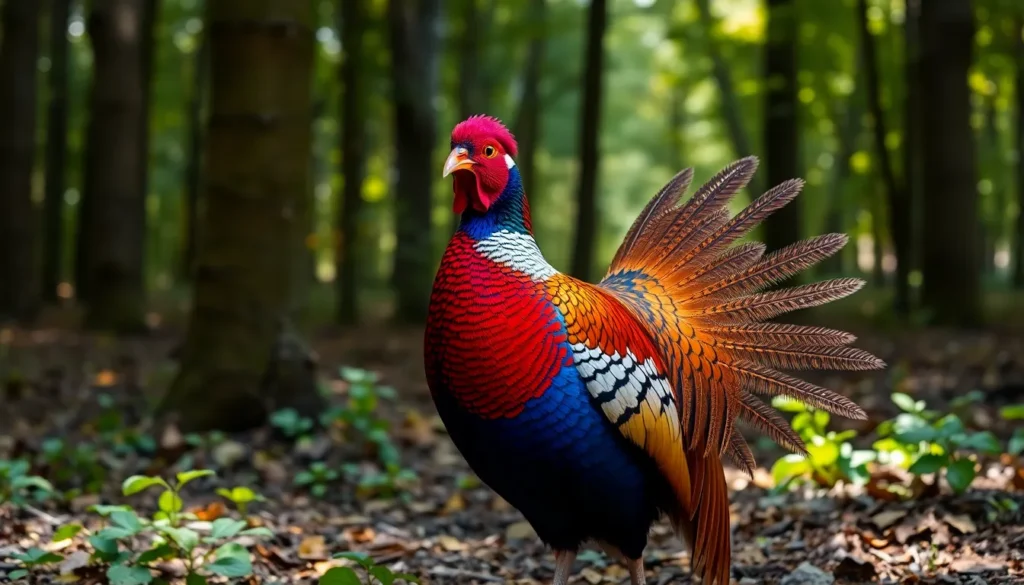
- Appearance: The male Lady Amherst’s pheasant is known for its striking and vibrant plumage, featuring iridescent green, red, white, and black colors.
- Sexual Dimorphism: Females exhibit duller brown and grey tones, which provide camouflage, contrasting the male’s bright colors.
- Tail Feature: The male has a long, barred tail with alternating black and white patterns that can reach up to 70 centimeters in length.
- Native Range: The species is native to the mountainous forests of southwestern China and northern Myanmar.
- Introduction to the UK: Lady Amherst’s pheasants were introduced to parts of the United Kingdom in the 19th century, where small feral populations became established.
- Diet: Their diet mainly consists of seeds, leaves, berries, and insects, reflecting their omnivorous feeding habits.
- Behavior: They are shy and elusive birds, usually foraging on the forest floor and taking flight only when threatened.
- Reproduction: Females typically lay between 6 to 12 eggs per clutch, nesting on the ground.
- Conservation Status: Currently, Lady Amherst’s pheasant is not considered globally threatened, though habitat loss could impact local populations.
- Mating Display: Males perform a complex courtship display involving spreading their cape-like feathers to attract females.
- Lifespan: In captivity, they can live up to 15 years, though exact lifespan in the wild is less documented.
- Flight Ability: While capable of short bursts of flight, they primarily prefer running and hiding in dense undergrowth.
- Vocalizations: Their calls are typically soft and not frequently heard, used mainly during mating or alarm situations.
- Taxonomic Family: Lady Amherst’s pheasant belongs to the Phasianidae family, which includes other pheasants, partridges, and quails.
- Historical Naming: The species is named after Sarah Amherst, wife of the British Governor-General of India in the 19th century.
- Hybridization: They can hybridize with the closely related Golden pheasant (Chrysolophus pictus) in captivity.
- Plumage Molt: They undergo a molt once a year, renewing their feathers to maintain vibrant colors.
- Predators: Natural predators include larger birds of prey and terrestrial mammals.
- Adaptations: Their cryptic female plumage and ability to quickly hide help them avoid predation.
- Population Trends: Wild population data is limited, but they are considered stable where habitat remains intact.
Habitat and Behavior
Lady Amherst’s pheasant inhabits dense, mountainous forests with thick undergrowth, primarily in southwestern China and northern Myanmar. They prefer temperate woodland environments where they can forage on the forest floor. Their behavior is generally secretive and elusive, avoiding open areas to reduce predation risk. These birds forage for a mixed diet of seeds, fruits, and invertebrates, adapting their feeding habits seasonally. During breeding seasons, males engage in elaborate displays to attract females, showing off their bright plumage by spreading their cape feathers and fanning their long tail feathers. Nests are typically concealed on the ground beneath dense vegetation, where the female incubates the eggs alone. Although capable of flight, they rely more on running and hiding to evade threats, often retreating to dense cover when disturbed.
Why This Animal Matters
Ecologically, Lady Amherst’s pheasant plays a role in seed dispersal and controlling insect populations within its habitat. Its striking appearance has made it a subject of interest for bird watchers and researchers, contributing to the study of sexual selection and avian coloration. The species also holds cultural significance due to its association with colonial history and its namesake. Conservation-wise, while not currently endangered, the bird’s reliance on forest habitats means that habitat destruction could threaten its populations. Monitoring and protecting its natural environment helps preserve biodiversity and maintains the ecological balance in its native range.
Common Misconceptions
Misconception: Lady Amherst’s pheasant is an aggressive bird.
Correction: This species is generally shy and avoids confrontation, preferring to flee or hide rather than engage aggressively.
Misconception: The species is widespread and common worldwide.
Correction: While introduced populations exist, Lady Amherst’s pheasant is native to a limited region in Asia and is not widely distributed globally.
Misconception: Male and female birds have similar plumage.
Correction: There is strong sexual dimorphism; males have vibrant, colorful plumage, while females are much duller for camouflage purposes.
FAQ
Where is Lady Amherst’s pheasant originally from?
It is native to the mountainous forests of southwestern China and northern Myanmar.
What does Lady Amherst’s pheasant eat?
It has an omnivorous diet consisting mainly of seeds, leaves, berries, and insects.
Is Lady Amherst’s pheasant endangered?
Currently, it is not considered globally threatened, though habitat loss could pose future risks.


Leave a Reply