
Short Answer
21 Facts About Gerenuk (Antelopes)
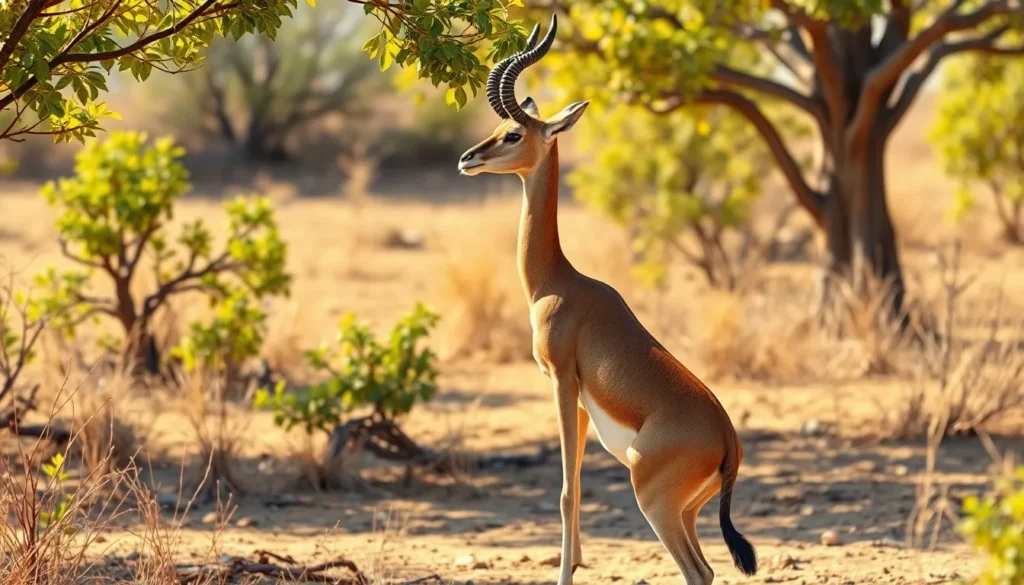
- Unique Neck Adaptation: The gerenuk has an elongated neck, allowing it to reach leaves and shoots higher than most other antelopes can access.
- Scientific Name: Its scientific name is Litocranius walleri, reflecting its distinctive morphology.
- Physical Appearance: Gerenuks have a slender body, long legs, and large eyes, giving them a delicate and graceful appearance.
- Size: Adult gerenuks typically stand about 80–105 cm (31–41 inches) at the shoulder and weigh between 18 and 52 kg (40–115 lbs), with males generally larger than females.
- Habitat Range: They are native to dry bushland and scrublands of East Africa, particularly in Kenya, Tanzania, Ethiopia, and Somalia.
- Diet: Unlike many antelopes, gerenuks primarily browse on leaves, shoots, flowers, and fruits rather than grazing on grass.
- Feeding Behavior: Gerenuks are known for their ability to stand on their hind legs, stretching their necks to reach foliage higher up in trees and bushes.
- Water Independence: They can survive for long periods without drinking water, obtaining moisture from the plants they consume.
- Social Structure: Gerenuks are generally solitary or found in small groups, typically consisting of females and their young or bachelor males.
- Territoriality: Males maintain territories during the breeding season and mark them with scent glands located beneath their eyes.
- Reproduction: Females usually give birth to a single calf after a gestation period of about seven months.
- Lifespan: In the wild, gerenuks can live up to 10 years, while in captivity they may live longer.
- Predators: Common predators include lions, leopards, cheetahs, and hyenas, against which gerenuks rely on agility and alertness.
- Conservation Status: The International Union for Conservation of Nature (IUCN) currently lists the gerenuk as Near Threatened due to habitat loss and hunting pressures.
- Camouflage: Their reddish-brown coat helps them blend into the dry bush environment to avoid predators.
- Behavioral Adaptations: Gerenuks are primarily crepuscular, being most active during early morning and late afternoon to avoid the heat of midday.
- Communication: They use scent marking and visual signals to communicate, especially during mating season.
- Hoof Structure: Their narrow and sharp hooves enable them to navigate rocky and uneven terrain efficiently.
- Evolutionary Relations: Gerenuks belong to the tribe Antilopini, closely related to gazelles and impalas.
- Unique Name Origin: The name “gerenuk” is derived from the Somali language, meaning “giraffe-necked,” referring to their distinctive neck length.
- Adaptations to Arid Environments: Their physiological and behavioral traits allow them to thrive in semi-arid regions where water is scarce.
Habitat and Behavior
The gerenuk primarily inhabits dry, scrubby bushland and arid regions of East Africa, including parts of Kenya, Tanzania, Ethiopia, and Somalia. They prefer open woodlands and areas with sparse vegetation where they can browse on acacia and other thorny bushes. Their long necks and legs facilitate access to high foliage that other herbivores cannot reach, reducing food competition.
Behaviorally, gerenuks are mostly solitary or found in small groups, with males defending territories during the mating season. They are crepuscular, active mainly at dawn and dusk to avoid daytime heat. Gerenuks use scent glands under their eyes to mark territory boundaries. Their agility and vigilance help them evade predators, and their ability to survive without direct water sources is a key adaptation to their arid habitats.
Why This Animal Matters
The gerenuk plays an important ecological role by browsing on vegetation that other herbivores cannot easily reach, contributing to the balance of their ecosystems. This selective feeding helps shape plant community structures and supports biodiversity by preventing overgrowth of certain shrubs. Culturally, the gerenuk is recognized in local folklore and has significance in the regions it inhabits.
From a conservation perspective, the gerenuk’s Near Threatened status highlights the growing pressures on dryland habitats due to human activity such as agriculture expansion, habitat fragmentation, and hunting. Protecting gerenuk populations helps preserve the ecological integrity of East African dry bushland environments.
Common Misconceptions
Misconception: Gerenuks are closely related to giraffes because of their long necks.
Correction: Although gerenuks have long necks, they belong to the antelope family and are not closely related to giraffes, which belong to a different family (Giraffidae).
Misconception: Gerenuks need to drink water daily like many other animals.
Correction: Gerenuks can survive long periods without drinking water, obtaining necessary moisture from the plants they consume.
Misconception: Gerenuks live in large herds similar to other antelope species.
Correction: Gerenuks are usually solitary or in small groups, unlike some antelope species that form large herds.
FAQ
What is unique about the gerenuk's feeding behavior?
Gerenuks can stand on their hind legs to reach leaves and shoots higher up in trees and bushes, a behavior uncommon among most antelope species.
Where do gerenuks typically live?
They inhabit dry bushlands and scrublands in East Africa, including countries like Kenya, Tanzania, Ethiopia, and Somalia.
Are gerenuks endangered?
Currently, gerenuks are classified as Near Threatened due to habitat loss and hunting, but they are not yet considered endangered.


Leave a Reply