
Short Answer
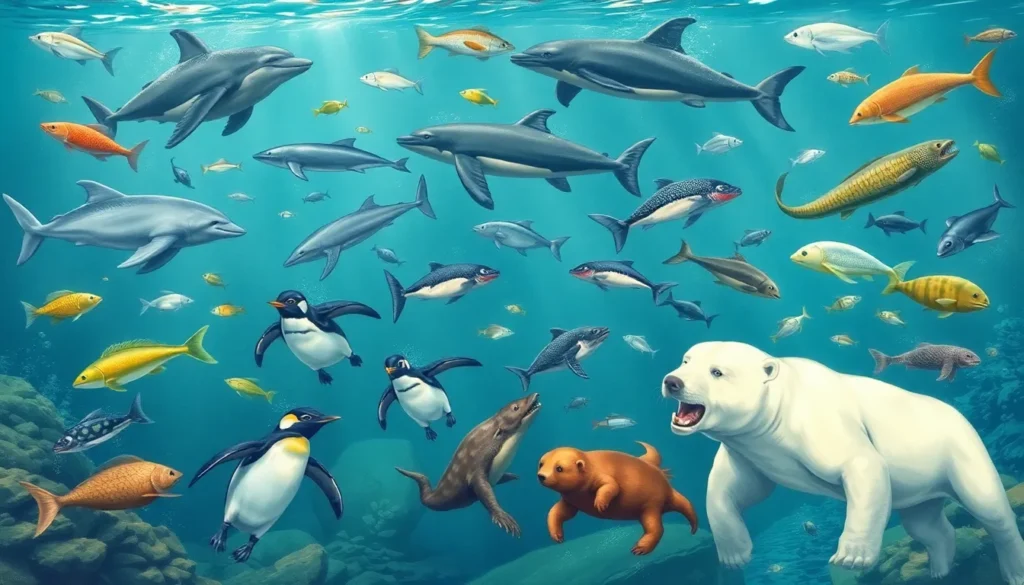
21 Facts About Animal Swimming Skills
- Swimming Is Not Limited to Aquatic Animals.
Many terrestrial animals, such as dogs, horses, and even elephants, possess the ability to swim, often using different techniques compared to aquatic species. - Birds Use Different Swimming Methods.
Birds like penguins use their wings to propel themselves underwater, effectively ‘flying’ through water, while ducks paddle using their webbed feet. - Fish Use Their Entire Body for Propulsion.
Most fish swim by moving their bodies and tails in waves, generating thrust to move efficiently through water. - Some Animals Can Swim Long Distances.
Sea turtles migrate thousands of kilometers in the ocean, demonstrating remarkable endurance and navigation abilities. - Marine Mammals Have Specialized Limbs.
Dolphins and whales have flippers adapted for swimming, and they use powerful tail flukes to propel themselves. - Amphibians Use Both Limbs and Body Movements.
Frogs swim primarily by kicking with their hind legs, while salamanders often use undulating movements. - Swimming Speed Varies Greatly Among Species.
The sailfish is often cited as one of the fastest swimming fish, capable of speeds up to 110 km/h (68 mph), while other species swim much slower. - Some Animals Float Rather Than Swim Actively.
Jellyfish drift with ocean currents and use minimal energy by pulsating their bell to move. - Webbed Feet Enhance Swimming Efficiency.
Many animals, including ducks, otters, and beavers, have webbed feet that increase surface area to improve propulsion. - Swimming Can Be a Survival Skill.
Many animals swim to escape predators, find food, or migrate between habitats. - Otters Use Their Tails as Rudders.
Otters have long, muscular tails that aid steering and balance while swimming underwater. - Seals and Sea Lions Are Agile Swimmers.
These pinnipeds use their foreflippers or hind flippers differently depending on species to maneuver through water efficiently. - Some Animals Can Hold Their Breath for Extended Periods.
Dolphins can hold their breath for up to 10 minutes, allowing deep dives and prolonged swimming underwater. - Crocodiles Use Their Tails for Propulsion.
They swim using powerful thrusts from their tails, keeping their bodies streamlined. - Swimming is Innate But Can Be Improved.
Many animals are born with basic swimming ability, but they often improve skills through practice. - Some Animals Use Swimming to Regulate Temperature.
Elephants sometimes swim to cool down by submerging themselves in water. - Polar Bears Are Strong Swimmers.
They can swim for several kilometers in cold Arctic waters to hunt seals or move between ice floes. - Fish Use Different Swimming Modes.
Some use body and caudal fin propulsion, while others rely on pectoral fins for maneuvering. - Swimming Is Crucial for Migration.
Species like salmon swim upstream during spawning migrations, often overcoming challenging obstacles. - Some Invertebrates Can Swim.
Examples include krill and certain species of squid that use jet propulsion to move through water. - Swimming Abilities Reflect Evolutionary Adaptations.
Animals have evolved various morphologies and behaviors suited to their aquatic or semi-aquatic lifestyles.
Habitat and Behavior
Animals that swim occupy a wide range of habitats, including freshwater rivers and lakes, coastal and open ocean environments, wetlands, and even terrestrial zones where water is present. Aquatic animals such as fish, amphibians, and marine mammals spend most or all of their lives in water, using swimming for locomotion, hunting, and migration. Semi-aquatic species, like otters and beavers, divide their time between land and water, relying on swimming to forage and evade predators. Terrestrial animals may swim occasionally to cross water bodies or escape danger. Swimming behavior varies depending on ecological needs, from fast bursts to evade predators to sustained swimming during long migrations. Many animals rely on sensory adaptations like echolocation or lateral lines to navigate aquatic environments effectively.
Why This Animal Matters
Swimming animals play essential roles in ecosystems as predators, prey, and ecosystem engineers. Fish regulate aquatic food webs, while amphibians contribute to both aquatic and terrestrial ecosystems. Marine mammals influence marine trophic dynamics and nutrient cycling. Animals with swimming skills also have cultural importance, inspiring art, folklore, and conservation efforts. Understanding swimming adaptations helps scientists monitor species health and environmental changes. Conservation of aquatic habitats is critical to preserving the diverse species with specialized swimming abilities, especially in the face of pollution, habitat destruction, and climate change.
Common Misconceptions
Misconception: Only aquatic animals can swim.
Correction: Many terrestrial animals, including mammals and birds, can swim effectively, often as a survival mechanism or for foraging.
Misconception: All fish swim using the same method.
Correction: Fish employ diverse swimming styles, including body and fin propulsion, depending on species and environment.
FAQ
Can all animals swim?
Not all animals can swim, but many species across different taxa have some swimming ability. Some terrestrial animals can swim, while others cannot or avoid water.
How do fish swim?
Fish primarily swim by moving their bodies and tails in wave-like motions to generate thrust, with some species using their fins for maneuvering or propulsion.
Why do some animals swim long distances?
Many animals swim long distances for migration, searching for food, mating, or moving between habitats, which is vital for their survival and reproduction.
Leave a Reply