
Short Answer
21 Facts About Orangutans
- Orangutans are native to Southeast Asia. They are found only on the islands of Borneo and Sumatra in Indonesia and Malaysia.
- There are three species of orangutans. These include the Bornean orangutan (Pongo pygmaeus), the Sumatran orangutan (Pongo abelii), and the recently identified Tapanuli orangutan (Pongo tapanuliensis).
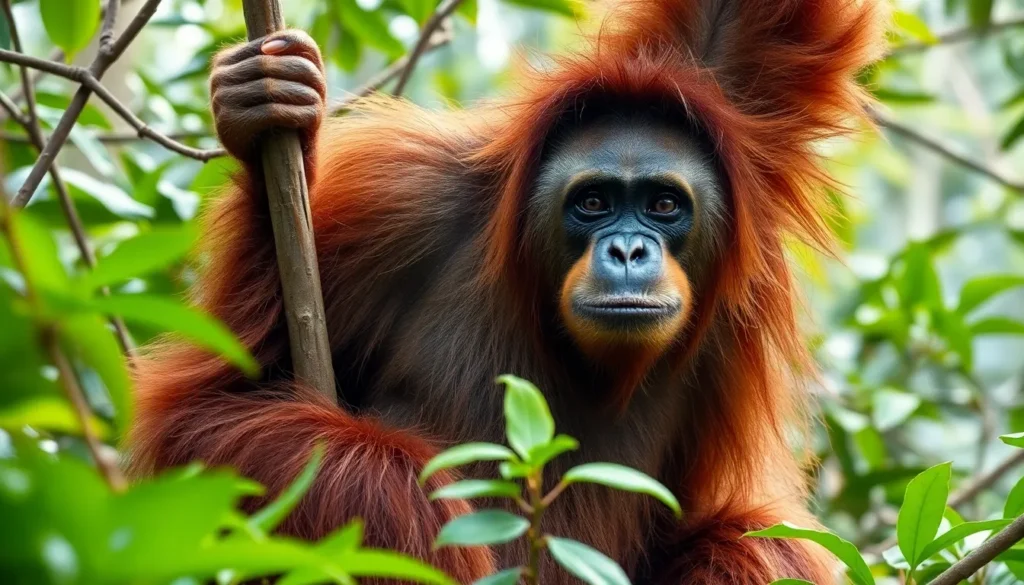
- Orangutans have distinctive reddish-brown hair. Their long, coarse fur helps them blend into the forest canopy.
- They are the largest arboreal mammals. Orangutans spend most of their lives in trees, moving slowly and deliberately among branches.
- Orangutans are highly intelligent. They use tools, such as sticks to extract insects or seeds, and display problem-solving skills.
- They have the longest interbirth interval of any land mammal. Females give birth approximately every 7 to 9 years, reflecting the extensive care given to each offspring.
- Orangutans are primarily frugivorous. Their diet mainly consists of fruit, but they also eat leaves, bark, insects, and occasionally bird eggs.
- They construct elaborate sleeping nests. Each night, orangutans build a new nest in the trees by bending branches and layering leaves for comfort and safety.
- Adult male orangutans develop large cheek pads. Known as flanges, these pads may signal dominance and attract females.
- They have a slow reproductive rate. This contributes to their vulnerability to population declines.
- Orangutans are solitary compared to other great apes. Adult males tend to live alone, while females are accompanied by their offspring.
- They communicate using a variety of vocalizations. Long calls made by males can be heard over long distances and serve territorial or mating purposes.
- Orangutans have opposable thumbs and big toes. This adaptation allows them to grip branches securely while moving through the forest.
- They exhibit cultural behaviors. Different orangutan populations have distinct tool-use traditions and foraging techniques passed down through generations.
- Orangutans have a lifespan of around 30 to 40 years in the wild. Some individuals have lived longer in captivity.
- They are important seed dispersers. By consuming fruit and excreting seeds, orangutans help maintain forest diversity.
- Orangutans face severe threats from habitat loss. Deforestation for palm oil plantations, logging, and mining significantly reduce their natural habitat.
- Poaching and illegal pet trade also threaten orangutans. Infants are often taken from the wild to be sold as pets, usually involving the killing of mothers.
- Conservation efforts include habitat protection and rehabilitation centers. Various organizations work to rescue, rehabilitate, and reintroduce orangutans into the wild.
- Orangutans are classified as Critically Endangered. According to the International Union for Conservation of Nature (IUCN), their populations are declining rapidly.
- They play a crucial role in ecosystem health. As one of the largest arboreal frugivores, they contribute significantly to forest regeneration and biodiversity.
Habitat and Behavior
Orangutans inhabit tropical rainforests, predominantly in lowland and mountainous regions on Borneo and Sumatra. These dense forests provide abundant fruit and shelter essential for their survival. Their arboreal lifestyle means they spend most of their time in the canopy, traveling cautiously along branches. They build new sleeping nests daily, using leaves and branches to create a safe resting place. Orangutans are mostly solitary animals, with social interactions mainly between mothers and their offspring or occasional encounters between adults. Their diet is mainly fruit-based but varies seasonally to include leaves, bark, and insects. Their slow reproductive cycle and extended maternal care are adaptive traits that reflect their complex social and ecological needs.
Why This Animal Matters
Orangutans are vital to the health of Southeast Asian rainforests. By dispersing seeds through their fruit consumption, they facilitate forest regeneration and contribute to biodiversity. Their presence indicates a healthy forest ecosystem, as they require large tracts of undisturbed habitat. Culturally, orangutans hold significance for indigenous communities and have become symbols in global conservation campaigns. Protecting orangutans also helps preserve the broader rainforest environment, which is crucial for climate regulation and sustaining numerous other species. Their critical conservation status highlights the urgency of addressing deforestation and wildlife trafficking to prevent further population declines.
Common Misconceptions
Misconception: Orangutans are aggressive and dangerous to humans.
Correction: Orangutans are generally shy and avoid human contact. They are not naturally aggressive unless threatened or provoked.

Misconception: Orangutans live on the African continent like other great apes.
Correction: Orangutans are native only to the islands of Borneo and Sumatra in Asia, while African great apes include chimpanzees, gorillas, and bonobos.
Misconception: Orangutans are monkeys.
Correction: Orangutans are great apes, which are distinct from monkeys in several anatomical and behavioral traits, including the absence of tails.
Misconception: Orangutans can easily adapt to captivity and urban environments.
Correction: Orangutans have specialized habitat needs and complex behaviors that make survival outside their natural forest environment challenging and often detrimental.
Misconception: All orangutans are the same species.
Correction: There are three distinct species of orangutans with different genetic, behavioral, and ecological characteristics.
FAQ
Where do orangutans live?
Orangutans are found exclusively on the islands of Borneo and Sumatra in Southeast Asia, where they inhabit tropical rainforests.
Why are orangutans endangered?
Orangutans are endangered primarily due to habitat destruction caused by logging, palm oil plantations, and mining, as well as poaching and illegal pet trade.
How intelligent are orangutans?
Orangutans are considered highly intelligent primates capable of using tools, solving problems, and exhibiting cultural behaviors unique to different populations.



Leave a Reply