
Short Answer
21 Facts About Animals in Space
Fruit Flies
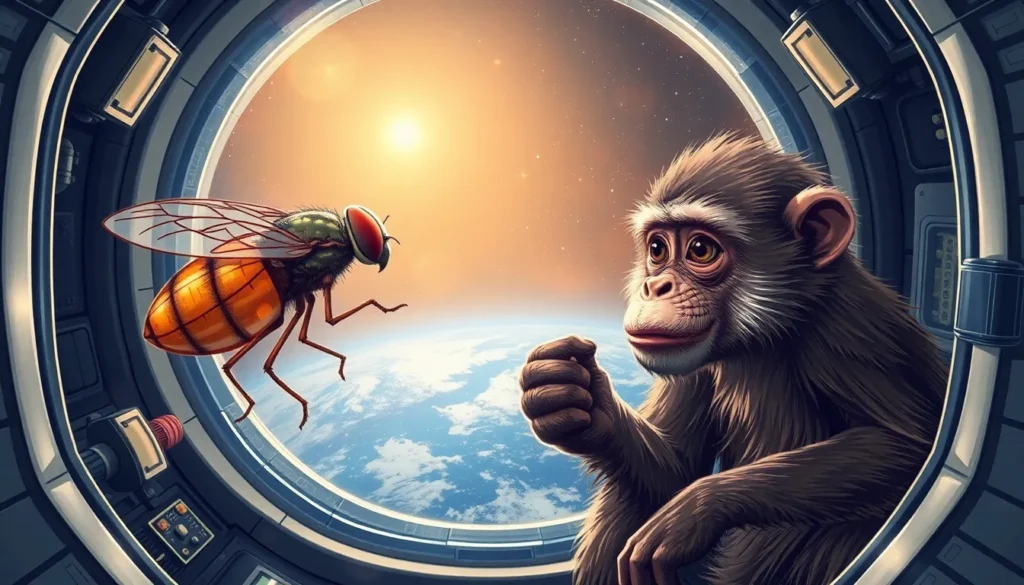
- Fruit flies were the first animals sent to space. In 1947, fruit flies were launched aboard a V-2 rocket to study radiation exposure in space.
- They helped scientists understand cosmic radiation effects. Their short life cycles allowed rapid observation of genetic changes.
- Fruit flies have been used to study the impact of microgravity on development and behavior.
- Space-flown fruit flies showed alterations in gene expression related to stress and metabolism.
- They are ideal for space research due to their small size, ease of care, and well-understood genetics.
Monkeys
- Monkeys were among the first mammals sent into space to study physiological effects on complex organisms.
- The first monkey in space was Albert I, a rhesus macaque, launched by the U.S. in 1948, though the flight was suborbital and unsuccessful in terms of survival.
- Monkeys helped assess the impact of acceleration, microgravity, and cosmic radiation on mammalian bodies.
- They provided crucial data on cardiovascular, neurological, and respiratory responses during spaceflight.
- Monkeys were often used to test life support systems and spacecraft safety before human missions.
- Training included acclimatizing them to confined spaces and restraint devices to simulate spacecraft conditions.
- Some monkeys survived multiple spaceflights, contributing to longitudinal studies on space effects.
- Monkeys contributed to the development of biomedical protocols for human astronauts.
- Studies on monkeys helped understand the effects of re-entry and weightlessness on muscle and bone density.
- Their use raised ethical questions, leading to increased animal welfare considerations in later research.
- Monkeys in space missions were primarily rhesus macaques and squirrel monkeys, chosen for their size and physiology.
- Data from monkey spaceflights informed the design of countermeasures for space-related health issues.
- Post-flight observations showed that monkeys could experience disorientation and stress similar to humans.
- Monkeys’ brain activity was monitored to study neurological effects of space travel.
- They helped validate the use of telemetry and remote physiological monitoring in orbit.
- Monkeys’ participation in space research has largely been replaced by more advanced technologies and ethical standards.
Habitat and Behavior
Fruit flies naturally inhabit environments rich in fermenting fruit, where they feed and reproduce rapidly. Their short life cycle and genetic simplicity make them resilient and adaptable. Monkeys used in space research, such as rhesus macaques, are terrestrial primates native to South and Southeast Asia. They are social animals with complex behaviors, often living in troops. Both animals exhibit stress responses when taken from their natural habitats, especially under constrained conditions such as those in space missions.
Why This Animal Matters
Fruit flies are fundamental to genetics and biological research due to their rapid reproduction and well-mapped genome. Their use in space has expanded understanding of genetic and physiological changes in microgravity. Monkeys serve as important models for human physiology and medicine, providing critical insights into neurological, cardiovascular, and musculoskeletal effects of space travel. Their involvement has been essential for ensuring astronaut health and mission safety.
Common Misconceptions
Misconception: Only large animals like monkeys were sent to space.
Correction: Small animals, including fruit flies, were actually the first animals sent to space to study biological effects.

Misconception: Animals sent to space were sent without care or ethical consideration.
Correction: Although early missions had fewer regulations, animal welfare has increasingly been prioritized, with strict protocols in place during and after spaceflights.
FAQ
Why were fruit flies chosen for early space experiments?
Fruit flies were selected because of their small size, rapid reproduction, and well-understood genetics, making them ideal for studying the biological effects of space conditions quickly and efficiently.
What kinds of monkeys were sent to space?
Primarily rhesus macaques and squirrel monkeys were used due to their manageable size and physiological similarities to humans, which provided valuable data for human spaceflight.
Are animals still sent to space today?
While the use of animals in space research has declined due to ethical concerns and technological advances, certain studies still involve animals, but many are now replaced by cell cultures, computer models, and simulated environments.

Leave a Reply