
Short Answer
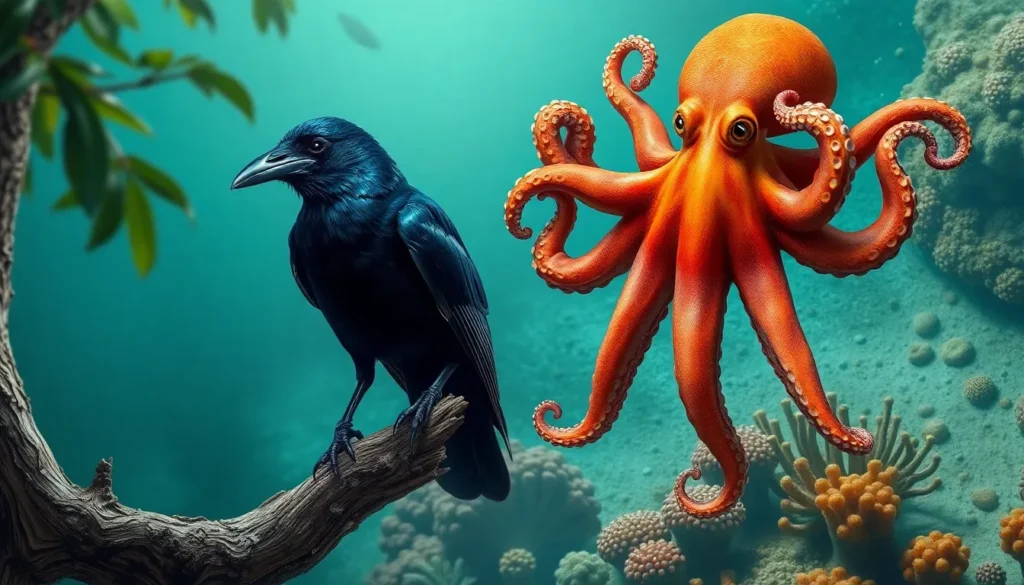
21 Facts About Animal Memory: Crows and Octopuses
- Crows can remember human faces. Studies show crows recognize and remember individual human faces, particularly those who pose a threat, and can communicate this information to other crows.
- Octopuses have short- and long-term memory capabilities. They can recall information about their environment and past experiences to solve problems and escape enclosures.
- Crows use memory for tool use. They remember the location and type of tools they use for specific tasks, showing foresight and planning.
- Octopuses exhibit spatial memory. They navigate complex environments using memory of landmarks and spatial cues.
- Crows can store food and remember its locations. They cache food in multiple places and recall these spots even after long periods.
- Octopuses can learn through observation. They remember actions performed by other octopuses and replicate behaviors, indicating social learning.
- Crows display episodic-like memory. They remember where, when, and what type of food was stored, resembling human episodic memory.
- Octopuses have large brains relative to body size. Their complex nervous system supports advanced memory and learning.
- Crows can remember threats over long durations. They retain memories of dangerous humans for years and warn others.
- Octopuses adapt their hunting strategies using memory. They remember successful techniques and adjust based on previous outcomes.
- Crows can recognize individual crows and remember social interactions. This memory helps maintain social hierarchies and alliances.
- Octopuses demonstrate short bursts of memory for problem-solving tasks. They can recall solutions to puzzles during experimental trials.
- Crows show memory flexibility. They modify remembered information based on changing environmental conditions.
- Octopuses sometimes exhibit forgetting, which may help adapt behaviors. Forgetting irrelevant or outdated information can improve learning efficiency.
- Crows use memory to communicate complex information. They share knowledge about predators and food sources with their group.
- Octopuses remember individual humans and may react differently to them. Their memory of specific experiences influences their behavior around people.
- Crows have been observed to plan for future events. Their memory supports anticipation of needs, such as tool acquisition before a task.
- Octopuses’ decentralized nervous system involves memory storage in arms. Some memory functions are localized outside the brain, in their arms.
- Crows’ memory capacity supports complex vocalizations. They remember calls and can mimic sounds, aiding social communication.
- Octopuses’ memory contributes to camouflage and escape responses. Recognizing threats and remembering environments help them survive.
- Both crows and octopuses demonstrate that complex memory is not exclusive to mammals. Their advanced cognitive abilities challenge traditional views of animal intelligence.
Habitat and Behavior
Crows inhabit diverse ecosystems worldwide, including forests, urban areas, and grasslands. They are highly adaptable birds that exhibit complex social behaviors, including cooperative breeding and communication. Crows are omnivorous and use their memory to find and store food, recognize threats, and navigate social hierarchies.
Octopuses live primarily in marine environments such as coral reefs, rocky shores, and ocean floors. They are solitary creatures known for their problem-solving skills, camouflage, and escape tactics. Octopuses rely on their memory to navigate their surroundings, hunt prey, and avoid predators, often displaying remarkable learning abilities despite their short lifespans.
Why This Animal Matters
Crows play an important ecological role as scavengers and seed dispersers, contributing to ecosystem health. Their advanced cognitive abilities have made them subjects of scientific research, enhancing understanding of avian intelligence and social behavior.
Octopuses contribute to marine ecosystems as both predators and prey, influencing food web dynamics. Their unique nervous system and memory capabilities offer insights into alternative models of intelligence and neurological function, with implications for neuroscience and robotics.
Common Misconceptions
Misconception: Crows have poor memories.
Correction: Crows possess excellent memory, capable of recognizing individual humans and storing information about food and threats for years.
Misconception: Octopuses have simple reflexive behavior only.
Correction: Octopuses exhibit complex memory and learning abilities, including problem solving and observational learning.
Misconception: Only mammals have advanced memory.
Correction: Both crows and octopuses demonstrate advanced memory skills despite being non-mammalian, highlighting cognitive diversity across animal taxa.
FAQ
Can crows really remember individual human faces?
Yes, research has demonstrated that crows can recognize and remember human faces, particularly those associated with threats, and communicate this information to other crows.
How do octopuses use their memory in the wild?
Octopuses use their memory to navigate complex environments, remember hiding spots, learn from previous experiences, and adapt hunting strategies to improve success.
Are animal memories like human memories?
While animal memories share some similarities with human memory, such as spatial and episodic-like memory, the mechanisms and experiences can differ significantly across species.

Leave a Reply