
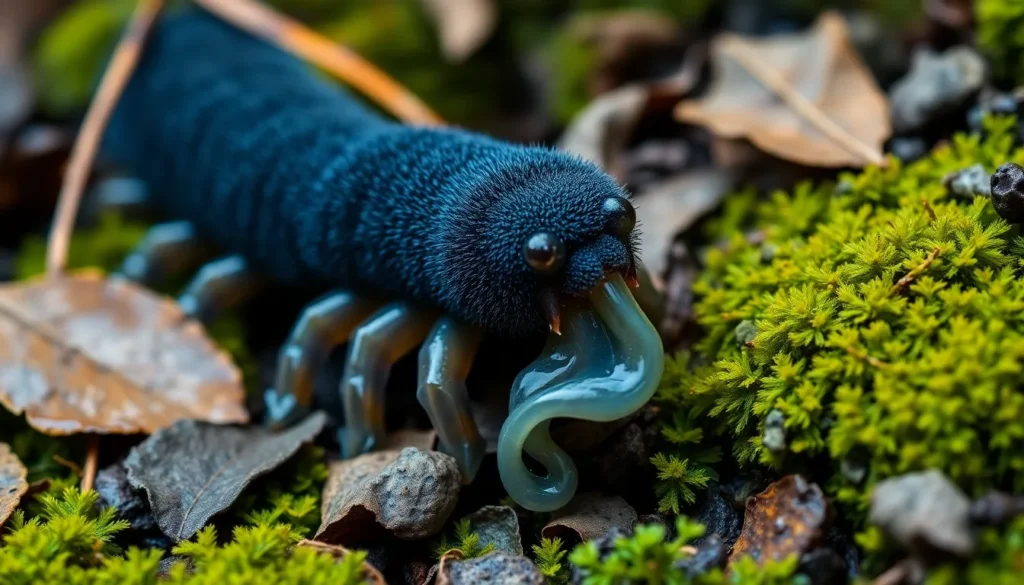
Short Answer
21 Facts About Velvet Worms
- Ancient lineage: Velvet worms are considered living fossils, with fossil records dating back over 500 million years, representing one of the earliest terrestrial animal groups.
- Phylum Onychophora: Velvet worms belong to their own distinct phylum, Onychophora, which is closely related to arthropods and tardigrades.
- Soft-bodied appearance: Unlike many other worm-like animals, velvet worms have a soft, velvety texture due to a thin, flexible cuticle rather than a hard exoskeleton.
- Segmented legs: They possess numerous pairs of stubby, unjointed legs called lobopods, typically ranging from 13 to 43 pairs depending on the species.
- Unique locomotion: Velvet worms move by synchronously contracting muscles in their lobopods, allowing a slow but deliberate gait unlike crawling or slithering.
- Nocturnal hunters: These creatures are primarily nocturnal predators, hunting small invertebrates like insects and other worms during the night.
- Slime shooting defense: Velvet worms eject a sticky, quick-hardening slime from specialized glands to immobilize prey or deter predators.
- Slime ejection mechanism: The slime is expelled through oral papillae at high velocity, often in a targeted manner to entangle prey effectively.
- Hydrostatic skeleton: Their bodies rely on a hydrostatic skeleton, where fluid pressure within their body cavity aids in movement and support.
- Moisture dependence: Velvet worms require humid environments to prevent desiccation, as they lack a waterproof cuticle.
- Respiration: They breathe through tiny openings called spiracles connected to a tracheal system, similar to insects but less developed.
- Reproduction diversity: Some species are oviparous (egg-laying), while others are ovoviviparous or viviparous, giving live birth with varying degrees of maternal nourishment.
- Social behavior: Although generally solitary, certain species exhibit limited social interactions such as group hunting or communal living in moist microhabitats.
- Slow growth and longevity: Velvet worms grow slowly and can live several years, which is relatively long for invertebrates of their size.
- Geographic distribution: They are found mainly in tropical and temperate forests of the Southern Hemisphere, including Central and South America, Southeast Asia, and Australasia.
- Evolutionary significance: Velvet worms provide critical insight into the evolution of arthropods because of their shared characteristics and ancient lineage.
- Color variation: Species vary widely in coloration, from browns and reds to vibrant blues and greens, often serving as camouflage within leaf litter.
- Predation and defense: Besides slime ejection, they can retreat into crevices or curl their bodies to protect themselves from predators.
- Scientific rarity: Due to their secretive habits and specific habitat needs, velvet worms are difficult to study in the wild, making them less known than many other invertebrates.
- Conservation concerns: Habitat destruction, especially deforestation, threatens some velvet worm populations, although many species remain poorly assessed for conservation status.
- Research interest: Velvet worms are studied for their unique biology, evolutionary relationships, and potential biomimetic applications inspired by their slime and locomotion.
Habitat and Behavior
Velvet worms inhabit moist, shaded environments such as tropical rainforests, temperate forests, and leaf litter where humidity is consistently high. They avoid dry areas because their soft bodies are prone to desiccation. Typically, they reside under logs, stones, or within decaying wood, where they can maintain moisture and avoid predators. Velvet worms are nocturnal, coming out at night to hunt small invertebrates by shooting their adhesive slime to immobilize prey before consuming it. Their slow and deliberate movements are adapted to their environment, and they use their antennae to explore surroundings and detect chemical cues. Social behavior varies among species, with some exhibiting limited group interactions, although they are mostly solitary creatures.
Why This Animal Matters
Velvet worms are ecologically significant as predators of small invertebrates, helping regulate populations of insects and other soil organisms in forest ecosystems. Their evolutionary importance lies in their status as a living link between ancient marine ancestors and modern arthropods, offering valuable information about animal evolution and diversification. Velvet worms also hold cultural interest due to their unusual appearance and behaviors, often sparking curiosity among naturalists. Conservation-wise, many velvet worm species are vulnerable due to habitat loss, making them important indicators of forest health and biodiversity. Their unique slime and locomotion mechanisms have potential applications in biomaterials and robotics, drawing scientific attention.
Common Misconceptions
Misconception: Velvet worms are worms.
Correction: Despite their name, velvet worms are not true worms but belong to their own phylum, Onychophora, which is distinct from annelid worms.
Misconception: Velvet worms are insects.
Correction: Velvet worms are not insects; they are more closely related to arthropods but constitute a separate phylum with unique characteristics.
Misconception: Velvet worms are dangerous to humans.
Correction: Velvet worms are harmless to humans; their slime is used solely for hunting small prey and defense, and they pose no threat to people.
Misconception: Velvet worms live everywhere.
Correction: Velvet worms have a limited distribution mostly in moist tropical and temperate forests and do not inhabit dry or cold regions.
Misconception: All velvet worms lay eggs.
Correction: Reproductive strategies vary among species; some lay eggs, while others give live birth.
FAQ
What are velvet worms?
Velvet worms are soft-bodied, segmented invertebrates belonging to the phylum Onychophora, known for their velvety texture and unique slime-shooting hunting method.
Where do velvet worms live?
They inhabit moist tropical and temperate forests, typically residing in leaf litter, under logs, or in decaying wood where humidity is high.
Are velvet worms dangerous to humans?
No, velvet worms are harmless to humans. Their slime is only used to capture prey or deter predators and does not pose any threat to people.


Leave a Reply