
Short Answer
21 Facts About Turtles
- Turtles have existed for over 200 million years. This means they coexisted with dinosaurs and have survived multiple mass extinction events.
- Their shells are made of bone and covered in scutes. These scutes are made of keratin, the same material as human fingernails.
- Turtles are reptiles but differ from many by having a hard protective shell. Unlike most reptiles, their ribs and backbone are fused to their shells.
- There are over 350 species of turtles worldwide. They range from tiny species just a few centimeters long to large sea turtles.
- Turtles can live in a variety of habitats. These include oceans, freshwater rivers, lakes, and terrestrial environments like forests and deserts.
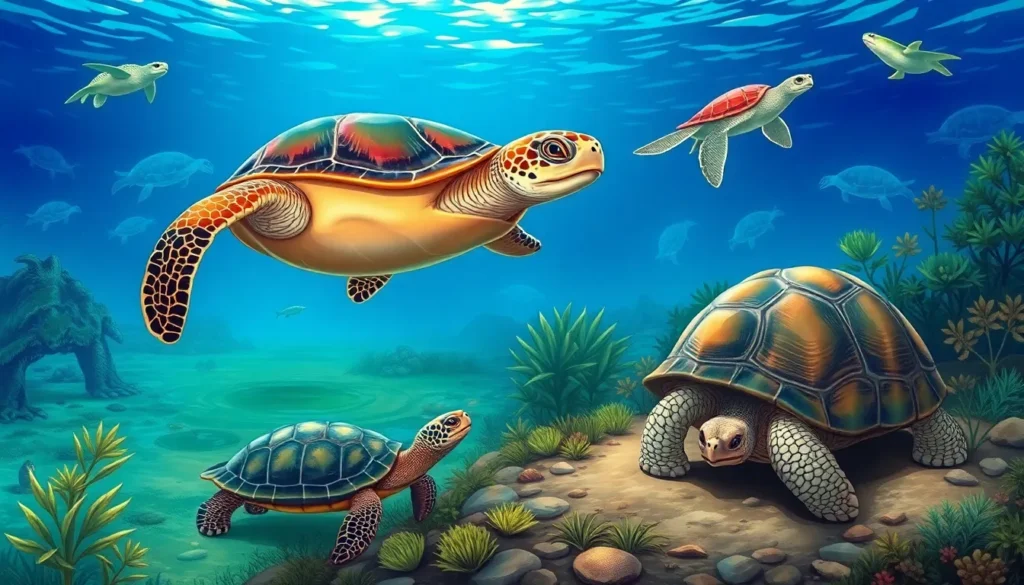
- Sea turtles have flipper-like limbs. This adaptation allows them to swim efficiently in the ocean.
- Freshwater turtles often have webbed feet for swimming. Some species are also good climbers or burrowers.
- Turtles are cold-blooded animals. They rely on external sources of heat to regulate their body temperature.
- Some turtles can live for several decades. Certain species have lifespans exceeding 50 years, with some giant tortoises living over 100 years.
- Turtles have a slow metabolism. This allows them to survive long periods without food or oxygen, especially underwater.
- Most turtles are omnivorous. Their diet can include plants, insects, fish, and carrion depending on the species.
- Turtles have excellent navigational abilities. Sea turtles, for example, use the Earth’s magnetic field to migrate across oceans.
- Temperature during egg incubation determines the sex of many turtle species. Warmer nests typically produce females, while cooler nests produce males.
- Turtles lay eggs on land. Female turtles dig nests in sand or soil to deposit their eggs before returning to the sea or water.
- Hatchling turtles face many predators. Birds, crabs, and fish often prey on young turtles during their journey to water.
- Turtles play important ecological roles. They help control aquatic vegetation and maintain healthy ecosystems by recycling nutrients.
- Some turtles exhibit unique behaviors such as basking in the sun. Basking helps regulate their body temperature and aids in vitamin D synthesis.
- Turtles have been culturally significant for centuries. Many indigenous and ancient cultures view turtles as symbols of longevity, wisdom, or creation.
- Several turtle species are threatened or endangered. Threats include habitat loss, pollution, poaching, and climate change affecting nesting sites.
- Conservation efforts worldwide aim to protect turtles. These include habitat protection, regulating trade, and public education campaigns.
- Turtles have distinct sensory adaptations. They have good vision and can detect vibrations and chemicals in water, which aid in finding food and avoiding predators.
Habitat and Behavior
Turtles inhabit diverse environments globally, ranging from marine to freshwater and terrestrial ecosystems. Sea turtles spend most of their lives in oceans, migrating thousands of kilometers between feeding grounds and nesting beaches. Freshwater turtles live in rivers, lakes, ponds, and swamps, often showing a mixture of aquatic and terrestrial behaviors. Terrestrial turtles, commonly known as tortoises, dwell in dry habitats such as deserts and forests. Behaviorally, turtles are known for their slow movements and protective shells that provide defense against predators. They regulate their body temperature through basking and seek shelter during extreme weather. Many turtles are solitary but can be found in groups during nesting or basking. Their reproductive behavior includes long migrations by females to nesting sites, where eggs are laid in carefully dug nests. Hatchlings typically emerge at night to increase survival chances, making a perilous journey to water or shelter.
Why This Animal Matters
Turtles play vital ecological roles in their habitats. As herbivores and omnivores, they contribute to the balance of aquatic and terrestrial ecosystems by controlling vegetation and consuming various organisms. Their nesting activities help aerate soil and facilitate nutrient cycling. Sea turtles help maintain healthy seagrass beds and coral reefs, which are crucial for marine biodiversity. Culturally, turtles have been symbols in mythology, art, and folklore across many societies, representing qualities such as wisdom, endurance, and creation. Conservation of turtles is crucial due to their declining populations caused by human activities such as habitat destruction, pollution, and illegal trade. Protecting turtles helps preserve biodiversity and the health of ecosystems that humans also depend upon.
Common Misconceptions
Misconception: All turtles can withdraw entirely into their shells.
Correction: While many turtles can retract their heads and limbs partially, some species, especially sea turtles, cannot fully withdraw into their shells due to their limb adaptations for swimming.
Misconception: Turtles are slow and defenseless.
Correction: Although turtles often move slowly on land, they can be surprisingly fast swimmers and have strong shells and behaviors that provide effective protection.
Misconception: Turtles and tortoises are the same.
Correction: Tortoises are a specific group of primarily land-dwelling turtles with distinct differences such as thicker, more domed shells and elephantine legs, whereas turtles generally refer to all species including aquatic ones.
Misconception: Turtles do not need much water.
Correction: While terrestrial tortoises require less water than aquatic turtles, all turtles need access to water for hydration and, in many cases, feeding and thermoregulation.
Misconception: Turtles are not important ecologically.
Correction: Turtles serve important roles in ecosystems such as controlling vegetation, maintaining habitats like seagrass beds, and supporting nutrient cycles.
FAQ
How do turtles breathe underwater?
Turtles can hold their breath for extended periods while underwater by slowing their metabolism and absorbing oxygen through specialized membranes in their throat and cloaca, allowing them to stay submerged longer.
Why do turtles have shells?
Turtles have shells as a protective adaptation. The shell, composed of a fused ribcage and backbone covered by bony plates and scutes, provides defense against predators and environmental hazards.
Are turtles endangered?
Many turtle species are endangered or threatened due to habitat destruction, pollution, poaching, and climate change. Conservation efforts focus on protecting habitats, regulating trade, and raising awareness to help their populations recover.


Leave a Reply