
Short Answer
21 Facts About Tiger Quolls
- Scientific Classification: Tiger quolls belong to the genus Dasyurus and are part of the Dasyuridae family, which includes other carnivorous marsupials.
- Species: There are two recognized species of tiger quolls: the eastern quoll (Dasyurus maculatus) and the northern quoll (Dasyurus hallucatus).
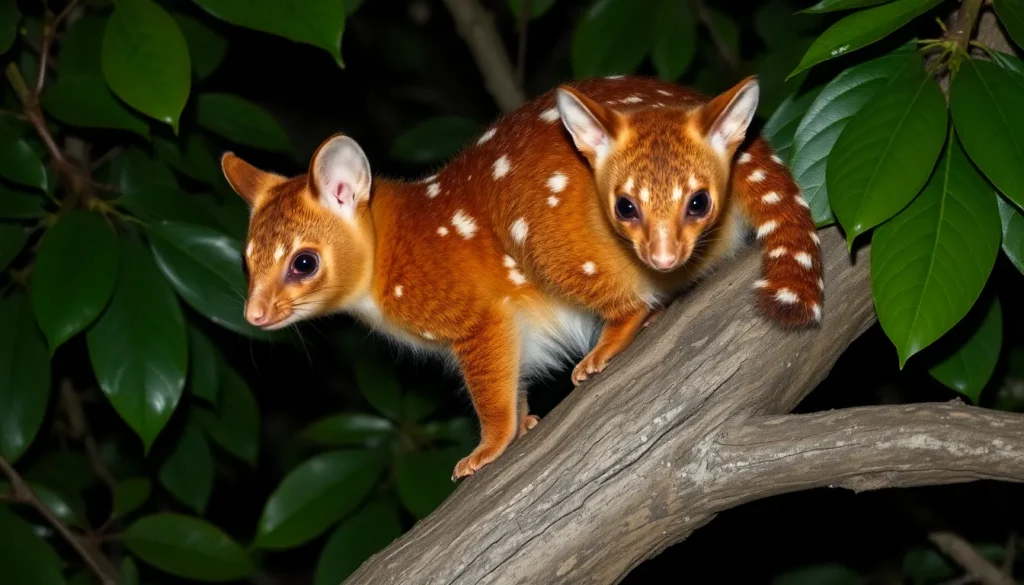
- Appearance: Tiger quolls have a reddish-brown to dark brown coat with distinctive white spots covering their body and tail.
- Size: They are the second-largest carnivorous marsupials in Australia, after the Tasmanian devil, with body lengths ranging from 45 to 75 cm, excluding the tail.
- Tail: Their tail is long and spotted, often as long as their body, and helps with balance and agility.
- Diet: Tiger quolls are carnivorous and opportunistic hunters, feeding on small mammals, birds, insects, reptiles, and carrion.
- Hunting Behavior: They are primarily nocturnal hunters, relying on stealth and agility to capture prey.
- Reproduction: Females have a short gestation period of around 21 days and typically give birth to 4 to 6 young, which develop in the pouch.
- Lifespan: In the wild, tiger quolls live up to 5 to 7 years, though they can live longer in captivity.
- Habitat: Tiger quolls inhabit a variety of environments including rainforests, wet sclerophyll forests, and woodlands.
- Distribution: The eastern quoll is mostly found in Tasmania, while the northern quoll is native to northern Australia, including Queensland, Northern Territory, and Western Australia.
- Solitary Nature: Tiger quolls are solitary animals that maintain territories which they mark using scent glands.
- Communication: They communicate through scent marking, vocalizations, and body language.
- Conservation Status: The northern quoll is listed as endangered due to habitat loss, invasive species, and poisoning from cane toads.
- Ecological Role: As mid-level predators, tiger quolls help control populations of smaller animals and scavenge carrion, contributing to ecosystem balance.
- Adaptations: Their sharp teeth and strong jaws allow them to hunt effectively, and their spotted coat provides camouflage in forested environments.
- Threats: Habitat destruction, competition from introduced species like foxes and feral cats, and toxicity from invasive cane toads pose significant threats.
- Conservation Efforts: Programs include habitat protection, captive breeding, and research to mitigate the impact of cane toads.
- Cultural Significance: Tiger quolls are part of indigenous Australian cultures, featuring in some traditional stories and beliefs.
- Scientific Research: Studies on tiger quolls contribute to understanding marsupial ecology, predator-prey dynamics, and conservation biology.
- Unique Behavior: Tiger quolls are known to cache food and sometimes drag prey up trees to avoid scavengers.
Habitat and Behavior
Tiger quolls are native to Australia, primarily found in forested areas ranging from rainforests to dry woodlands. The eastern quoll is mostly restricted to Tasmania, while the northern quoll occupies northern parts of the Australian mainland. These animals are solitary and nocturnal, using keen senses of sight and smell to hunt prey at night. During the day, they rest in dens made from hollow logs, rocky outcrops, or dense vegetation. Tiger quolls are territorial, marking their ranges with scent glands and defending them from intruders. They hunt a wide variety of prey, including small mammals, birds, reptiles, and insects, and also scavenge carrion. Their agility allows them to climb trees, an uncommon ability among many carnivorous marsupials, which aids in hunting and avoiding threats.
Why This Animal Matters
Tiger quolls play a crucial role in Australian ecosystems as mid-sized predators. By controlling populations of smaller mammals and birds, they help maintain a balanced food web. Their scavenging activities assist in nutrient recycling. From a conservation perspective, tiger quolls are indicators of healthy forest ecosystems, as they require intact habitats to survive. The northern quoll’s endangered status has led to focused conservation actions that highlight the challenges posed by invasive species and habitat fragmentation. Additionally, tiger quolls hold cultural significance for some Indigenous Australian communities, enriching the cultural heritage and biodiversity of the continent.
Common Misconceptions
Misconception: Tiger quolls are related to tigers due to their name.
Correction: Despite the name “tiger” quoll referencing their spotted coat pattern, they are marsupials unrelated to tigers, which are large felines native to Asia.
Misconception: Tiger quolls are aggressive towards humans.
Correction: Tiger quolls are generally shy and avoid humans. They may defend themselves if threatened but are not typically aggressive.
Misconception: All quolls look the same.
Correction: There are several species of quolls with differing sizes, colors, and geographic distributions, including the tiger quoll and the eastern quoll.
FAQ
What do tiger quolls eat?
Tiger quolls are carnivorous and have a varied diet that includes small mammals, birds, insects, reptiles, and carrion. They are opportunistic hunters and scavenge as needed.
Where do tiger quolls live?
Tiger quolls primarily inhabit forested areas in Australia, including rainforests, wet sclerophyll forests, and woodlands. The eastern quoll is mostly found in Tasmania, while the northern quoll lives in northern Australia.
Are tiger quolls endangered?
The northern quoll is classified as endangered due to threats such as habitat loss, introduced predators, and poisoning from invasive cane toads. The eastern quoll is considered vulnerable but more stable in population.


Leave a Reply