
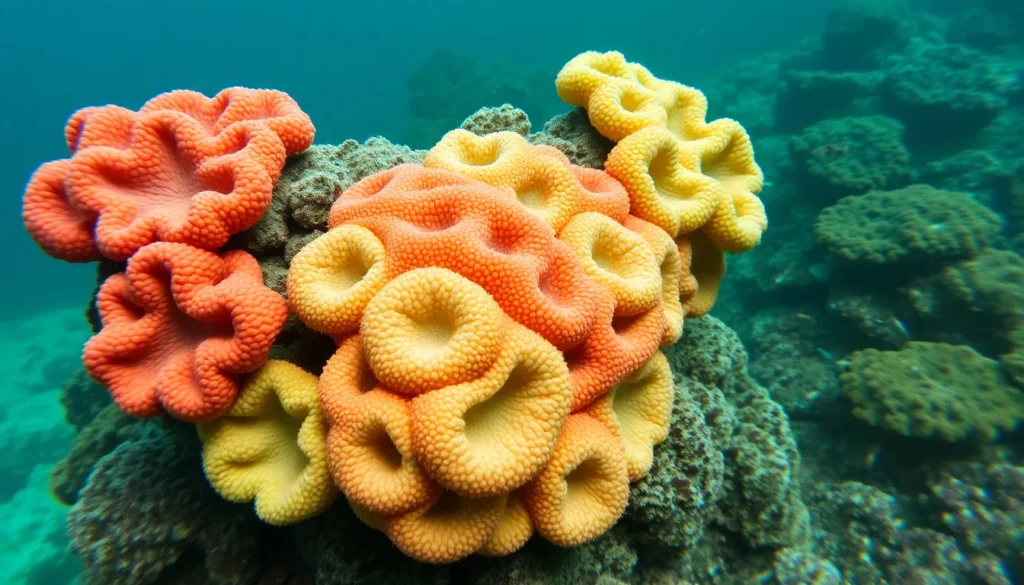
Short Answer
21 Facts About Sea Sponges
- Oldest Multicellular Animals: Sea sponges are among the oldest known multicellular organisms, with fossil records dating back over 500 million years, predating the Cambrian explosion.
- Simple Body Structure: Unlike most animals, sponges lack true tissues and organs, consisting instead of a porous body with specialized cells.
- Pores and Canals: Their bodies have numerous pores and canals that allow water to circulate, facilitating feeding, respiration, and waste removal.
- Filter Feeding: Sponges feed by filtering microscopic particles and plankton from water, drawing water through their pores and expelling it through larger openings called oscula.
- Varied Sizes and Shapes: They can range from tiny encrusting forms to large, branching or vase-shaped structures, adapting to diverse marine environments.
- Skeletal Composition: Their skeletons are made of spicules composed of silica or calcium carbonate, or a tough protein called spongin, providing structural support.
- Regenerative Abilities: Sponges can regenerate lost parts and even reassemble from dissociated cells, demonstrating remarkable plasticity.
- Reproduction Methods: They reproduce both sexually, by releasing sperm into the water to fertilize eggs, and asexually, through budding or fragmentation.
- Sessile Lifestyle: Adult sponges are sessile, meaning they are fixed in one place and do not move, typically attaching to substrates like rocks or coral reefs.
- Symbiotic Relationships: Many sponges harbor symbiotic microorganisms such as bacteria and algae, which can contribute to their nutrition and chemical defenses.
- Chemical Defense Mechanisms: Some sponges produce bioactive compounds that deter predators and prevent overgrowth by other organisms.
- Diverse Habitats: While predominantly marine, some sponges inhabit freshwater environments, showcasing adaptability to different conditions.
- Ecological Engineers: Sponges can influence water clarity and nutrient cycling in marine ecosystems through their filtration activity.
- Indicator Species: Because of their sensitivity to environmental changes, sponges can serve as indicators of water quality and ecosystem health.
- Slow Growth Rates: Many sponges grow slowly, with some species living for decades or even centuries.
- Biotechnological Potential: Sponge-derived compounds are studied for pharmaceutical applications, including antimicrobial and anticancer properties.
- Classification: Sponges belong to the phylum Porifera, which is divided into several classes based on skeletal composition and other traits.
- Water Pumping System: Specialized cells called choanocytes use flagella to create water currents that drive the sponge’s filtration process.
- Absence of Nervous System: Sponges lack neurons and muscles, yet they can coordinate cellular activities through chemical signaling.
- Global Distribution: Sponges are found worldwide, from shallow tropical reefs to deep-sea environments.
- Fossil Evidence: Fossilized sponges provide important insights into early animal evolution and marine ecosystems of the past.
Habitat and Behavior
Sea sponges inhabit a wide range of aquatic environments, mainly marine but also freshwater. They are found attached to solid surfaces such as rocks, coral reefs, and submerged wood, from shallow coastal waters to deep ocean floors. Their sessile nature means they remain fixed in place throughout their adult lives. Sponges survive by filtering large volumes of water to extract microscopic food particles, oxygen, and to remove waste. The water flow is maintained by the coordinated beating of flagella on specialized cells called choanocytes. Sponges exhibit minimal movement but can respond to environmental stimuli by closing their pores or oscula to regulate water flow. They reproduce sexually by releasing sperm into the water column, which fertilizes eggs retained within another sponge, and asexually by budding or fragmentation, allowing them to colonize available habitats effectively.
Why This Animal Matters
Sea sponges play crucial ecological roles in marine ecosystems. Their filtration activity improves water clarity and facilitates nutrient cycling, supporting other marine life. They provide habitat and shelter for various microorganisms, small invertebrates, and fish species. Additionally, sponges contribute to the structural complexity of coral reefs and other benthic environments. From a scientific perspective, sponges offer insights into early animal evolution due to their simple body plan and ancient lineage. Chemically, they are a source of bioactive compounds with potential applications in medicine and biotechnology, such as novel antibiotics and anticancer agents. Conservation of sponge populations is important as they can serve as bioindicators of environmental health, reflecting changes in water quality and ecosystem stability.
Common Misconceptions
Misconception: Sponges are plants.
Correction: Despite their plant-like appearance, sea sponges are animals. They belong to the phylum Porifera and perform animal functions such as filter feeding and sexual reproduction.
Misconception: Sponges have nervous systems.
Correction: Sponges lack nerves and muscles. Instead, they rely on cellular coordination through chemical signals and water flow to perform necessary functions.
Misconception: All sponges live in saltwater.
Correction: While most sponges inhabit marine environments, there are freshwater sponge species that thrive in rivers, lakes, and streams.
FAQ
How do sea sponges feed?
Sea sponges feed by filtering water through their porous bodies. Specialized cells called choanocytes use flagella to create water currents, capturing microscopic food particles such as plankton and organic debris.
Do sea sponges have a nervous system?
No, sea sponges lack a nervous system and muscles. Instead, they coordinate cellular activities through chemical signaling and rely on water flow to maintain biological functions.
Can sea sponges regenerate?
Yes, sea sponges have remarkable regenerative abilities and can regrow lost parts. They can even reassemble from individual cells that have been separated, demonstrating high cellular plasticity.


Leave a Reply