
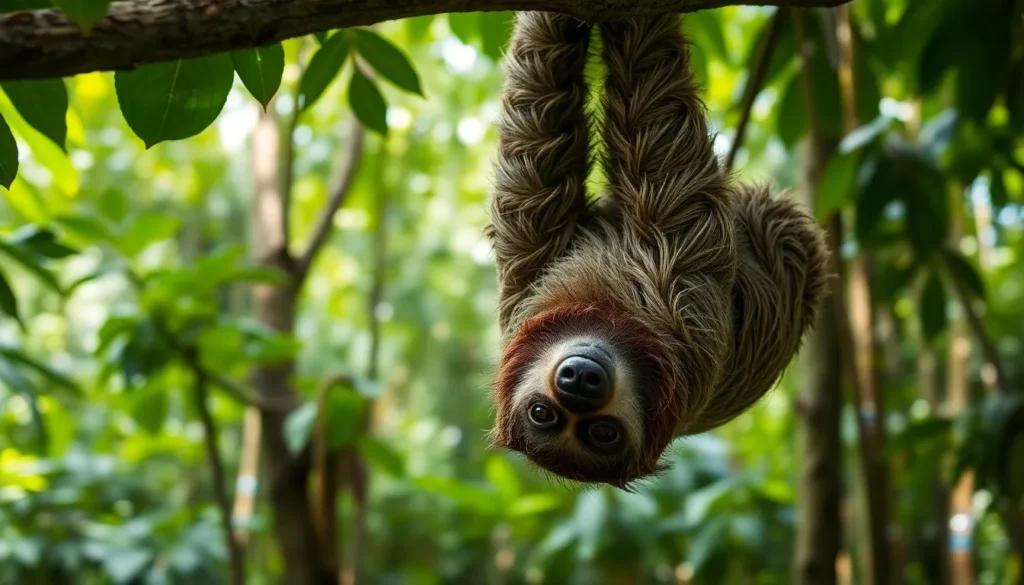
Short Answer
21 Facts About Sloths
- Sloths are extremely slow movers.
They move at an average speed of about 0.03 miles per hour, which helps them conserve energy and avoid detection by predators. - There are two main types of sloths: two-toed and three-toed.
These two groups differ in species, behavior, and anatomy but share many adaptations for arboreal life. - Sloths spend most of their lives hanging upside down in trees.
Their strong, curved claws allow them to grip branches firmly and hang effortlessly for hours. - They have a very low metabolic rate.
This slow metabolism contributes to their slow movement and requires them to eat a diet low in calories. - Sloths are herbivores primarily eating leaves.
Their diet mainly consists of leaves, buds, and tender shoots, which are difficult to digest and low in nutrients. - Their fur hosts a unique ecosystem.
Algae, fungi, and insects live in the sloth’s fur, providing camouflage and sometimes nutrients when the sloth licks its fur. - Sloths have specialized stomachs.
Their multi-chambered stomachs slowly ferment tough leaves, similar to how cows digest food. - They descend from the trees only about once a week to defecate.
This behavior is risky but essential for their digestive processes and possibly for fertilizing the trees they inhabit. - Sloths have poor eyesight but a strong sense of smell and hearing.
These senses help them detect predators and navigate their environment despite their slow movement. - Despite their slowness, sloths are good swimmers.
They can move through water up to three times faster than on land or in trees. - Sloths are solitary animals.
They tend to live alone except during mating or when females care for their young. - Sloths have a low body temperature for mammals.
Their body temperature ranges from 30 to 34 degrees Celsius, which is lower than most other mammals. - They have an unusually low muscle mass for their size.
About 25–30% of their body weight is muscle compared to 40–45% in most mammals, contributing to their slow movement. - Sloths exhibit a unique anatomical adaptation in their neck vertebrae.
Some species have extra neck vertebrae allowing them to turn their heads up to 270 degrees. - Their slow lifestyle helps avoid predators.
Predators like jaguars, harpy eagles, and snakes find it difficult to detect them due to their camouflage and minimal movement. - Sloths can live up to 20–30 years in the wild.
Captive sloths have occasionally lived longer due to controlled environments and absence of predators. - Sloths have a low reproductive rate.
Females typically give birth to one offspring after a gestation period ranging from six months to a year, depending on the species. - They play a role in nutrient cycling in rainforests.
By defecating on the ground and through their fur ecosystem, sloths contribute to nutrient distribution and forest health. - Sloths have inspired cultural symbolism.
They are often associated with traits like patience, calmness, and peacefulness in various cultures and media. - Deforestation and habitat loss threaten sloth populations.
Conservation efforts are necessary to protect their habitats and ensure survival of various sloth species. - Sloths have been studied for insights into energy conservation and metabolism.
Their unique physiological adaptations provide valuable information for biological and medical research.
Habitat and Behavior
Sloths are native to the tropical rainforests of Central and South America, where they occupy the upper canopy layers of the forest. They are arboreal mammals that spend nearly all of their lives in trees, descending to the ground infrequently primarily for defecation. Their slow movement and camouflage help them avoid predation in dense forest environments. Sloths are predominantly solitary and nocturnal or crepuscular, resting for up to 15–20 hours per day. They feed mainly on leaves, which are abundant but nutritionally poor, prompting adaptations such as a slow metabolism and a multi-chambered stomach to digest cellulose efficiently. Their slow lifestyle and unique fur ecosystem, which includes symbiotic algae and insects, further enhance their survival in the rainforest canopy. Despite their slow pace on land, sloths are surprisingly capable swimmers, which helps them cross rivers and flooded areas within their habitat.
Why This Animal Matters
Sloths play a significant ecological role in their rainforest ecosystems. By consuming large amounts of leaves and contributing to the cycling of nutrients through their defecation and the algae in their fur, sloths support forest health and biodiversity. Their presence aids in maintaining the structure of forest canopies and the species that depend on them. Cultural significance also arises from their symbolic representation of patience and tranquility in human societies. Furthermore, sloths face threats from habitat destruction and fragmentation, making them important species for conservation efforts. Studying sloths offers insights into metabolic adaptation, energy conservation, and symbiotic relationships, enhancing scientific understanding of ecology and physiology.
Common Misconceptions
Misconception: Sloths are lazy animals.
Correction: Sloths are not lazy; their slow movement is an evolutionary adaptation to conserve energy due to a low-calorie diet and to avoid predators.
Misconception: Sloths only live in trees and never come down.
Correction: While sloths spend most of their time in trees, they do come down approximately once a week to defecate and may occasionally move on the ground.
Misconception: Sloths are related to monkeys.
Correction: Sloths belong to the order Pilosa and are more closely related to anteaters than to monkeys, which are primates.
Misconception: All sloths have three toes.
Correction: There are two main types of sloths: two-toed and three-toed, distinguished by the number of toes on their forelimbs.
Misconception: Sloths are defenseless.
Correction: Sloths have strong claws and can defend themselves, and their camouflage and slow, minimal movement also serve as defense mechanisms.
FAQ
Why do sloths move so slowly?
Sloths move slowly primarily to conserve energy due to their low-calorie diet of leaves and to avoid attracting predators by minimizing movement and noise.
Are sloths good swimmers?
Yes, sloths are surprisingly strong swimmers and can move three times faster in water than on land or in trees, which helps them cross rivers in their rainforest habitat.
How often do sloths come down from trees?
Sloths typically descend from the canopy about once a week, mainly to defecate, which is a vulnerable activity but essential for their digestive health.



Leave a Reply