
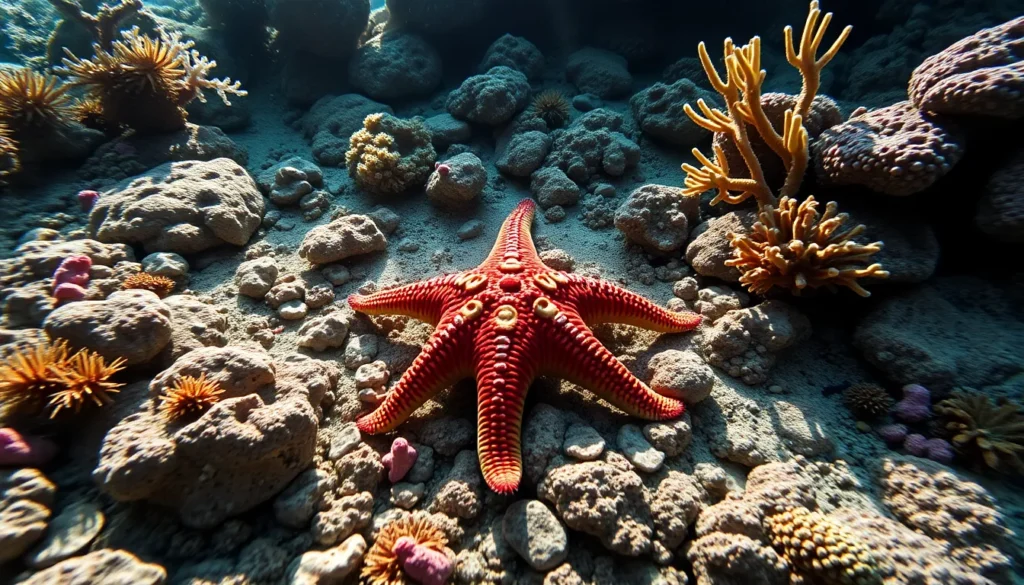
Short Answer
21 Facts About Sea Stars
- Not True Fish: Despite their common name “starfish,” sea stars are not fish but echinoderms related to sea urchins and sand dollars.
- Radial Symmetry: Most sea stars have five arms radiating from a central disc, though some species have more than five arms.
- Tube Feet Locomotion: Sea stars move using hundreds of tiny tube feet located on the undersides of their arms, which operate through hydraulic pressure.
- Regeneration Ability: Many sea stars can regenerate lost arms, and some species can regrow an entire body from a single arm and part of the central disc.
- Water Vascular System: They possess a unique water vascular system that aids in locomotion, feeding, and respiration.
- Feeding Method: Sea stars feed primarily on bivalves like clams and mussels by prying open shells with their arms and everting their stomachs to digest prey externally.
- No Blood: Sea stars do not have blood; instead, their water vascular system circulates nutrients and gases.
- Sensory Cells: They have light-sensitive eye spots at the tips of their arms but lack a centralized brain.
- Varied Colors and Textures: Sea stars exhibit diverse colors and textures, which can serve as camouflage or warning coloration.
- Habitat Range: They inhabit a wide range of marine environments, from tidal pools to deep ocean floors.
- Predators and Defense: Predators include fish, crabs, and sea otters; some sea stars produce toxins or shed arms to escape predation.
- Reproduction: Sea stars reproduce both sexually, by releasing eggs and sperm into the water, and asexually, through regeneration.
- Larval Stage: Their larvae are planktonic and undergo metamorphosis before settling to the ocean floor.
- Ecological Role: They are keystone predators in many ecosystems, controlling populations of mollusks and other invertebrates.
- Longevity: Some species can live for several decades in the wild.
- Temperature Sensitivity: Sea stars are sensitive to temperature changes and have been indicators in studying the effects of climate change.
- Unique Skin Composition: Their skin contains calcareous plates called ossicles, providing both protection and flexibility.
- Symbiotic Relationships: Some sea stars host small organisms like shrimp or copepods that live on or inside them.
- Not All Are Star-Shaped: While most have star-like shapes, some deep-sea species have more irregular forms adapted to their environment.
- Scientific Importance: Sea stars have been extensively studied for insights into developmental biology and regeneration.
- Human Impact: Overfishing, pollution, and disease outbreaks have affected some sea star populations worldwide.
Habitat and Behavior
Sea stars are marine animals found in oceans worldwide, from tropical coral reefs to polar waters. They typically inhabit the benthic zone, living on or near the seabed. Sea stars are slow-moving and use their tube feet to navigate rocky substrates, sandy bottoms, and coral reefs. Their behavior often involves active predation on mollusks, echinoderms, and detritus. Some species are solitary, while others may aggregate in specific habitats. Sea stars rely on their water vascular system for movement and feeding. They can survive in various depths, from shallow tide pools to depths exceeding 6,000 meters in some species.
Why This Animal Matters
Sea stars play a crucial ecological role as keystone predators, helping maintain the balance of marine ecosystems by regulating the populations of bivalves and other invertebrates. Their presence influences community structure and biodiversity. Additionally, sea stars are important in scientific research due to their remarkable regenerative capabilities, contributing to understanding tissue regeneration and developmental biology. Some cultures have recognized sea stars in folklore and art, symbolizing regeneration and guidance. Conservation of sea star populations is vital, as environmental changes and human activities threaten their habitats and health, potentially disrupting marine food webs.
Common Misconceptions
Misconception: Sea stars are fish.
Correction: Sea stars are echinoderms, not fish; they lack gills, scales, and a backbone.

Misconception: Sea stars have a brain.
Correction: Sea stars do not have a centralized brain but possess a complex nervous system with nerve rings and radial nerves.
Misconception: Sea stars always have five arms.
Correction: While five arms are common, some species have more, and arm number can vary even within species.
FAQ
Are sea stars dangerous to humans?
Most sea stars are harmless to humans. However, some species produce mild toxins or have spiny surfaces that can cause irritation if handled improperly.
How do sea stars eat their prey?
Sea stars use their tube feet to pry open the shells of bivalves, then evert their stomachs through their mouths to externally digest the prey before pulling it back inside.
Can sea stars survive out of water?
Sea stars can survive out of water for short periods, especially in moist environments such as tidal pools, but prolonged exposure to air can be harmful or fatal.



Leave a Reply