
Short Answer
21 Facts About Grasshoppers
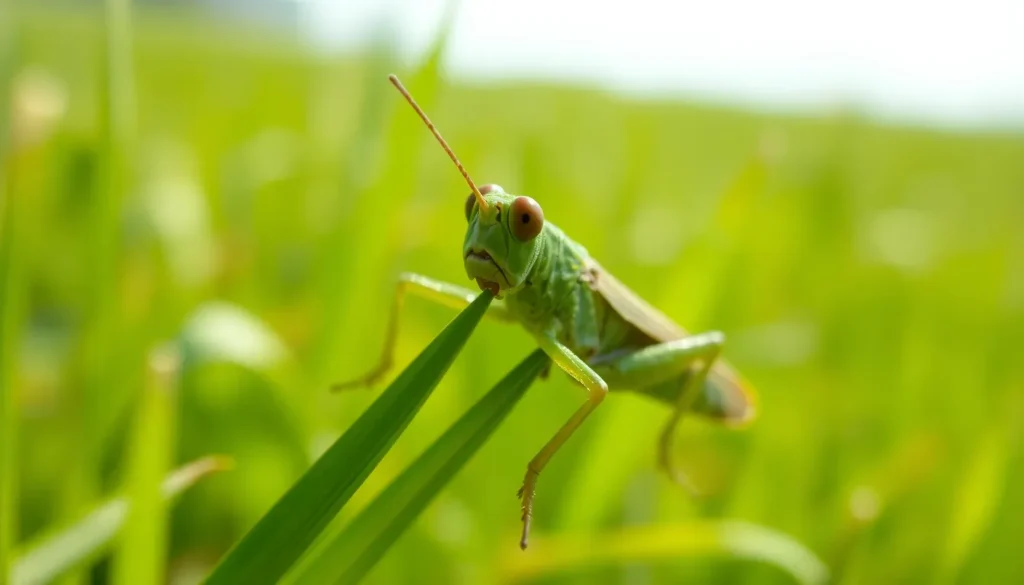
- Grasshoppers belong to the order Orthoptera. This group includes crickets and locusts, characterized by their jumping hind legs and chewing mouthparts.
- They have powerful hind legs adapted for jumping. These legs allow grasshoppers to leap distances up to 20 times their body length.
- Grasshoppers communicate using sound. Many species produce chirping noises by rubbing their hind legs against their forewings, a process called stridulation.
- There are over 11,000 known species of grasshoppers worldwide. They inhabit diverse environments from grasslands to forests.
- Grasshoppers are primarily herbivores. They feed on grasses, leaves, and cereal crops, sometimes causing agricultural damage.
- Some grasshopper species can change color. This adaptation helps them blend into their environment or signal readiness to mate.
- Grasshoppers have compound eyes. These eyes provide a wide field of vision and help detect movement effectively.
- Their life cycle includes incomplete metamorphosis. They develop from eggs to nymphs, which resemble adults but lack wings, before maturing.
- Grasshoppers can produce sounds only during the day. Unlike crickets, their stridulation is mostly diurnal.
- Some grasshoppers can fly short distances. Their forewings are tough and protect the hindwings used for flight.
- Grasshoppers have a unique respiratory system. They breathe through spiracles connected to a network of tracheae delivering oxygen directly to tissues.
- Locusts are a type of grasshopper. Under certain conditions, they form large swarms that can devastate crops over vast areas.
- Grasshoppers use their antennae to sense their environment. These appendages detect touch, smell, and temperature.
- They exhibit sexual dimorphism. Females are often larger than males and may have different coloration or wing length.
- Grasshoppers play a role in nutrient cycling. By feeding on plants and being prey to other animals, they contribute to ecosystem functioning.
- Some species have been used as a food source for humans. In various cultures, grasshoppers are harvested and consumed for protein.
- Grasshoppers have tympanal organs for hearing. These sensory organs detect sound vibrations and help in communication and predator avoidance.
- Their jumping mechanism is powered by rapid muscle contractions. Elastic energy is stored in leg tendons to enable explosive jumps.
- Grasshoppers can be indicators of environmental health. Changes in their populations may reflect habitat quality and biodiversity.
- They are prey for a wide range of animals. Birds, reptiles, amphibians, and mammals commonly feed on grasshoppers.
- Grasshoppers have existed for millions of years. Fossil evidence shows their presence since the Jurassic period, indicating their long evolutionary history.
Habitat and Behavior
Grasshoppers are found on every continent except Antarctica, inhabiting environments ranging from grasslands and savannas to forests and deserts. They tend to favor areas with abundant vegetation suitable for feeding. Their behavior is largely influenced by the need to avoid predators and find mates. Grasshoppers use their jumping ability to escape threats, and many species are active during the day. They communicate through sound production, primarily for mating purposes. During warmer months, grasshoppers lay eggs in soil or plant material, with nymphs emerging after a few weeks. Their development through incomplete metamorphosis involves several molts before reaching adulthood.
Why This Animal Matters
Grasshoppers play significant ecological roles as herbivores, influencing plant community composition and productivity. They serve as a critical food source for various predators, supporting biodiversity. In agricultural contexts, grasshoppers can become pests, particularly when populations surge, risking crop damage. Conversely, they are also part of sustainable food practices in some cultures, providing protein. Ecologically, grasshoppers contribute to nutrient cycling by breaking down plant material and facilitating decomposition. Their sensitivity to environmental changes makes them useful bioindicators for monitoring habitat health and the impacts of climate change.
Common Misconceptions
Misconception: All grasshoppers can form locust swarms.
Correction: Only certain species of grasshoppers, known as locusts, exhibit swarming behavior under specific environmental conditions.

Misconception: Grasshoppers are harmful to all plants.
Correction: While some grasshoppers feed on crops and can damage plants, many species feed on wild vegetation and have limited impact on agriculture.
Misconception: Grasshoppers can only hop and cannot fly.
Correction: Many grasshoppers have wings and can fly, although their flight is typically short-range compared to their jumping ability.
Misconception: Grasshoppers are nocturnal.
Correction: Most grasshoppers are diurnal, being active during the day, unlike related insects such as crickets.
FAQ
What distinguishes grasshoppers from locusts?
Locusts are a subset of grasshoppers that can change behavior and physiology to form large swarms under certain environmental conditions, unlike typical grasshoppers.
How do grasshoppers produce their characteristic chirping sounds?
Grasshoppers produce sounds by rubbing their hind legs against their forewings, a process called stridulation, which is mainly used for mating communication.
Are grasshoppers harmful to crops?
While some species can damage crops, especially during population outbreaks, many grasshoppers feed on wild plants and have minimal agricultural impact.



Leave a Reply