
Short Answer
21 Facts About Red Kangaroos
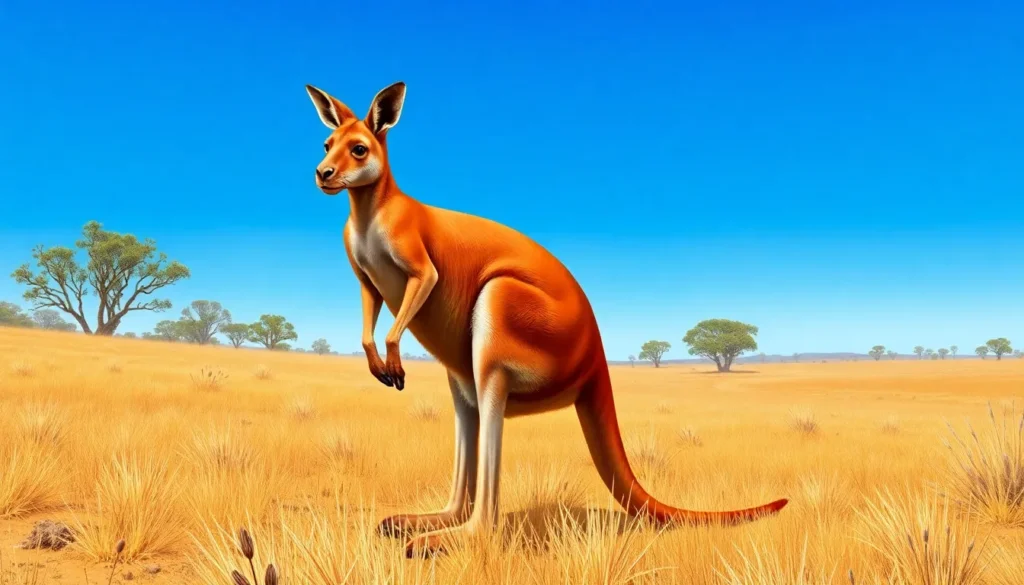
- Largest Marsupial: The red kangaroo (Macropus rufus) is the largest marsupial species in the world, with males standing over 1.8 meters tall.
- Sexual Dimorphism: Males are typically larger and more brightly colored in reddish hues, while females are usually smaller and more bluish-grey.
- Powerful Hind Legs: They use their strong hind legs to hop at speeds up to 60 km/h and cover distances of up to 9 meters in a single leap.
- Tail as a Support: Their muscular tail acts as a fifth limb, helping balance and support while standing or moving slowly.
- Herbivorous Diet: Red kangaroos primarily feed on grasses and shrubs, adapting their diet according to seasonal availability.
- Nocturnal and Crepuscular: They are most active during cooler periods such as dawn, dusk, and night to avoid daytime heat.
- Efficient Water Use: Red kangaroos can survive long periods without direct water, obtaining moisture mainly from their food.
- Social Structure: They live in groups called mobs, which provide protection and social interaction.
- Breeding and Joeys: Females have a unique reproductive strategy called embryonic diapause, allowing them to pause development of an embryo until conditions are favorable.
- Rapid Growth of Joeys: Newborns are underdeveloped and continue growing inside the mother’s pouch for several months.
- Communication: Red kangaroos use a range of vocalizations, body postures, and foot thumping to communicate danger or other messages.
- Adapted to Arid Environments: They are well-suited to Australia’s dry interior, enduring extreme temperatures and scarce water sources.
- Predators: Natural predators include dingoes and eagles, with humans also influencing populations through hunting and habitat changes.
- Longevity: In the wild, red kangaroos can live up to 22 years, though average lifespan tends to be shorter.
- Conservation Status: They are currently classified as Least Concern due to their wide distribution and large population, though some local threats exist.
- Ecological Role: As grazers, they influence vegetation patterns and provide prey for predators, contributing to ecosystem balance.
- Cultural Significance: Red kangaroos feature prominently in Indigenous Australian culture, art, and mythology.
- Symbol of Australia: They appear on the Australian coat of arms and various emblems as national symbols.
- Efficient Locomotion: Their hopping style is energy efficient, enabling long-distance travel in search of food and water.
- Thermoregulation: They lick their forearms to cool blood vessels and dissipate heat in hot climates.
- Scientific Research: Red kangaroos are important subjects in studies of marsupial biology, locomotion, and adaptation to arid environments.
Habitat and Behavior
Red kangaroos are native to the arid and semi-arid regions of Australia, primarily found in open plains, grasslands, and deserts. They are highly adapted to hot, dry climates, often resting during the heat of the day in shaded areas or wallowing in dust to reduce body temperature. Their social groups, or mobs, typically consist of several females, their young, and a dominant male. Red kangaroos are herbivores, grazing mainly on grasses but also consuming shrubs when necessary. Their locomotion through hopping conserves energy, allowing them to cover large distances while searching for food and water. Reproductive behavior includes a unique embryonic diapause system whereby females can delay the development of an embryo until environmental conditions improve. Communication within mobs involves vocalizations, thumping of hind legs, and body language to signal danger or establish dominance.
Why This Animal Matters
Red kangaroos play a significant ecological role as primary grazers, helping to shape vegetation communities and provide a food source for native predators. Their grazing patterns influence plant species distribution and contribute to nutrient cycling in their ecosystems. Culturally, red kangaroos hold importance for Indigenous Australians, featuring in traditional stories, art, and as a source of sustenance. Nationally, the red kangaroo is an iconic symbol of Australia, representing the country’s unique wildlife. From a conservation perspective, monitoring red kangaroo populations helps assess the health of arid ecosystems, although they currently face fewer threats compared to other native species.
Common Misconceptions
Misconception: All kangaroos are red.
Correction: While red kangaroos have distinctive reddish fur, other species such as eastern grey and western grey kangaroos have different colorations ranging from grey to brown.
Misconception: Kangaroos are dangerous to humans.
Correction: Red kangaroos generally avoid humans and only become aggressive when threatened or cornered.
Misconception: Kangaroos can walk backward.
Correction: Due to their large tail and leg structure, kangaroos cannot walk backward effectively and primarily move by hopping forward.
Misconception: Kangaroos are only found in forests.
Correction: Red kangaroos are mostly found in open grasslands, deserts, and scrublands, not dense forests.
FAQ
What do red kangaroos eat?
Red kangaroos primarily eat grasses and shrubs, shifting their diet based on seasonal availability and water content.
How fast can a red kangaroo hop?
Red kangaroos can reach speeds of up to 60 km/h (37 mph) and can cover distances of up to 9 meters in a single hop.
Where do red kangaroos live?
They inhabit arid and semi-arid regions across mainland Australia, preferring open grasslands and deserts.

Leave a Reply