
Short Answer
21 Facts About Reciprocal Altruism in Vampire Bats
- Definition of reciprocal altruism: Reciprocal altruism refers to the behavior where an individual provides a benefit to another with the expectation that the favor will be returned in the future.
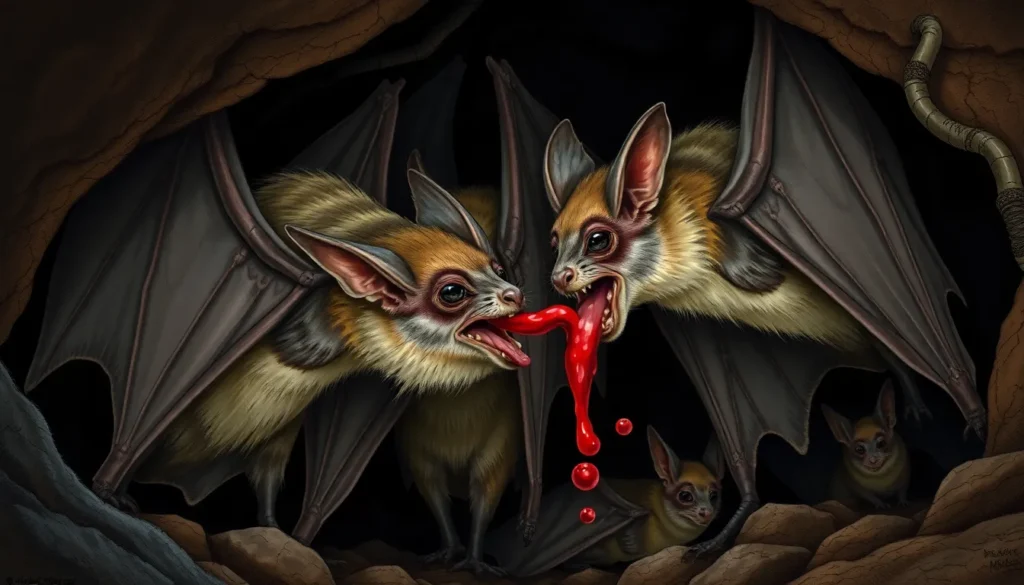
- Food sharing by regurgitation: Vampire bats share blood meals by regurgitating blood to feed unrelated individuals who failed to feed that night.
- Survival benefit: Food sharing increases survival chances for vampire bats because missing a single night’s meal can be fatal.
- Non-kin cooperation: Unlike many altruistic behaviors seen in animals, reciprocal altruism in vampire bats often occurs between non-related individuals.
- Long-term social bonds: Food sharing strengthens social bonds and facilitates cooperation among vampire bats over long periods.
- Memory and recognition: Vampire bats can remember past interactions and preferentially share with individuals who have previously fed them.
- Cost of sharing: Donor bats lose about 20% of their stomach content when sharing, representing a significant energetic cost.
- Frequency of sharing: Sharing events occur frequently among stable groups, highlighting the importance of cooperation for survival.
- Reciprocity enforcement: Bats that do not reciprocate food sharing are less likely to be fed in the future.
- Social grooming correlation: Reciprocal altruism is also linked to social grooming, which helps maintain bonds among bats.
- Kin selection vs. reciprocal altruism: While kin selection explains altruism among relatives, reciprocal altruism explains cooperation among unrelated individuals.
- Experimental evidence: Controlled studies have demonstrated that vampire bats preferentially share with past donors.
- Impact on group cohesion: Reciprocal altruism promotes group cohesion and stability in vampire bat colonies.
- Evolutionary significance: Reciprocal altruism likely evolved as an adaptive strategy to enhance survival in a risky feeding environment.
- Communication cues: Bats use vocalizations and physical contact to solicit food sharing from roost mates.
- Variation among species: Reciprocal food sharing behavior is most studied in common vampire bats (Desmodus rotundus), with less evidence in other bat species.
- Physiological adaptations: Vampire bats have evolved specialized kidneys and digestive systems to process large blood meals efficiently.
- Energy demands: Their high metabolism and risk of starvation create strong selective pressure for reciprocal altruism.
- Social network structure: Food sharing is influenced by the social network, with bats sharing more with well-connected individuals.
- Research implications: Studies on reciprocal altruism in vampire bats provide insights into the evolution of cooperation in animals.
- Human parallels: Reciprocal altruism concepts in vampire bats have been used to better understand cooperation and social behavior in humans and other primates.
Habitat and Behavior
Vampire bats, primarily the common vampire bat (Desmodus rotundus), inhabit the Americas, ranging from Mexico to South America. They prefer roosting in caves, hollow trees, and abandoned buildings. These nocturnal mammals feed exclusively on blood, primarily from livestock and wildlife. Their feeding strategy involves stealthily approaching sleeping animals and making a small incision to lap up the blood. Due to the risk of starvation if they fail to feed, vampire bats have developed complex social behaviors, including reciprocal food sharing. They live in colonies where social bonds and cooperation are essential for survival. Social grooming and vocal communication play significant roles in maintaining group cohesion and facilitating reciprocal altruism.
Why This Animal Matters
Vampire bats play an important ecological role by influencing the populations of their prey species and acting as vectors for diseases such as rabies. Their unique social behaviors, especially reciprocal altruism, provide valuable models for studying the evolution of cooperation in animals. Understanding these behaviors can offer insights into social dynamics, friendship, and mutual aid in broader biological contexts, including human societies. Conservation of vampire bat habitats is important for maintaining ecological balance, although managing their interaction with livestock requires careful attention to prevent disease transmission. Their study advances knowledge in behavioral ecology, evolutionary biology, and animal cognition.
Common Misconceptions
Misconception: Vampire bats only feed on humans and are highly aggressive.
Correction: Vampire bats primarily feed on livestock and wildlife, rarely biting humans unless other food sources are scarce. They are not typically aggressive and use stealth to feed.
Misconception: Reciprocal altruism in vampire bats is instinctive and does not involve memory.
Correction: Vampire bats demonstrate complex memory and recognize individual bats who have helped them, indicating cognitive involvement in reciprocal altruism.
Misconception: Vampire bats share food indiscriminately with all colony members.
Correction: Food sharing is selective, favoring individuals who have previously shared or have strong social bonds.
Misconception: Reciprocal altruism only occurs among related vampire bats.
Correction: Reciprocal altruism frequently occurs between unrelated individuals, distinguishing it from kin selection.
FAQ
How do vampire bats practice reciprocal altruism?
Vampire bats share blood meals with other bats that failed to feed by regurgitating blood, expecting that the favor will be returned in the future, enhancing survival for both parties.
Do vampire bats share food with all colony members?
No, vampire bats selectively share food, typically with individuals who have shared with them before or with whom they have strong social bonds.
Why is reciprocal altruism important for vampire bats?
Because vampire bats can die after missing a single night of feeding, reciprocal altruism allows individuals to survive by receiving help from others, thereby increasing the overall fitness of the group.



Leave a Reply