
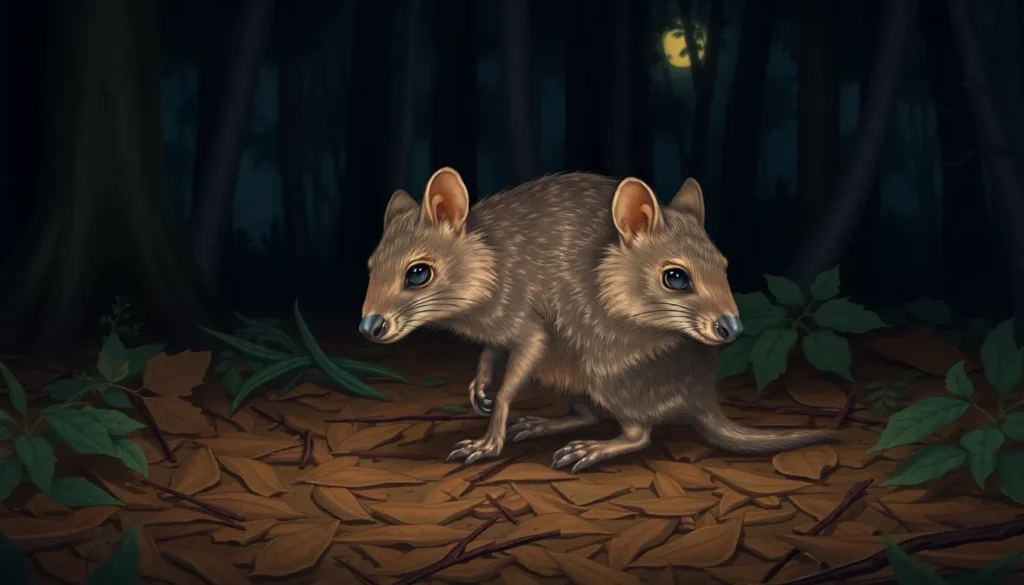
Short Answer
21 Facts About Potoroos
- Potoroos are small marsupials native to Australia. They belong to the family Potoroidae, which includes rat-kangaroos and bettongs.
- They resemble a small kangaroo but are generally much smaller. Adult potoroos typically weigh between 1 and 3 kilograms.
- There are several species of potoroos. The most well-known include the long-footed potoroo (Potorous longipes) and the Gilbert’s potoroo (Potorous gilberti), the latter being one of the rarest mammals in the world.
- Potoroos are nocturnal animals. They are mostly active at night to avoid predators and extreme daytime temperatures.
- They have long, pointed snouts used for foraging. Their snouts help them dig in leaf litter and soil to find food.
- Potoroos are mainly herbivorous but have an omnivorous diet. They feed on fungi, roots, tubers, seeds, and occasionally insects.
- They play a critical role in their ecosystem as fungal spore dispersers. By consuming truffles and fungi, potoroos help maintain healthy forest ecosystems.
- Potoroos have strong hind legs and long feet. These adaptations allow them to hop efficiently and dig for food.
- They have a pouch where their young develop after birth. Like other marsupials, potoroos give birth to underdeveloped young that complete growth in the mother’s pouch.
- Potoroos are generally shy and secretive animals. They tend to avoid human contact and hide in dense vegetation.
- The Gilbert’s potoroo was once thought to be extinct. It was rediscovered in 1994, highlighting the importance of conservation efforts.
- Potoroos are threatened by habitat loss and introduced predators. Foxes and feral cats pose significant threats to their populations.
- Some potoroo species are listed as endangered or critically endangered. Conservation programs focus on habitat protection and predator control.
- Their breeding season varies depending on the species and location. Reproductive timing is often linked to environmental conditions.
- Potoroos have a relatively long lifespan for small marsupials. In the wild, they can live up to 7 years or more.
- They are solitary creatures, usually living alone except during breeding. Potoroos maintain individual territories.
- Potoroos use their keen sense of smell to locate food. Their olfactory abilities are essential for detecting underground fungi and roots.
- They contribute to soil health through their digging activities. By turning over soil, potoroos aid in nutrient cycling and seed dispersal.
- Potoroos have a unique dental structure suited to their diet. Their teeth are adapted for grinding plant materials and fungi.
- They are considered important indicators of forest ecosystem health. Changes in potoroo populations can signal environmental shifts.
- Research on potoroos is ongoing to better understand their ecology and conservation needs. Continued study is critical due to their vulnerable status.
Habitat and Behavior
Potoroos inhabit a variety of forested and scrubland environments along the southeastern and southwestern coasts of Australia. They prefer areas with dense ground cover, which provides protection from predators and harsh weather. These marsupials are nocturnal and spend most of the day resting in nests made from leaves and grass. At night, potoroos forage primarily for underground fungi, roots, and seeds, using their strong forelimbs and claws to dig. Their solitary nature means they rarely interact except during mating periods. Potoroos mark their territories with scent glands and avoid confrontations with other individuals. Their behavior is adapted to minimize predation risk, especially from introduced species such as foxes and feral cats.
Why This Animal Matters
Potoroos play an essential ecological role as mycophagous mammals, meaning they feed on fungi, particularly underground truffles. This feeding behavior promotes the dispersal of fungal spores, which are crucial for nutrient cycling and the health of forest ecosystems. By maintaining symbiotic relationships between fungi and plants, potoroos support biodiversity and forest regeneration. Culturally, potoroos are part of Australia’s unique marsupial fauna, contributing to the country’s natural heritage. Conservation of potoroos highlights broader environmental concerns such as habitat preservation and the control of invasive species. Protecting potoroos also helps safeguard other native species that share similar habitats.
Common Misconceptions
Misconception: Potoroos are just small kangaroos.
Correction: Although related, potoroos belong to a different family (Potoroidae) and differ significantly in size, behavior, and ecological roles from kangaroos.
Misconception: Potoroos are widespread and not threatened.
Correction: Many potoroo species are endangered or critically endangered, with limited distributions and significant threats from habitat loss and introduced predators.
FAQ
What do potoroos eat?
Potoroos primarily feed on underground fungi, roots, seeds, and occasionally insects. Their diet plays an important role in dispersing fungal spores.
Where do potoroos live?
Potoroos are native to Australia and inhabit forested and scrubland areas with dense ground cover, mainly in southeastern and southwestern regions.
Are potoroos endangered?
Yes, several species of potoroos, including Gilbert's potoroo, are considered endangered or critically endangered due to habitat loss and predation by introduced species.


Leave a Reply