
Short Answer
21 Facts About Octopuses
- Highly Intelligent Invertebrates
Octopuses are among the most intelligent invertebrates, exhibiting problem-solving skills, memory, and even tool use in some species. - Three Hearts
Octopuses have three hearts; two pump blood to the gills, and one pumps it to the rest of the body. - Blue Blood
Unlike most animals, octopus blood contains hemocyanin, which is copper-based and gives their blood a blue color. - Master of Camouflage
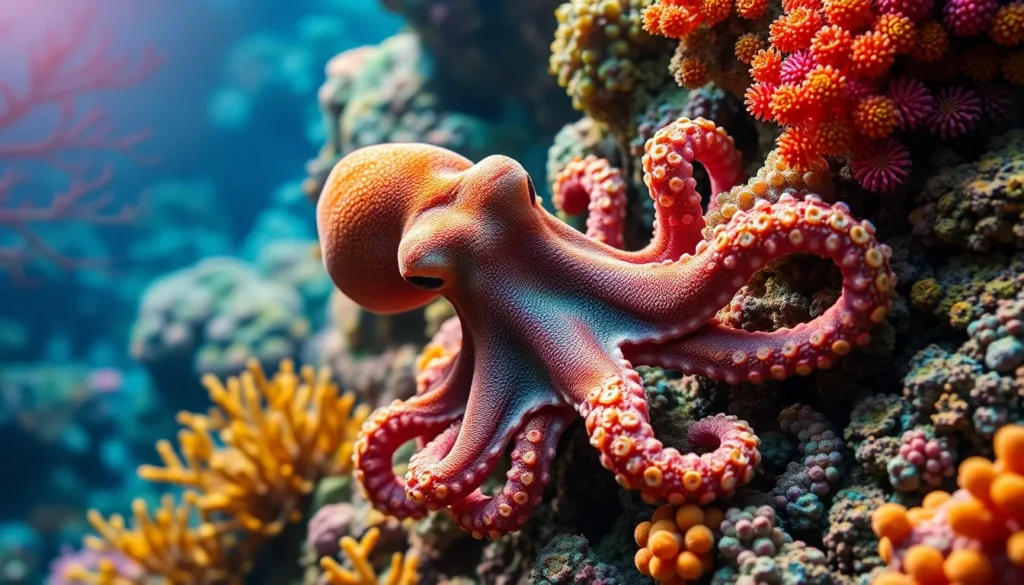
They can change both the color and texture of their skin to blend seamlessly into their environment. - Eight Arms with Suckers
Each arm is lined with suckers capable of tasting and gripping objects independently. - Short Lifespan
Most octopus species live for only 1 to 2 years, though some larger species may live longer. - Ink Defense
When threatened, octopuses can eject a cloud of ink to confuse predators and make a quick escape. - Complex Nervous System
Octopuses have around 500 million neurons, with a large portion located in their arms, allowing autonomous movement. - No Bones
Their soft, boneless bodies allow them to squeeze through very narrow spaces. - Regeneration
Octopuses can regenerate lost arms, which helps them survive predatory attacks. - Varied Diet
They feed on crabs, shrimp, fish, and sometimes other octopuses. - Jet Propulsion
Octopuses move quickly by expelling water through a siphon, propelling themselves backward. - Ink Contains Toxins
Their ink contains substances that can irritate predators or interfere with their senses. - Egg Care
Female octopuses lay thousands of eggs and often guard and tend them until they hatch, generally without eating during this period. - Unique Reproduction
Males use a specialized arm called a hectocotylus to transfer spermatophores to females. - Distributed Intelligence
Most of an octopus’s neurons are in its arms, which can operate somewhat independently from the brain. - Color Vision Debate
While octopuses can change their skin color, it is uncertain if they see color the same way humans do, as they have only one type of photoreceptor. - Solitary Creatures
Octopuses generally live alone and are territorial. - Deep-Sea Species
Some octopus species inhabit depths over 4,000 meters, adapting to extreme pressure and darkness. - Short Memory
Although intelligent, octopuses have relatively short memories, often lasting only a few months. - Important Research Subject
Octopuses are studied widely in neuroscience and behavior due to their complex nervous systems and problem-solving abilities.
Habitat and Behavior
Octopuses are found in diverse marine habitats worldwide, from shallow coastal waters to deep ocean floors. They prefer dens or crevices to hide in during the day and tend to be nocturnal hunters. Their behavior includes active exploration, use of camouflage to avoid predators, and complex interactions with their environment. Octopuses primarily feed on crustaceans, mollusks, and small fish, using their dexterous arms and beak-like jaws to capture and consume prey. Their ability to squeeze into tight spaces helps them evade predators and hunt effectively. They tend to be solitary animals and show territorial behavior, often defending their dens aggressively.
Why This Animal Matters
Octopuses play a crucial ecological role as both predators and prey in marine ecosystems, helping maintain the balance of species populations. Their unique behaviors and intelligence have inspired scientific research, particularly in neurobiology and robotics. Culturally, octopuses have been symbolic in various mythologies and folklore, representing intelligence, mystery, and adaptability. Conservation-wise, some octopus species face threats from habitat destruction, pollution, and overfishing, highlighting the need for sustainable marine management practices to protect these distinctive animals and their ecosystems.
Common Misconceptions
Misconception: Octopuses have eight legs.
Correction: Octopuses have eight arms, not legs; their arms are highly flexible and equipped with suckers for manipulation and sensing.
Misconception: Octopuses are aggressive toward humans.
Correction: Octopuses are generally shy and avoid humans; they may defend themselves if threatened but do not seek out confrontation.
Misconception: All octopuses can change color to match their surroundings.
Correction: While many species can change color and texture, some deep-sea species lack this ability due to their dark, stable environment.
Misconception: Octopuses are fish.
Correction: Octopuses are mollusks, specifically cephalopods, distinct from fish in anatomy and physiology.
Misconception: Octopuses have a long lifespan.
Correction: Most octopuses have a short lifespan, typically one to two years, with some exceptions for larger species.
FAQ
How intelligent are octopuses compared to other animals?
Octopuses are considered highly intelligent among invertebrates, displaying behaviors such as problem-solving, using tools, and complex escape tactics, rivaling some vertebrates in cognitive abilities.
Why do octopuses have blue blood?
Octopuses have blue blood because it contains hemocyanin, a copper-based molecule that transports oxygen efficiently in cold and low-oxygen environments, unlike hemoglobin in red blood.
Can octopuses regenerate lost arms?
Yes, octopuses can regenerate their arms if they are lost due to injury or predation, regrowing the limb over time to recover full function.

Leave a Reply