
Short Answer
21 Facts About Nightingales
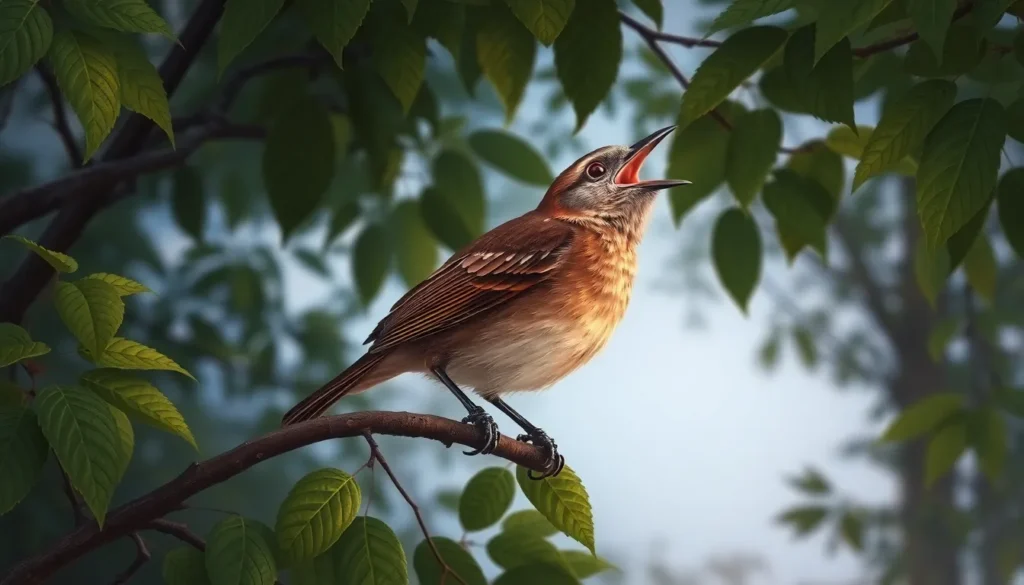
- Nightingales are famous for their singing ability. They produce complex and melodious songs that include whistles, trills, and clicks, often delivered at night as well as during the day.
- The common nightingale’s scientific name is Luscinia megarhynchos. It belongs to the thrush family, Turdidae.
- Nightingales are medium-sized passerines. They typically measure about 15–16.5 cm in length with a wingspan of 20–25 cm.
- They exhibit a plain brown plumage. Their understated coloration helps them stay camouflaged in dense undergrowth.
- Nightingales migrate seasonally. They breed in Europe and parts of Asia and winter in sub-Saharan Africa.
- Their song is often heard at night during the breeding season. This nocturnal singing is believed to attract mates and defend territory.
- Nightingales have a varied diet. They primarily feed on insects and other invertebrates, supplemented with berries and fruits.
- The nightingale’s song is considered one of the most beautiful in the bird world. It has inspired poets and musicians for centuries.
- Nightingales are territorial birds. Males defend nesting sites vigorously during the breeding season.
- The name “nightingale” means “night songstress” or “night singer.” This reflects their tendency to sing after dark.
- Nightingales are monogamous during the breeding season. They typically form pairs that cooperate in raising young.
- Nightingales build cup-shaped nests. These are usually placed low in dense shrubs or thickets.
- Females lay between 4 to 6 eggs per clutch. The eggs are usually pale with reddish spots.
- Both parents participate in feeding the chicks. They feed the hatchlings insects and other protein-rich prey.
- Nightingales have a wide distribution across Europe and western Asia. They are especially common in temperate forests and scrublands.
- They prefer dense, moist habitats with ample undergrowth. Such environments provide protection and feeding opportunities.
- Nightingales exhibit seasonal vocal variation. Their song complexity and intensity peak during the breeding season.
- They are considered indicators of healthy ecosystems. Their presence reflects well-preserved woodland habitats.
- Nightingales have been referenced in literature and folklore globally. Their song symbolizes love, hope, and poetic inspiration.
- Their populations have experienced declines in some areas. Habitat loss and environmental changes are contributing factors.
- Conservation efforts focus on habitat protection. Maintaining suitable breeding and wintering grounds is key to their survival.
Habitat and Behavior
Nightingales inhabit temperate woodlands, dense thickets, and shrublands across Europe, parts of western Asia, and North Africa. They favor moist environments with thick vegetation that provides cover for nesting and feeding. During the breeding season, males establish and defend territories by singing persistently both day and night. Their nocturnal song is a distinctive behavior that helps attract females and deter rival males. Nightingales feed primarily on insects, spiders, and other invertebrates, supplementing their diet with berries when available. They are migratory birds, traveling to sub-Saharan Africa for the winter months, returning to breed in the spring. Nesting involves constructing cup-shaped nests hidden close to the ground within dense foliage, where females lay and incubate eggs. Both parents help rear the young until they fledge.
Why This Animal Matters
Nightingales play an important ecological role as insect predators, helping control populations of various invertebrates. Their presence serves as an indicator of healthy woodland and scrub habitats, highlighting the importance of ecosystem conservation. Beyond ecology, nightingales hold considerable cultural significance, symbolizing beauty, love, and poetic inspiration in many traditions and literatures around the world. Their remarkable song has influenced countless artists, poets, and musicians. Conservation of nightingales also contributes to broader biodiversity protection efforts, as safeguarding their habitats benefits numerous other species sharing the same environments.
Common Misconceptions
Misconception: Nightingales sing only at night.
Correction: While nightingales are well known for their night singing, especially during the breeding season, they also sing during daylight hours.
Misconception: Nightingales are the same as mockingbirds.
Correction: Nightingales and mockingbirds are different species with distinct songs and behaviors. Nightingales belong to the thrush family, while mockingbirds belong to the mimic thrush family and have different geographic ranges and song characteristics.
FAQ
Why do nightingales sing at night?
Nightingales sing at night primarily during the breeding season to attract mates and establish territory. Night singing may reduce competition and increase their song's range due to quieter nighttime environments.
Where do nightingales migrate during winter?
Nightingales migrate from their breeding grounds in Europe and western Asia to sub-Saharan Africa, where they spend the winter months in warmer climates.
How can you distinguish a nightingale from similar birds?
Nightingales can be distinguished by their plain brown plumage, relatively large size for a songbird, and most notably, their rich, varied, and melodious song, often sung at night, which sets them apart from other similar small brown birds.



Leave a Reply