
Short Answer
21 Facts About Monarch Butterflies
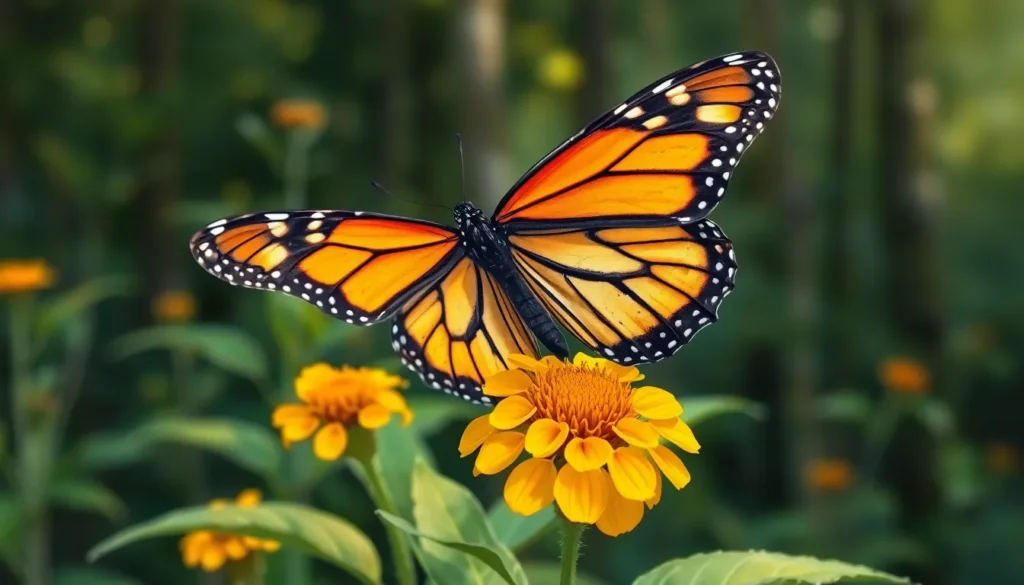
- Monarch butterflies are known for their bright orange and black wings. Their distinctive coloration serves as a warning to predators about their toxicity.
- They undergo a complete metamorphosis. Monarchs transition through four stages: egg, larva (caterpillar), pupa (chrysalis), and adult butterfly.
- Monarch caterpillars feed exclusively on milkweed plants. Milkweed contains toxic compounds called cardenolides, which make monarchs distasteful to predators.
- Monarch butterflies are famous for their long-distance migration. Some populations travel thousands of miles between breeding grounds in North America and overwintering sites in Mexico or California.
- The monarch migration is multi-generational. No single butterfly completes the entire round trip; instead, several generations are involved in completing the cycle.
- Monarchs use environmental cues to navigate. They rely on the position of the sun and an internal circadian clock to maintain their migratory direction.
- Overwintering monarchs cluster together on trees. In Mexico and California, they form dense clusters to conserve heat and protect themselves from cold weather.
- The monarch butterfly is a symbol of transformation and endurance. It holds cultural significance in many societies, particularly in Mexico where it is linked to the Day of the Dead celebrations.
- Monarch populations have declined in recent decades. Habitat loss, pesticide use, and climate change threaten their survival.
- Monarchs are important pollinators. While feeding on nectar, they help pollinate various flowering plants.
- Female monarchs lay eggs singly on milkweed leaves. This careful placement ensures caterpillars have immediate access to food upon hatching.
- Monarch butterflies have a wingspan of about 3.5 to 4 inches. Their size helps distinguish them from similar species.
- Adult monarchs primarily feed on nectar. Their long proboscis allows them to extract nectar from deep within flowers.
- Monarchs have specialized scales on their wings. These scales not only give color but also help regulate temperature.
- Monarch butterflies exhibit sexual dimorphism. Males and females can be distinguished by the presence of two black scent glands on the hind wings of males.
- Predators include birds, spiders, and wasps. However, monarch toxicity deters many potential predators.
- Monarch larvae go through five instars. These are growth stages between molts before pupation.
- The monarch butterfly genome has been sequenced. This has provided insights into migration, detoxification, and wing pattern genetics.
- Monarch butterflies are studied extensively as model organisms. Their migration and development make them valuable for ecological and genetic research.
- Climate change impacts monarch migration timing and success. Changes in temperature and weather patterns affect their breeding and migration routes.
- Conservation programs aim to protect monarch habitats. Efforts include planting milkweed and creating butterfly-friendly environments.
Habitat and Behavior
Monarch butterflies inhabit a wide range of environments across North America, from southern Canada to Central America. They favor open fields, meadows, and gardens where milkweed, their larval host plant, is abundant. Monarchs exhibit remarkable migratory behavior, traveling thousands of miles to specific overwintering sites—primarily oyamel fir forests in central Mexico and eucalyptus groves in coastal California. Their migration is triggered by decreasing daylight and cooler temperatures in autumn. During migration, monarchs fly during the day, using air thermals to conserve energy. In winter, they cluster in dense groups on trees to maintain warmth. Monarchs are diurnal and engage in nectar feeding, mating, and oviposition during daylight hours. The species’ survival depends heavily on the availability of milkweed for reproduction and adequate nectar sources for adults.
Why This Animal Matters
Monarch butterflies play an important role in ecosystems as pollinators, contributing to the reproduction of many flowering plants. Their dependency on milkweed highlights the intricate ecological relationships between species. Monarchs also serve as indicators of environmental health, with population changes reflecting habitat loss and climate impacts. Culturally, monarch butterflies hold symbolic value, especially in Mexico where their annual arrival coincides with the Day of the Dead, symbolizing the return of souls. Conservation of monarch butterflies raises awareness about broader environmental issues such as pesticide overuse, habitat fragmentation, and climate change. Their migratory phenomenon is one of the most studied examples of insect navigation and adaptation, providing valuable scientific insights.
Common Misconceptions
Misconception: Monarch butterflies hibernate during winter.
Correction: Monarchs do not hibernate; instead, they enter a state called diapause where reproduction is suspended, and they cluster together to conserve energy during overwintering.
Misconception: All monarchs migrate every year.
Correction: Only populations in North America perform long-distance migration. Monarchs in some tropical regions are non-migratory and remain year-round in the same location.
Misconception: Monarch butterflies are immune to all predators because of their toxicity.
Correction: While monarchs are toxic to many predators, some birds and insects have developed tolerance or strategies to prey on them.
Misconception: Milkweed is harmful to humans because monarchs feed on it.
Correction: Milkweed contains toxins that can be harmful if ingested in large amounts, but it is not dangerous to humans through casual contact and is important for monarch survival.
FAQ
How far do monarch butterflies migrate?
Monarch butterflies in North America can migrate up to 3,000 miles from their breeding grounds in the United States and Canada to overwintering sites in Mexico and California.
What do monarch caterpillars eat?
Monarch caterpillars feed exclusively on milkweed plants, which provide them with toxins that protect them from predators.
Why are monarch butterflies important to the environment?
Monarch butterflies act as pollinators and serve as indicators of ecosystem health. Their migratory behavior also provides valuable scientific insights into animal navigation and adaptation.




Leave a Reply