
Short Answer
21 Facts About Loriciferans
- Microscopic Size: Loriciferans are tiny animals, typically less than 1 millimeter in length, making them difficult to observe without a microscope.
- First Described in 1983: Loriciferans were formally described as a new phylum by Reinhardt Kristensen in 1983, highlighting their unique anatomical features.
- Marine Meiofauna: They belong to the meiofauna, a group of small benthic invertebrates living in marine sediments.
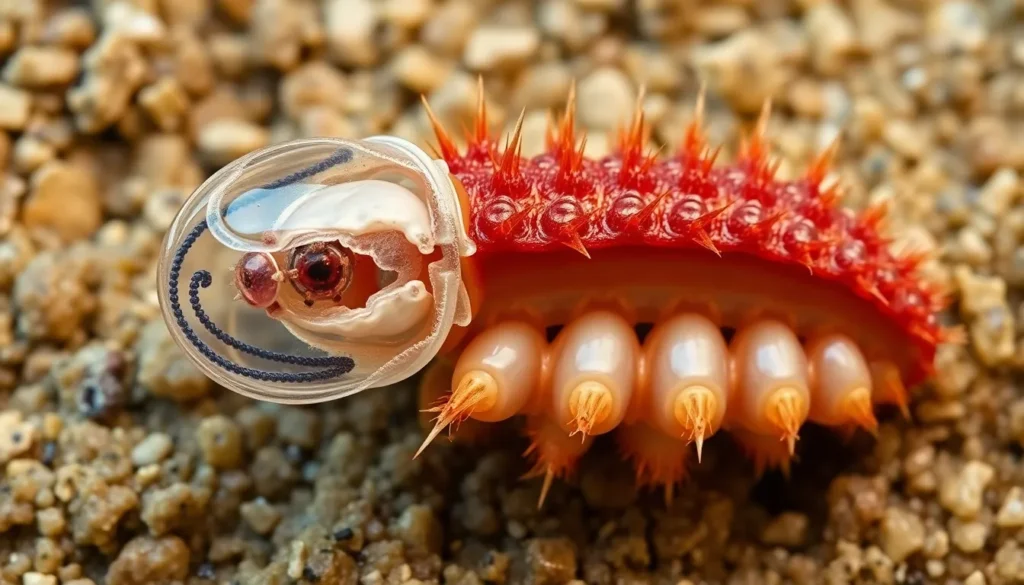
- Protective Lorica: The name “loriciferan” comes from their characteristic lorica, a protective outer case or shell that surrounds their body.
- Complex Body Structure: Their body consists of a head (introvert), neck, thorax, and abdomen, with the introvert bearing scalids used for locomotion and sensory functions.
- Unique Life Cycle: Some loriciferans exhibit complex life cycles with alternating sexual and asexual phases, although details vary among species.
- Habitat in Extreme Environments: Certain loriciferan species have been found in anoxic (oxygen-free) sediments, surviving in conditions previously thought uninhabitable for multicellular animals.
- Symbiotic Relationships: Loriciferans in anoxic environments may host symbiotic bacteria that help them survive without oxygen.
- Locomotion: They use spiny structures called scalids on their introvert to anchor and move through sediment particles.
- Feeding Methods: Loriciferans feed by scraping microorganisms and organic detritus from sediment grains.
- Reproduction: They reproduce sexually, with distinct males and females, but some species also reproduce asexually.
- Phylogenetic Position: Loriciferans are part of the group Scalidophora, which also includes kinorhynchs and priapulids, sharing certain morphological traits.
- Ecological Role: As meiofaunal organisms, loriciferans contribute to sediment ecosystem processes such as nutrient cycling.
- Adaptations to Sediment Life: Their small size and protective lorica enable them to inhabit interstitial spaces between sediment grains.
- Distribution: They are found worldwide, primarily in marine sediments from shallow to deep-sea environments.
- Discovery of Anoxic Species: In 2010, loriciferans were discovered living in permanently anoxic Mediterranean Sea basins, challenging assumptions about animal life limits.
- Limited Fossil Record: Due to their small size and soft bodies, loriciferans have an extremely limited fossil record, making their evolutionary history difficult to trace.
- Research Challenges: Their minute size and specialized habitats make loriciferans challenging to study, resulting in many aspects of their biology remaining poorly understood.
- Potential for New Species: Ongoing research continues to reveal new loriciferan species, indicating higher biodiversity than currently documented.
- Importance for Evolutionary Studies: Studying loriciferans provides insights into early animal evolution and adaptations to extreme environments.
- Indicator Species: Due to their sensitivity to environmental conditions, loriciferans can potentially serve as indicators of sediment health and marine ecosystem changes.
Habitat and Behavior
Loriciferans inhabit marine sediments worldwide, from shallow coastal waters to deep-sea environments. They dwell in the spaces between sediment grains, often in areas rich in organic material. Some species have adapted to life in completely oxygen-free environments, such as hypersaline basins in the Mediterranean Sea. Their behavior includes slow movement through sediment using spiny appendages called scalids and feeding on microscopic organic detritus and microorganisms. Reproduction involves both sexual and asexual means depending on the species. Loriciferans are adapted to survive the physical and chemical challenges of their interstitial habitats, including low oxygen and high pressure in deep-sea settings.
Why This Animal Matters
Loriciferans play a role in marine sediment ecosystems by contributing to nutrient cycling and organic matter breakdown, helping maintain sediment health. Their unique ability to survive in anoxic environments challenges traditional views on the limits of multicellular animal life, making them important for studies on extremophile biology and evolutionary biology. Additionally, as meiofaunal organisms sensitive to environmental changes, loriciferans may help scientists monitor the impacts of pollution and climate change on marine sediments. Their distinct evolutionary lineage also provides valuable information on the diversity and evolution of invertebrates.
Common Misconceptions
Misconception: Loriciferans are a type of microscopic worm.
Correction: Although loriciferans resemble worms, they belong to a distinct phylum separate from common worms like nematodes or annelids, characterized by unique morphological features such as the lorica and scalids.
Misconception: All loriciferans live in oxygen-rich environments.
Correction: Some loriciferan species have been discovered living in completely anoxic (oxygen-free) environments, demonstrating unusual adaptations to extreme conditions.
Misconception: Loriciferans are well-understood animals.
Correction: Due to their small size and challenging habitats, many aspects of loriciferan biology, ecology, and diversity remain poorly studied and understood.
FAQ
What are loriciferans?
Loriciferans are microscopic marine invertebrates characterized by a protective outer shell called a lorica and a complex body structure adapted for life between sediment grains.
Where do loriciferans live?
They live in marine sediments worldwide, including shallow coastal areas and deep-sea environments, with some species adapted to oxygen-free (anoxic) sediments.
Why are loriciferans important to science?
They provide insights into the limits of animal life in extreme environments, contribute to marine sediment ecosystems, and help understand evolutionary relationships within ecdysozoans.


Leave a Reply