
Short Answer
21 Facts About Margays
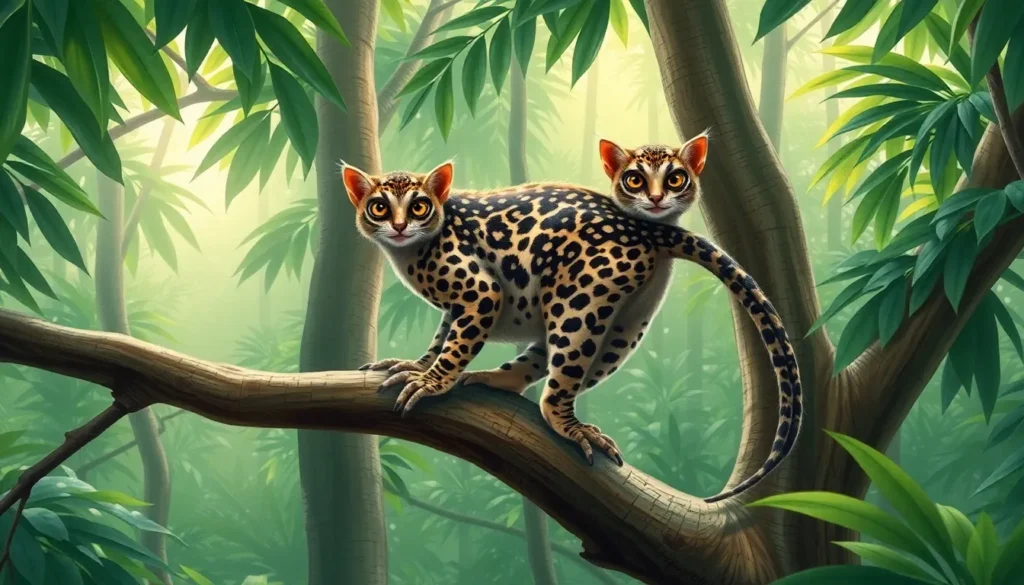
- Margays are small wild cats: Margays (Leopardus wiedii) typically weigh between 5 to 9 kilograms (11 to 20 pounds), making them one of the smaller species of wild cats in the Americas.
- They have exceptional climbing skills: Margays are highly arboreal, capable of climbing headfirst down trees and leaping great distances between branches.
- Tail length aids balance: Their long tail, often as long as their body, helps maintain balance while navigating the forest canopy.
- Distinctive coat pattern: Their fur is marked with dark rosettes and spots on a tawny or grayish background, providing camouflage in dense forest environments.
- They have flexible ankles: Margays can rotate their ankles up to 180 degrees, allowing them to grip tree branches securely and even descend trees headfirst.
- Margays are nocturnal hunters: They primarily hunt at night, using their keen eyesight and stealth to capture prey.
- Diet mainly consists of small mammals and birds: Their prey includes rodents, birds, eggs, lizards, and occasionally insects.
- Margays are solitary animals: They usually live and hunt alone except during mating or when females are raising kittens.
- Territorial behavior: Margays mark their territory with scent markings to ward off other individuals.
- Reproduction and lifespan: Females typically give birth to one or two kittens after a gestation of about 80 to 85 days; their lifespan in the wild is estimated to be around 10 to 12 years.
- They mimic the calls of their prey: Some studies suggest margays can imitate the vocalizations of small monkeys to lure them closer.
- Margays have large eyes relative to body size: This adaptation enhances their night vision, aiding nocturnal hunting.
- They inhabit dense tropical forests: Margays prefer rainforests but can also be found in deciduous forests and cloud forests.
- Range extends from Mexico to South America: They are found in countries including Mexico, Central America, and parts of northern and central South America.
- Margays are elusive and rarely seen: Their secretive nature and dense forest habitats make them difficult to observe in the wild.
- They are excellent swimmers: Margays can swim when necessary, although they spend most of their time in trees.
- Margays communicate through vocalizations and scent: They use various sounds, including yowls and hisses, and scent marking to interact with others.
- They play a role in controlling prey populations: As carnivores, margays help regulate populations of small mammals and birds.
- Margays are listed as Near Threatened: Habitat loss and fragmentation pose significant threats to their populations.
- Conservation efforts focus on habitat protection: Preserving tropical forests is crucial to the survival of margays in the wild.
- Margays are sometimes confused with ocelots: Though similar in appearance, margays are smaller and more adapted to arboreal life than ocelots.
Habitat and Behavior
Margays inhabit dense tropical and subtropical forests across Central and South America, ranging from Mexico through Panama and into parts of Brazil, Bolivia, and Argentina. Their preference for dense forested areas provides ample cover and vertical habitat that suits their arboreal nature. Margays are primarily nocturnal and solitary creatures, spending much of their time in trees where they hunt and rest. Their remarkable climbing ability, including rotating ankles and flexible limbs, allows them to navigate the forest canopy with ease. They prey on a variety of small animals such as rodents, birds, lizards, and occasionally insects, demonstrating opportunistic feeding behavior. Margays mark territories using scent glands and vocalizations to communicate with conspecifics. Despite their adaptability, they are vulnerable to habitat destruction, which threatens their survival.
Why This Animal Matters
Margays play an important ecological role as mid-level predators in tropical forest ecosystems. By controlling populations of small mammals, birds, and reptiles, they help maintain ecological balance. Their presence can be an indicator of healthy forest environments, as they require intact canopy cover and biodiversity to thrive. Culturally, margays have been part of indigenous folklore and are sometimes admired for their agility and elusive nature. Conservation of margays also contributes to the broader protection of tropical forests, which are vital for global biodiversity and climate regulation. Understanding and preserving margay populations supports ecosystem stability and biodiversity conservation efforts.
Common Misconceptions
Misconception: Margays are just small ocelots.
Correction: Although margays and ocelots share similar markings, margays are smaller and possess unique adaptations such as rotating ankles that allow them to be more arboreal compared to the more terrestrial ocelots.
Misconception: Margays are aggressive and dangerous to humans.
Correction: Margays are shy and elusive wild cats that tend to avoid humans. There are no records of margays attacking people, and they pose little threat to humans.
Misconception: Margays can be kept as domestic pets.
Correction: Margays are wild animals with specific habitat and behavioral needs; they are not suitable as pets and often suffer in captivity.
FAQ
What is the typical habitat of margays?
Margays primarily inhabit dense tropical and subtropical forests, including rainforests and cloud forests, where they can utilize the tree canopy for hunting and shelter.
How do margays differ from ocelots?
While both have spotted coats, margays are smaller, more arboreal, and possess flexible ankles that allow them to climb and descend trees headfirst, unlike the more terrestrial ocelots.
Are margays endangered?
Margays are currently classified as Near Threatened due to habitat loss and fragmentation, but they are not considered endangered. Conservation efforts focus on protecting their forest habitats.


Leave a Reply