
Short Answer
21 Facts About Lorises
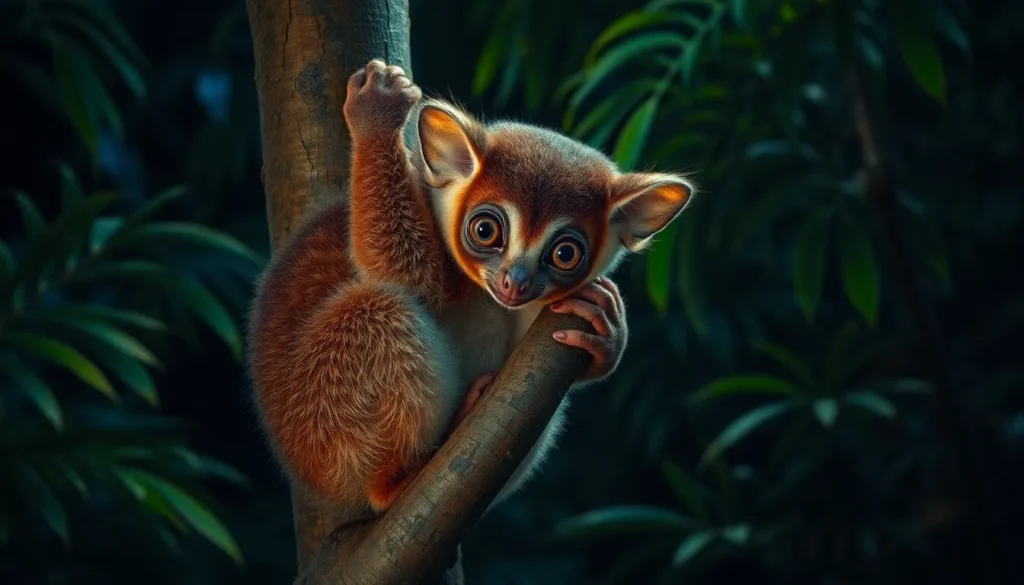
- Lorises are nocturnal primates. They are active primarily at night, which helps them avoid predators and conserve energy in tropical forests.
- They belong to the family Lorisidae. This family includes slow lorises, slender lorises, and angwantibos, all of which share similar traits.
- Lorises have a slow and deliberate mode of locomotion. Their slow movement helps them remain unnoticed by predators and prey.
- They possess a specialized blood toxin. Some loris species produce a toxin from glands on their arms that becomes venomous when mixed with their saliva.
- Lorises have a strong grasping ability. Their hands and feet are adapted for gripping branches tightly, aiding in their arboreal lifestyle.
- They have large, forward-facing eyes. This adaptation enhances their night vision and depth perception for navigating in darkness.
- Their diet is omnivorous. Lorises eat insects, small animals, fruits, gums, and nectar.
- Lorises are generally solitary animals. They tend to live alone or in small family groups and mark territories with scent glands.
- They communicate through vocalizations and scent marking. This helps establish territories and social bonds.
- Lorises have a low metabolic rate. This slow metabolism supports their energy-efficient lifestyle and slow movements.
- The slow loris has a unique grooming claw. This claw helps in fur maintenance and parasite removal.
- Their geographic distribution is mainly in Southeast Asia. Countries like Indonesia, Malaysia, Thailand, and Sri Lanka are home to various loris species.
- Lorises have a gestation period of about 6 months. Mothers usually give birth to one or two offspring at a time.
- Infant lorises cling to their mother’s fur. This behavior allows them to be transported safely through the trees.
- Lorises are threatened by habitat loss. Deforestation and human encroachment reduce their natural habitats.
- They are also victims of the illegal pet trade. Their slow movements make them easy targets, but they often suffer stress and health problems in captivity.
- Conservation efforts are underway for lorises. These include habitat protection, rescue centers, and public education campaigns.
- Lorises play a role in controlling insect populations. By feeding on insects, they help maintain ecological balance.
- They have been subjects of scientific research. Studies focus on their venom, behavior, and evolutionary biology.
- Lorises appear in cultural folklore. In some Southeast Asian cultures, they are featured in traditional stories and beliefs.
- Lorises exhibit slow reproductive rates. This makes population recovery challenging when numbers decline.
Habitat and Behavior
Lorises inhabit tropical and subtropical forests primarily in Southeast Asia, including countries such as Indonesia, Malaysia, Thailand, Vietnam, and Sri Lanka. They are arboreal, spending most of their time in trees where dense foliage provides shelter and food resources. Their slow, deliberate movements help them avoid detection by predators like snakes, birds of prey, and carnivorous mammals. Lorises are generally solitary, marking territories with scent glands and communicating through soft vocalizations. Their diet includes insects, small vertebrates, fruits, tree gum, and nectar, making them omnivores with flexible feeding habits. Nocturnality is a key behavioral trait, enabling them to exploit nighttime niches and avoid daytime predators.
Why This Animal Matters
Lorises contribute to forest ecosystems by controlling insect populations and aiding in seed dispersal through fruit consumption. Their presence is an indicator of healthy forest environments. Culturally, lorises have significance in some Southeast Asian societies, appearing in folklore and traditional beliefs. From a conservation perspective, lorises face threats from habitat destruction and illegal wildlife trade, making them important species for conservation programs. Their unique venomous defense mechanism and slow lifestyle offer valuable insights into primate evolution and adaptation. Protecting lorises helps preserve biodiversity and forest health in their native regions.
Common Misconceptions
Misconception: Lorises are harmless and cannot bite.
Correction: Some loris species have venomous saliva that can cause allergic reactions and serious wounds, so their bite can be harmful.
Misconception: Lorises make good pets because they are cute and slow-moving.
Correction: Lorises are wild animals with complex needs, and keeping them as pets often harms them and contributes to illegal wildlife trade.
Misconception: All lorises are the same species.
Correction: There are multiple species of lorises with distinct characteristics, including slow lorises, slender lorises, and angwantibos.
FAQ
Are lorises venomous?
Yes, some loris species produce a toxin from a gland on their arm that becomes venomous when mixed with their saliva, which they can use for defense.
Why are lorises so slow?
Lorises have evolved slow, deliberate movements as a strategy to avoid detection by predators and to stealthily capture prey, conserving energy in the process.
Can lorises be kept as pets?
Keeping lorises as pets is harmful and illegal in many places. They have complex dietary and environmental needs, and the pet trade contributes to their population decline.





Leave a Reply