
Short Answer
21 Facts About Howler Monkeys
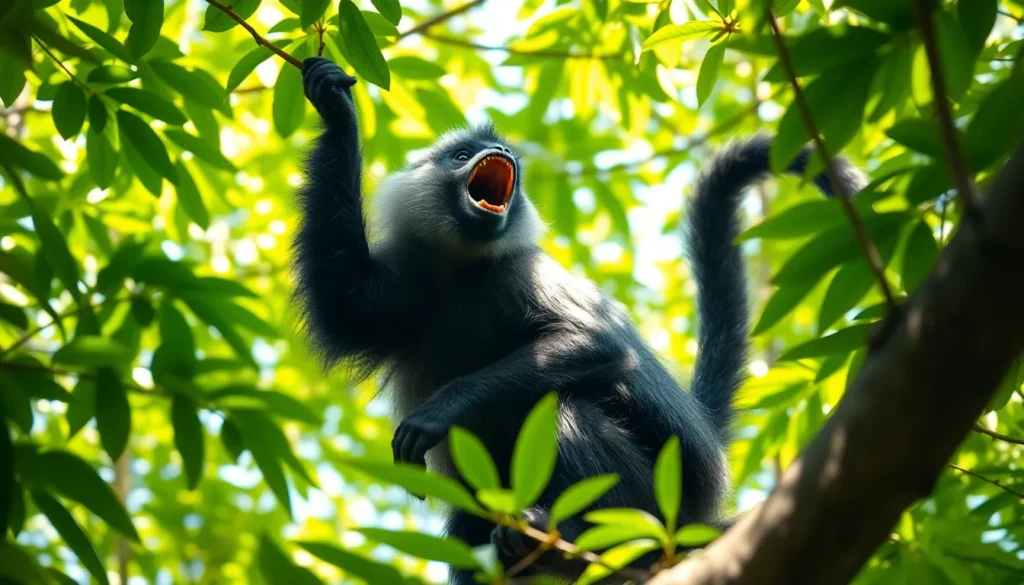
- Howler monkeys are among the loudest land animals. Their calls can be heard up to three miles (5 km) through dense forest, serving to mark territory and communicate with groups.
- They belong to the genus Alouatta. This genus includes several species distributed mainly across Central and South America.
- Howler monkeys have an enlarged hyoid bone. This adaptation amplifies their vocalizations, enabling their characteristic howls.
- They are primarily folivores. Their diet mainly consists of leaves, although they also consume fruits, flowers, and nuts.
- Howler monkeys are arboreal and diurnal. They live and move mostly in the forest canopy during daylight hours.
- They have prehensile tails. These tails act as a fifth limb, aiding in climbing and stability in the trees.
- Group size varies by species. Groups typically range from 6 to 15 individuals, including males, females, and offspring.
- Howler monkeys use their howls to defend territory. Vocalizations reduce physical confrontations by warning rival groups to stay away.
- Their social structure is usually polygynous. One dominant male often mates with several females within a group.
- They have a slow metabolism. This helps them digest their leafy diet efficiently and conserve energy.
- Infants cling to their mothers for several months. This extended care is vital for learning survival skills.
- Howler monkeys’ fur color varies. Depending on the species, they can be black, brown, or reddish.
- Their vocal cords are unique among primates. Enlarged vocal folds enable their powerful howling sounds.
- Howler monkeys have relatively large bodies. Adults can weigh between 4.5 to 9 kg (10 to 20 pounds).
- They are important seed dispersers. By eating fruits and excreting seeds, they help maintain forest diversity.
- Predators include big cats and birds of prey. Their loud calls can sometimes alert predators to their presence.
- Howler monkeys face threats from habitat loss. Deforestation and human encroachment reduce their living areas.
- They communicate using a variety of sounds besides howls. These include grunts, barks, and roars for different social interactions.
- Howler monkeys are classified in the family Atelidae. This family includes other New World monkeys with prehensile tails.
- They have an important role in indigenous cultures. Some cultures regard their howls as spiritual or symbolic sounds.
- Conservation status varies by species. Some howler monkey species are considered of least concern, while others are threatened or endangered.
Habitat and Behavior
Howler monkeys inhabit tropical and subtropical forests ranging from southern Mexico through Central America to northern Argentina. They primarily dwell in the upper canopy of dense forests, where they use their strong limbs and prehensile tails to navigate the trees. Their loud vocalizations serve to communicate across large distances, helping to establish and maintain territory boundaries without direct physical conflict. Howler monkeys live in social groups that typically include one dominant male, several females, and their offspring. Their diet consists mainly of leaves, supplemented by fruits and flowers, which influences their slow metabolic rate and largely sedentary lifestyle. They are active during the day (diurnal) and rest extensively to conserve energy.
Why This Animal Matters
Howler monkeys contribute significantly to the ecology of tropical forests as seed dispersers and herbivores, promoting forest regeneration and plant diversity. Their presence indicates healthy forest ecosystems. Ecologically, their loud calls also influence the behavior and distribution of other forest animals. Culturally, howler monkeys hold various symbolic meanings for indigenous peoples and local communities in their native ranges. Conservation of howler monkeys is important as they face habitat destruction, hunting, and fragmentation, which threaten their populations and the broader biodiversity of the forests they inhabit.
Common Misconceptions
Misconception: Howler monkeys are aggressive and dangerous to humans.
Correction: Howler monkeys are generally shy and avoid human contact. Their loud calls are territorial warnings directed at other monkeys, not humans.
Misconception: The loud howls are made by the entire group simultaneously.
Correction: Usually, one or a few males produce the howling to communicate group presence and territory boundaries.
FAQ
Why do howler monkeys howl so loudly?
Howler monkeys howl to communicate with other groups and defend their territory without engaging in physical conflict. Their enlarged vocal apparatus allows their calls to travel long distances in dense forests.
What do howler monkeys eat?
They primarily eat leaves but also consume fruits, flowers, and nuts depending on availability. Their diet is mainly folivorous, which requires a slow metabolism to digest.
Are howler monkeys endangered?
The conservation status varies among howler monkey species. Some are listed as least concern, while others face threats from habitat loss and hunting, making certain species endangered or vulnerable.






Leave a Reply