
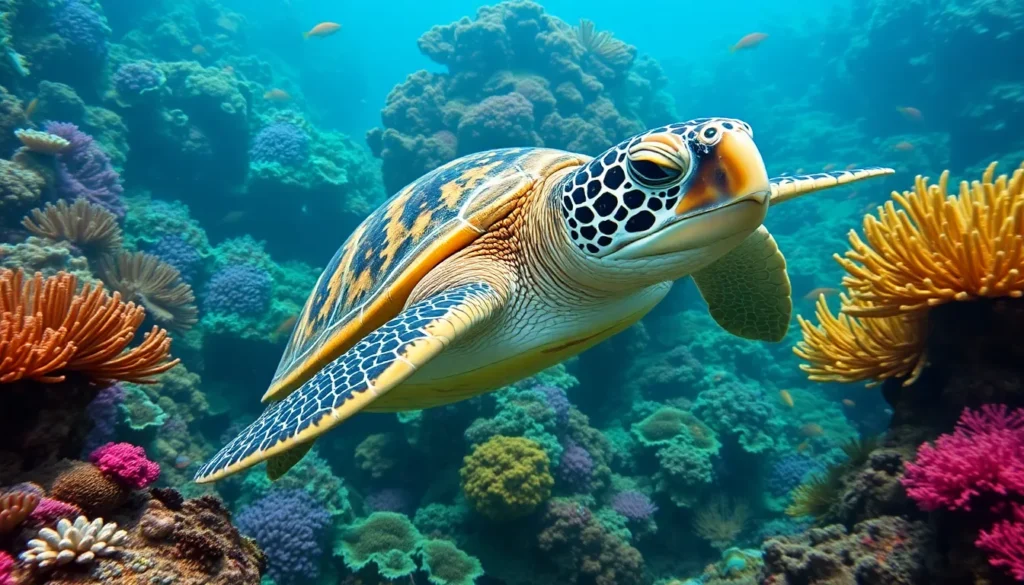
Short Answer
21 Facts About Hawksbill Turtles
- Distinctive Shell Pattern: Hawksbill turtles have a unique, overlapping scute pattern on their shells, often featuring vibrant colors and a serrated edge, making them easily recognizable among sea turtles.
- Scientific Name: Their scientific name is Eretmochelys imbricata, reflecting the overlapping nature of their scutes (imbricate means overlapping).
- Critically Endangered Status: Hawksbill turtles are classified as critically endangered by the International Union for Conservation of Nature (IUCN) due to habitat loss, poaching, and bycatch.
- Primary Habitat: They primarily inhabit tropical coral reefs, where they play an important role in maintaining reef health.
- Diet Specialization: Hawksbills are spongivores, feeding mainly on sea sponges, which few other marine animals consume.
- Beak Shape: Their narrow, pointed beak resembles that of a hawk, an adaptation that helps them extract sponges and other invertebrates from crevices.
- Longevity: Hawksbill turtles can live up to 30-50 years in the wild, although exact lifespan data is limited.
- Nesting Behavior: Females return to the same beaches where they were born to lay eggs, a behavior known as natal homing.
- Reproductive Cycle: Females lay multiple clutches of about 140 eggs per season, with incubation lasting around 60 days.
- Temperature-Dependent Sex Determination: The sex of hatchlings is determined by nest temperature, with warmer nests producing more females.
- Migration Patterns: Hawksbills migrate long distances between feeding and nesting grounds, sometimes crossing entire ocean basins.
- Threats from Illegal Trade: Their shells have historically been used for ‘tortoiseshell’ jewelry and ornaments, leading to heavy exploitation.
- Bycatch Risks: Hawksbills are frequently caught unintentionally in fishing gear such as nets and longlines, contributing to population declines.
- Role in Coral Reef Health: By feeding on sponges, hawksbills help prevent sponges from overgrowing corals, thus promoting reef biodiversity.
- Slow Maturation: They reach sexual maturity relatively late, often taking 20-35 years, which affects their population recovery rate.
- Unique Shell Composition: Their shells are composed of keratin overlaid on bone, with scutes made of a material that can refract light, producing iridescence.
- Adaptation to Warm Waters: Hawksbills prefer warm tropical and subtropical waters, generally found at depths up to 30 meters.
- Solitary Lifestyle: Unlike some sea turtles, hawksbills are mostly solitary except during mating and nesting seasons.
- Conservation Efforts: Several international agreements, including CITES, protect hawksbill turtles, alongside local conservation initiatives for nesting beaches.
- Indicator Species: Their health and population trends serve as indicators of coral reef ecosystem integrity.
- Unique Hatchling Behavior: Hawksbill hatchlings emerge at night to avoid predators and instinctively move toward the brightest horizon, usually the ocean.
Habitat and Behavior
Hawksbill turtles are primarily found in tropical and subtropical marine environments, with a strong preference for coral reef habitats, rocky areas, lagoons, and shallow coastal waters. These environments provide abundant food sources, especially sponges, and shelter. Hawksbills are mostly solitary creatures, interacting mainly during mating and nesting periods. They exhibit long-distance migrations between feeding grounds and natal nesting beaches, demonstrating strong site fidelity for reproduction. Their diet is highly specialized, allowing them to exploit ecological niches that few other marine species can occupy. Their unique beak and shell adaptations aid in their survival within complex reef systems.
Why This Animal Matters
The hawksbill turtle fulfills a critical ecological role as a sponge predator, helping maintain the balance and health of coral reef ecosystems. By controlling sponge populations, they prevent sponges from overwhelming corals, which supports biodiversity and reef resilience. Culturally, hawksbill turtles have been significant in many coastal human communities, historically valued for their shells and as a food source. Conservation-wise, hawksbills are considered an important flagship species for marine protection efforts, symbolizing the challenges of marine biodiversity loss due to human activities. Protecting hawksbills also helps safeguard coral reefs, which provide ecosystem services such as coastal protection, fisheries, and tourism benefits.
Common Misconceptions
Misconception: Hawksbill turtles are not endangered because they are widespread.
Correction: Despite a wide distribution across tropical oceans, hawksbill turtle populations have declined drastically, and they are classified as critically endangered due to threats such as poaching and habitat loss.
Misconception: Hawksbill turtles only eat coral.
Correction: Hawksbills primarily feed on sponges and other invertebrates, not coral itself. Their diet helps protect coral reefs by controlling sponge growth.
Misconception: All sea turtles have the same nesting habits.
Correction: While many sea turtles show natal homing, hawksbill turtles have specific nesting preferences, often choosing remote sandy beaches near coral reefs and exhibiting particular nesting periodicity.
FAQ
Why are hawksbill turtles critically endangered?
Hawksbill turtles face threats such as illegal poaching for their shells, habitat destruction, bycatch in fishing gear, and climate change impacts on nesting sites, leading to their critically endangered status.
What do hawksbill turtles eat?
Hawksbill turtles primarily feed on sea sponges, but their diet can also include algae, anemones, and other small invertebrates found in coral reefs.
How do hawksbill turtles reproduce?
Female hawksbill turtles return to their natal beaches to lay eggs. They dig nests in sandy beaches, laying multiple clutches per season, with incubation periods influenced by temperature which determines hatchling sex.

Leave a Reply