
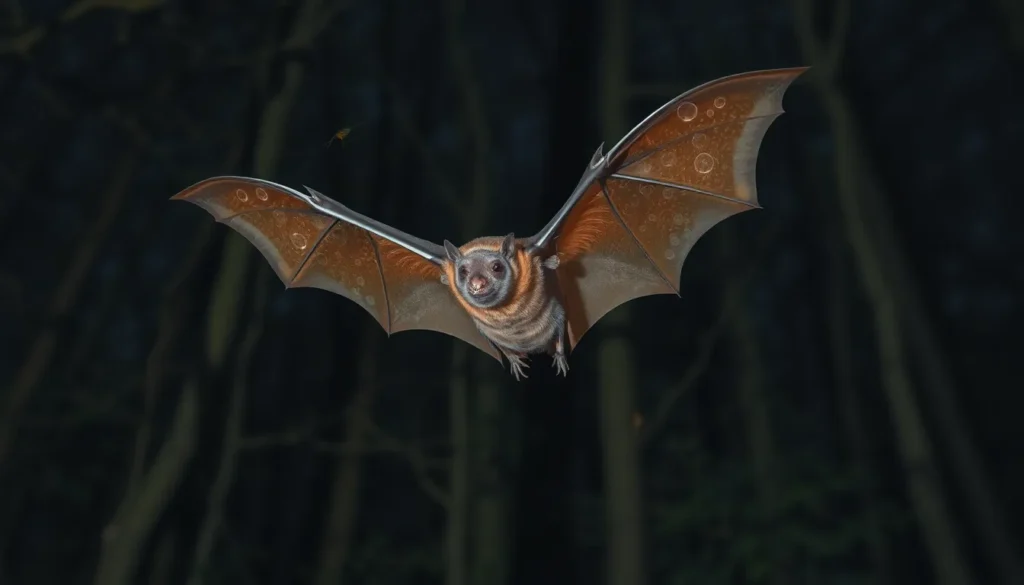
Short Answer
21 Facts About Bat Echolocation
- Bats use echolocation to navigate in the dark. They emit ultrasonic sounds that bounce off objects and return as echoes, allowing them to form mental maps of their surroundings even in complete darkness.
- Ultrasonic calls are beyond human hearing. Bat echolocation calls usually range from 20 kHz to 200 kHz, frequencies much higher than the human audible range of 20 Hz to 20 kHz.
- Echolocation calls vary by species. Different bat species produce unique call patterns, frequencies, and durations adapted to their specific hunting environments and prey types.
- Most insectivorous bats use echolocation. Echolocation is primarily used by bats that hunt flying insects, enabling precise prey detection and capture mid-flight.
- Some bats combine echolocation with vision. While echolocation is their primary sensory tool in darkness, many bats also rely on vision during twilight or in illuminated environments.
- Echolocation calls are produced through the larynx. Bats generate their echolocation sounds by pushing air through the vocal cords in the larynx, not by clicking their tongues or other means.
- Bats possess specialized ear structures. Their large, highly sensitive ears are adapted to detect returning echoes with great precision, enabling detailed spatial perception.
- Flight and echolocation are coordinated. Bats adjust their call rate and intensity based on flight speed and proximity to objects, increasing call repetition when approaching prey or obstacles.
- Some bats use constant frequency calls. Species such as horseshoe bats emit calls with a narrow frequency band, which helps detect the fluttering of insect wings through Doppler shifts.
- Others use frequency-modulated calls. These calls sweep through a range of frequencies, providing detailed information about object distance and size.
- Bats can discriminate between different prey types. Echolocation allows them to identify prey species by analyzing the echoes reflected from the prey’s size, shape, and movement.
- Echolocation is effective in cluttered environments. Bats hunting in dense vegetation use short, broadband calls to avoid echo overlap and better detect prey among obstacles.
- Some bats adjust call intensity to avoid detection. Certain species reduce call loudness to minimize detection by prey that can hear ultrasonic sounds, such as moths.
- Bat echolocation calls can be recorded and studied. Scientists use specialized ultrasonic microphones and recording equipment to analyze bat calls for research and conservation.
- Bats can interpret echo delays to gauge distance. The time between call emission and echo return allows bats to calculate the range to objects with remarkable accuracy.
- Echolocation aids in social communication. Besides navigation and hunting, some bats use echolocation calls for social interactions within colonies.
- Juvenile bats learn echolocation calls. Young bats develop their echolocation abilities through practice and interaction with adults, refining their call structures over time.
- Echolocation is energy-intensive. Producing high-frequency calls requires significant metabolic energy, influencing bats’ foraging behavior and rest periods.
- Not all bats echolocate. Fruit bats (family Pteropodidae) generally do not use echolocation, relying more on vision and smell for navigation and foraging.
- Bat echolocation has inspired technology. The principles of bat sonar have influenced human-made sonar and radar systems used in navigation and object detection.
- Echolocation is a remarkable example of convergent evolution. Other animals such as dolphins and certain birds have independently evolved echolocation abilities to navigate and hunt.
Habitat and Behavior
Bats inhabit diverse environments worldwide, ranging from tropical rainforests and deserts to urban areas. Echolocation enables them to forage efficiently in complete darkness, exploiting ecological niches unavailable to many other predators. They typically emerge at dusk or night, using their sonar abilities to locate insects, avoid obstacles, and navigate through complex landscapes such as dense forests or caves. Different species have adapted their echolocation calls to suit open spaces, cluttered environments, or water surfaces. Echolocation also assists bats in social behaviors, such as coordinating group movements or identifying roosting sites. These adaptations have made bats one of the most successful nocturnal mammals globally.
Why This Animal Matters
Bats play crucial ecological roles as insect predators, helping control pest populations that affect agriculture and human health. Their echolocation abilities enable them to hunt effectively, maintaining balanced ecosystems. Beyond ecology, bats hold cultural significance in many societies, symbolizing mystery or luck. Conservation of bats is important, as many species face threats from habitat loss, disease, and human disturbance. Understanding echolocation informs conservation strategies and helps mitigate human-wildlife conflicts. Additionally, bat echolocation has inspired biomimetic technologies in navigation and detection, demonstrating its broader scientific and practical relevance.
Common Misconceptions
Misconception: All bats are blind.
Correction: Contrary to popular belief, most bats have functional eyes and can see. Echolocation complements their vision and is particularly useful in darkness.
Misconception: Echolocation calls are audible to humans.
Correction: Bat echolocation calls are mostly ultrasonic and typically beyond the hearing range of humans, so they cannot be heard without special equipment.
Misconception: All bats use echolocation.
Correction: While many bats echolocate, some species, especially fruit bats, rely primarily on vision and smell rather than echolocation for navigation and foraging.
Misconception: Echolocation is simple clicking sounds.
Correction: Bat echolocation involves complex ultrasonic vocalizations with varying frequencies, durations, and patterns tailored to different environments and prey.
Misconception: Echolocation is unique to bats.
Correction: Echolocation has evolved independently in multiple animal groups, including dolphins, certain birds, and shrews.
FAQ
How do bats produce echolocation sounds?
Bats produce echolocation calls by forcing air through their larynx, where vocal cords create ultrasonic sounds. These calls are then emitted through the mouth or nose, depending on the species.
Can humans hear bat echolocation calls?
Generally, no. Bat echolocation calls are mostly ultrasonic, with frequencies above 20 kHz, which are beyond the range of human hearing. Specialized equipment is required to detect these calls.
Do all bats use echolocation?
No. While most insectivorous bats use echolocation, many fruit bats (family Pteropodidae) do not echolocate and instead rely on vision and smell for navigation and finding food.






Leave a Reply