
Short Answer
21 Facts About Chambered Nautilus
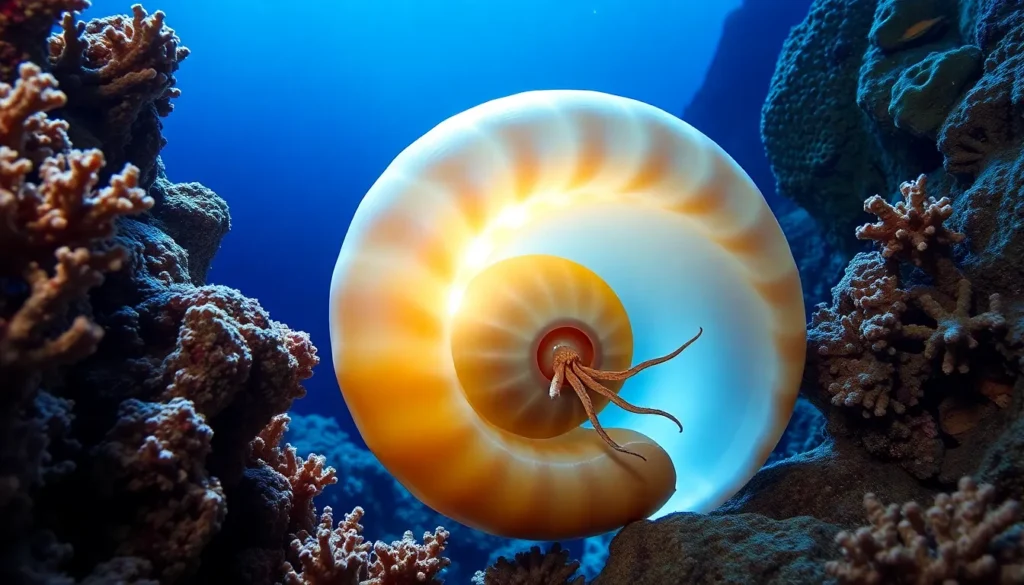
- Ancient Lineage: The chambered nautilus is often referred to as a “living fossil” due to its minimal evolutionary changes over approximately 500 million years.
- Distinctive Shell: It possesses a coiled, chambered shell that provides buoyancy and protection.
- Buoyancy Control: The animal controls its buoyancy by regulating gas and fluid within the shell chambers, allowing it to navigate different ocean depths.
- Multiple Tentacles: Unlike other cephalopods, the nautilus has up to 90 small, suckerless tentacles used for capturing prey and sensing the environment.
- Simple Eye Structure: Its eyes lack lenses and function more like pinhole cameras, relying on light sensitivity rather than sharp focus.
- Slow Movement: The nautilus moves by jet propulsion, expelling water through a siphon, but generally travels slowly compared to other cephalopods.
- No Ink Sac: Unlike squids and octopuses, the chambered nautilus lacks an ink sac for defense.
- Nocturnal Behavior: It is primarily active at night, retreating to deeper waters during the day.
- Diet: The nautilus feeds on crustaceans, small fish, and carrion, capturing food with its numerous tentacles.
- Shell Growth: As it grows, the nautilus creates new, larger chambers and seals off the older ones.
- Shell Composition: Its shell is composed mainly of aragonite, a crystalline form of calcium carbonate.
- Habitat Range: Chambered nautiluses are found mainly in the Indo-Pacific region, including waters around Australia, Fiji, and the Philippines.
- Depth Range: They inhabit depths typically between 100 and 500 meters but can move to shallower waters at night.
- Longevity: Nautiluses can live up to 20 years in the wild.
- Reproduction: They reproduce by laying eggs, which have a long incubation period, sometimes up to a year.
- Slow Growth Rate: The nautilus grows slowly, reaching maturity only after 15 years or more.
- Conservation Status: Some species of nautilus are considered vulnerable due to overfishing for their shells.
- Shell Use by Humans: Their shells are often collected for ornamental purposes, contributing to population pressures.
- Unique Locomotion: The nautilus can adjust its orientation by using its tentacles and jet propulsion in combination.
- Ecological Role: As scavengers and predators, they help maintain balance in reef ecosystems.
- Scientific Interest: Their ancient lineage and unique physiology make them valuable subjects for evolutionary and marine biology studies.
Habitat and Behavior
The chambered nautilus inhabits the deep slopes of coral reefs in the Indo-Pacific region, typically ranging from 100 to 500 meters in depth. During the day, it stays in deeper, darker waters to avoid predators and moves to shallower waters at night to feed. Its slow movement is facilitated by jet propulsion, expelling water through a siphon, and it uses numerous tentacles to grasp prey and navigate. The nautilus primarily feeds on crustaceans, small fish, and carrion, employing its tentacles to capture food. Its buoyancy control system, via gas-filled chambers in its shell, allows it to ascend or descend efficiently. Reproduction involves laying eggs that develop over an extended period, and juveniles hatch fully formed but small. The chambered nautilus is a solitary animal with no known schooling behavior.
Why This Animal Matters
The chambered nautilus plays a significant ecological role as both predator and scavenger in coral reef ecosystems, helping maintain the health and balance of marine environments. Its unique shell and ancient evolutionary lineage provide important insights into cephalopod evolution and marine biodiversity. Additionally, the nautilus shell has cultural and scientific value, often symbolizing natural beauty and mathematical principles such as the logarithmic spiral. Conservation concerns have arisen due to overharvesting for the ornamental shell trade, highlighting the need for sustainable practices to preserve wild populations. Studying the chambered nautilus also contributes to understanding how marine species adapt to deep-water habitats and changing ocean conditions.
Common Misconceptions
Misconception: The chambered nautilus is a type of octopus.
Correction: The chambered nautilus is a cephalopod but belongs to a different subclass (Nautiloidea) than octopuses (Octopoda), with distinct anatomical and behavioral traits.
Misconception: The nautilus uses ink to escape predators.
Correction: Unlike squids and octopuses, the chambered nautilus lacks an ink sac and relies on retreating to deeper waters and its hard shell for protection.
Misconception: The nautilus shell is a perfect mathematical spiral.
Correction: While the shell’s growth approximates a logarithmic spiral, it is not a mathematically perfect form but a natural growth pattern.
Misconception: Nautiluses are fast swimmers.
Correction: Nautiluses are relatively slow-moving, using gentle jet propulsion and limited muscle strength compared to other cephalopods.
FAQ
How does the chambered nautilus control its buoyancy?
The chambered nautilus controls buoyancy by regulating the gas and fluid within the chambers of its shell. It adjusts the volume of gas inside these chambers to ascend or descend in the water column.
Why is the chambered nautilus called a living fossil?
It is called a living fossil because it has remained morphologically similar for hundreds of millions of years, showing minimal evolutionary change compared to its ancient ancestors.
What threats face the chambered nautilus today?
The main threats include overfishing and collection for their decorative shells, habitat disturbance, and possible impacts from climate change, leading to vulnerable conservation status in some regions.

Leave a Reply