
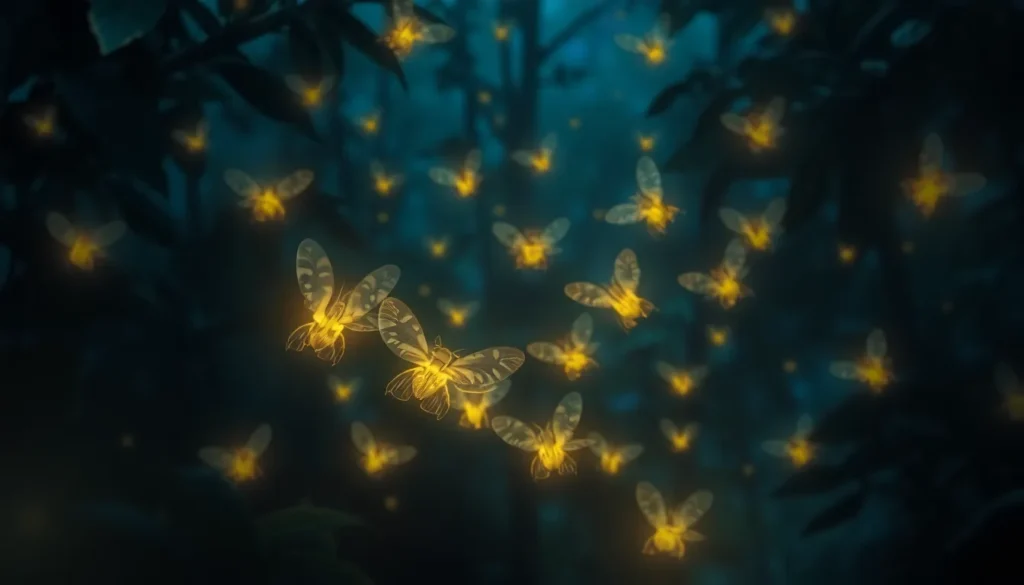
Short Answer
21 Facts About Fireflies
- Fireflies are beetles: Despite their name, fireflies belong to the beetle family Lampyridae, not flies.
- They produce light through bioluminescence: Fireflies generate light via a chemical reaction in organs called lanterns, using luciferin, luciferase, ATP, and oxygen.
- Light is used for communication: The flashing patterns of fireflies serve primarily to attract mates and facilitate species recognition.
- There are over 2,000 species worldwide: Fireflies are found on every continent except Antarctica, with diverse species exhibiting different flash patterns.
- Some species synchronize their flashes: In certain regions, groups of fireflies flash in unison, a rare natural phenomenon.
- Both larvae and adults can produce light: In many species, the larval stage glows, often serving as a warning to predators.
- Firefly larvae are predatory: They feed on small invertebrates, including snails and worms, using digestive enzymes to immobilize prey.
- Adult fireflies have varied diets: While some adults feed on nectar or pollen, others do not eat at all during their brief adult life.
- Fireflies are mostly nocturnal: Their bioluminescence is most effective in low light conditions during dusk or night.
- Different species have unique flash patterns: Species identification often depends on the timing and pattern of flashes.
- Fireflies prefer warm, humid environments: They are commonly found in forests, fields, wetlands, and gardens.
- Light production is energy efficient: The chemical reaction producing light generates very little heat, making it a ‘cold light.’
- Fireflies have inspired scientific research: Their bioluminescence mechanism has applications in medical and environmental fields.
- Light pollution threatens fireflies: Artificial lighting can disrupt firefly communication and mating.
- Some firefly species are endangered: Habitat loss, pollution, and climate change contribute to declining populations.
- Fireflies play a role in ecosystems: They serve as both predator and prey in their habitats, contributing to ecological balance.
- Fireflies have cultural significance: They appear in folklore, literature, and art worldwide as symbols of light and mystery.
- Firefly flashes can be mimicked: Some predatory fireflies imitate the flashes of other species to lure and prey on them.
- Fireflies have a short adult lifespan: Adults often live only a few weeks, focusing on reproduction.
- Firefly larvae can glow underwater: Some aquatic larvae emit light to deter predators or attract prey.
- Fireflies are indicators of environmental health: Their presence often reflects the quality of their habitat and ecosystem integrity.
Habitat and Behavior
Fireflies inhabit a variety of environments, primarily warm and humid areas such as forests, meadows, wetlands, and gardens. They tend to be most active during the evening and nighttime hours, when their bioluminescent signals are most visible. Fireflies use their light primarily for mating communication, with each species having distinct flash patterns to identify potential partners. Larvae typically live in moist soil or leaf litter where they hunt small invertebrates. Adult fireflies may feed on nectar, pollen, or in some cases, not at all, dedicating their brief lifespan to reproduction. Fireflies are sensitive to environmental changes and rely on dark, undisturbed habitats to successfully complete their life cycles.
Why This Animal Matters
Fireflies contribute to ecosystems as both predators and prey, helping regulate populations of smaller invertebrates and providing food for birds, amphibians, and other animals. Their unique bioluminescence has advanced scientific understanding of biological light production and has led to innovations in medical diagnostics and environmental monitoring. Culturally, fireflies have inspired human imagination in folklore, art, and literature, symbolizing wonder and natural beauty. Due to threats such as habitat destruction, light pollution, and climate change, fireflies are increasingly important indicators of environmental health, prompting conservation efforts worldwide.
Common Misconceptions
Misconception: Fireflies are flies.
Correction: Fireflies are actually beetles, belonging to the family Lampyridae, not true flies.
Misconception: All fireflies produce light.
Correction: While most fireflies are bioluminescent, some species do not produce light as adults.
Misconception: Fireflies produce light to scare predators.
Correction: The primary function of firefly light is for mating communication, although larvae use light as a warning signal.
Misconception: Fireflies can be kept as pets to produce light indefinitely.
Correction: Fireflies have a short adult lifespan and specific habitat requirements; they do not produce light indefinitely in captivity.
Misconception: Firefly light is hot.
Correction: Firefly light is a form of cold light, generated through a chemical reaction that produces very little heat.
FAQ
What causes fireflies to glow?
Fireflies glow due to a chemical reaction in specialized light-emitting organs involving luciferin, luciferase, ATP, and oxygen, producing bioluminescence.
Why do fireflies flash their lights?
Fireflies use their flashing lights primarily to attract mates and communicate species-specific signals, ensuring reproductive success.
Are fireflies endangered?
Some firefly species are experiencing population declines due to habitat loss, pollution, and light pollution, leading to concerns about their conservation status.




Leave a Reply