
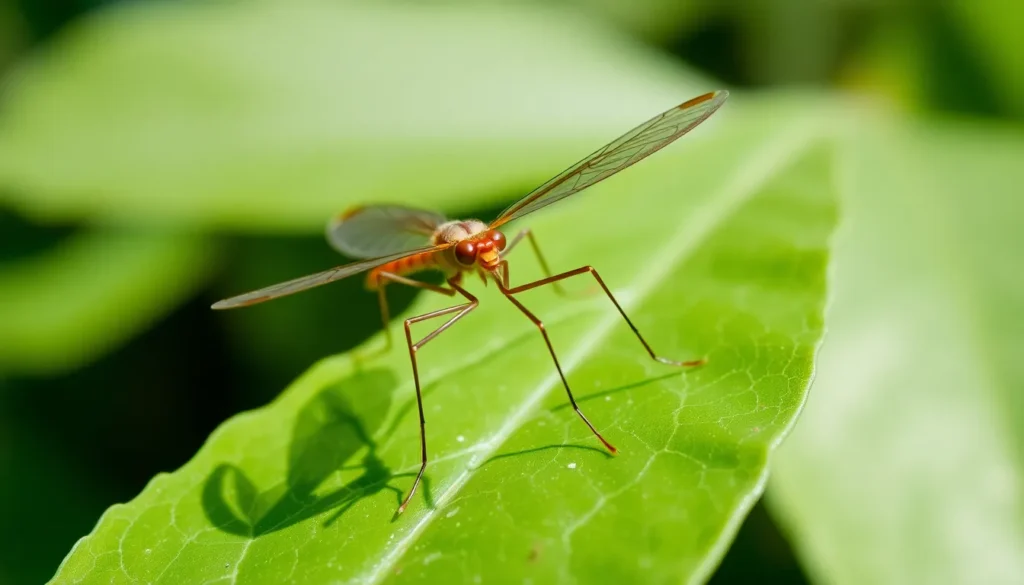
Short Answer
21 Facts About Crane Flies
- Not True Mosquitoes: Although crane flies resemble giant mosquitoes, they do not bite humans and belong to a different family, Tipulidae.
- Varied Species: There are over 15,000 species of crane flies worldwide, making them one of the most diverse families of flies.
- Long Legs: Crane flies are known for their notably long and slender legs, which can be easily detached as a defense mechanism.
- Short Adult Lifespan: Adult crane flies typically live only a few days to a week, mainly to mate and lay eggs.
- Larval Stage: The larvae, often called leatherjackets, live in moist soil or water and can feed on plant roots or decaying organic matter.
- Size Variation: Adult crane flies vary in size, with wingspans ranging from 7 mm to over 60 mm depending on the species.
- Non-Feeding Adults: Many adult crane flies do not feed at all, surviving solely on the energy stored from their larval stage.
- Flight Behavior: Crane flies have a distinctive weak and clumsy flight, often seen hovering near vegetation or water bodies.
- Global Distribution: Crane flies are found on every continent except Antarctica, thriving in a variety of climates and habitats.
- Ecological Role of Larvae: The larvae contribute to nutrient cycling by breaking down organic material in soil and water.
- Predators: Crane flies serve as prey for birds, spiders, amphibians, and other insectivores, forming an important part of food webs.
- Reproductive Behavior: Mating typically occurs shortly after adults emerge, with females laying eggs in moist environments.
- Flight Timing: Many crane fly species are most active during dusk or nighttime.
- Anatomical Features: Crane flies possess a V-shaped suture on the thorax, a characteristic used to differentiate them from other fly families.
- Species Identification: Identification is often based on wing venation patterns, body size, and antennal structure.
- Larval Damage: Some crane fly larvae can damage turfgrass and crops by feeding on roots, though damage is usually localized.
- Natural Control: Parasitoid wasps and nematodes can naturally control crane fly populations.
- Flight Muscles: Despite their weak flight, crane flies have well-developed indirect flight muscles.
- Historical Study: Crane flies have been studied since the 18th century, contributing to entomological taxonomy.
- Cultural References: They are sometimes called “daddy longlegs” in North America, though this name also applies to other unrelated arthropods.
- Importance in Research: Some species are used as bioindicators of wetland health due to their sensitivity to environmental changes.
Habitat and Behavior
Crane flies inhabit a wide range of environments, including wetlands, forests, grasslands, and urban areas. The larvae typically reside in moist soil, leaf litter, or aquatic habitats where they feed on decaying plant material or roots. Adults are mostly found near these larval habitats and are active during cooler periods of the day such as dusk. Crane flies do not bite or sting; their primary adult behavior is mating and egg laying. Their flight is generally slow and erratic, making them easy to recognize. Larvae can influence soil quality and plant health by their feeding habits, while adults provide a food source for various predators.
Why This Animal Matters
Crane flies play crucial ecological roles in nutrient recycling and as prey for many animals. Their larvae contribute to soil aeration and organic matter decomposition, enhancing soil fertility. Due to their sensitivity to environmental changes, certain crane fly species serve as bioindicators for ecosystem health, especially in wetlands. Although some larvae may cause minor damage to turfgrass or crops, they are generally not considered major pests. Understanding crane flies contributes to broader knowledge of insect biodiversity and ecosystem dynamics.
Common Misconceptions
Misconception: Crane flies are giant mosquitoes that bite humans.
Correction: Crane flies do not bite or sting; they lack the mouthparts necessary for biting and feed primarily as larvae.
Misconception: Crane flies are dangerous or harmful pests.
Correction: Most crane flies do not cause significant harm; while some larvae feed on roots, damage is usually limited and not widespread.
Misconception: The term “daddy longlegs” refers only to crane flies.
Correction: “Daddy longlegs” is a common name applied to crane flies, certain spiders, and harvestmen, which are taxonomically distinct groups.
FAQ
Do crane flies bite or sting humans?
No, crane flies do not bite or sting humans. They lack the mouthparts necessary for biting and are harmless to people.
What do crane fly larvae eat?
Crane fly larvae, known as leatherjackets, primarily feed on decaying organic matter, plant roots, and sometimes algae, depending on the species and habitat.
Why are crane flies important to the ecosystem?
Crane flies contribute to nutrient cycling through their larvae's decomposition of organic material and serve as an important food source for a variety of predators, supporting biodiversity.


Leave a Reply