
Short Answer
21 Facts About Sand Cats
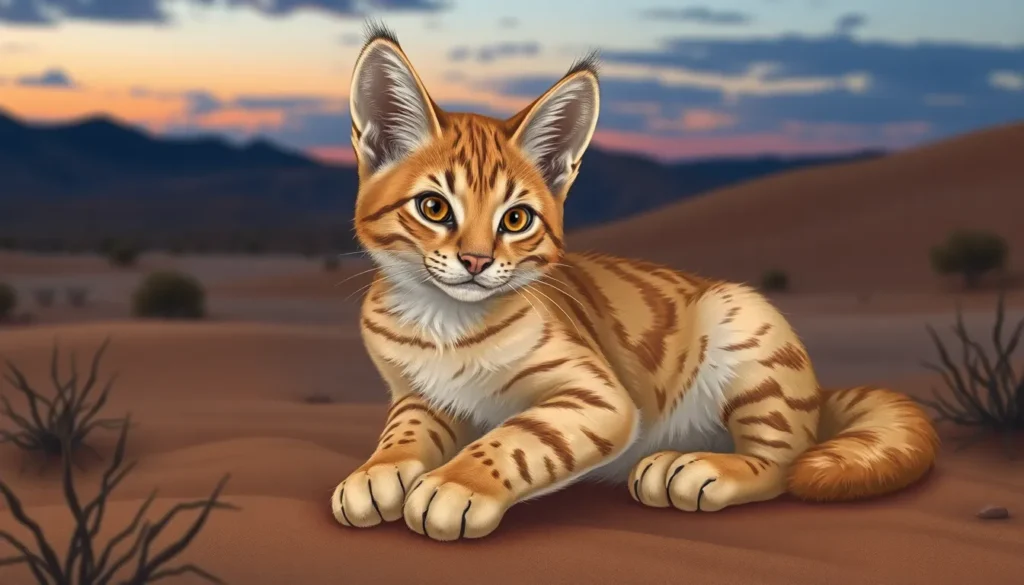
- Smallest wild cat in their range. Sand cats (Felis margarita) are among the smallest wild cats, measuring about 39 to 52 cm in body length, excluding the tail.
- Adapted to desert life. They inhabit sandy and stony deserts in North Africa, the Middle East, and Central Asia, showing remarkable adaptations to arid environments.
- Thick fur on feet. Their paws have dense fur that protects them from hot sand and helps with silent movement.
- Excellent hearing. Sand cats have large ears that enable them to detect prey underground.
- Primarily nocturnal. They are mostly active at night to avoid extreme daytime heat.
- Rarely drink water. They obtain moisture mainly from their prey, such as rodents, reptiles, and insects.
- Solitary animals. Sand cats live and hunt alone except during mating seasons.
- Distinctive facial markings. They have dark stripes on their faces and a light-colored coat that provides camouflage in desert surroundings.
- Short tail with a black tip. The tail is relatively short compared to other cats and ends with a black tip.
- Strong climbers. Despite living in deserts, sand cats can climb trees and shrubs when necessary.
- Reproductive cycle. Females typically give birth to 2-4 kittens after a gestation period of around 59-63 days.
- Communicate through scent marking. They use scent glands and urine to mark their territories.
- Excellent hunters. They can hunt prey that is larger than themselves due to agility and stealth.
- Conservation status. Classified as Least Concern by the IUCN but face threats from habitat degradation and human activities.
- Rarely seen by humans. Due to their elusive nature and remote habitats, sand cats are seldom observed in the wild.
- Can survive temperature extremes. Sand cats endure temperatures ranging from below freezing at night to over 50°C during the day.
- Distinct species within Felidae family. They belong to the genus Felis, which includes small wild cats like the domestic cat.
- Adapted kidneys. Their kidneys concentrate urine to minimize water loss in the arid environment.
- Historical significance. Named after French explorer Jean Auguste Margueritte, who first collected specimens.
- Captive breeding programs exist. Some zoos participate in breeding programs to study and conserve sand cats.
- Cultural symbolism. In some desert cultures, sand cats symbolize stealth and survival skills, though they are not commonly featured in folklore.
Habitat and Behavior
Sand cats inhabit arid desert regions characterized by sandy or rocky terrain with sparse vegetation. Their range spans parts of North Africa, the Arabian Peninsula, and Central Asia. They thrive in harsh climates with extreme temperature fluctuations, relying on their adaptations such as thick fur on paws to protect against hot sand and large ears to detect prey underground. Sand cats are solitary and nocturnal hunters, preying primarily on small rodents, lizards, and insects. They avoid daytime heat by resting in burrows or shaded areas. Their ability to survive with minimal water intake and withstand temperature extremes makes them uniquely suited to desert life.
Why This Animal Matters
Sand cats play an important ecological role as predators of small desert animals, helping to maintain the balance in fragile desert ecosystems. Their presence indicates a relatively healthy desert environment. While not as widely known as other wild cats, sand cats are valuable for understanding desert adaptations among mammals. Conservation efforts, including captive breeding and habitat protection, are significant because desert habitats face increasing threats from human encroachment, climate change, and resource extraction. Protecting sand cats contributes to preserving biodiversity in some of the world’s most challenging environments.
Common Misconceptions
Misconception: Sand cats are domesticated or related to house cats.
Correction: Although sand cats share a genus with domestic cats (Felis), they are wild animals with specialized adaptations for desert survival and are not domesticated.
Misconception: Sand cats drink large quantities of water like other animals.
Correction: Sand cats rarely drink water and obtain moisture mainly from their prey, an adaptation to scarce water availability in deserts.
Misconception: Sand cats are common and easy to spot in deserts.
Correction: Sand cats are elusive, nocturnal, and live in remote desert areas, making sightings extremely rare.
FAQ
Where do sand cats live?
Sand cats live in sandy and rocky deserts across North Africa, the Middle East, and Central Asia.
What do sand cats eat?
They primarily hunt small rodents, lizards, insects, and occasionally birds.
Are sand cats endangered?
Sand cats are currently classified as Least Concern by the IUCN but face threats from habitat loss and human activities.

Leave a Reply