
Short Answer
21 Facts About Coral Snakes
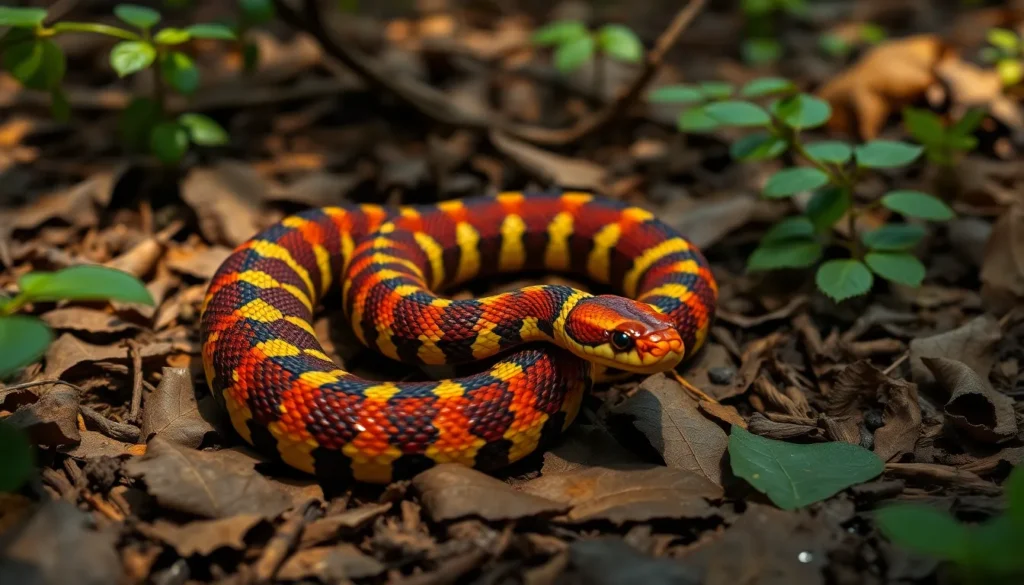
- Distinctive Color Pattern: Coral snakes are easily recognized by their vibrant red, yellow/white, and black banding, which serves as a warning to predators.
- Venomous Nature: They possess powerful neurotoxic venom, which affects the nervous system and can be fatal to humans if untreated.
- Elapidae Family: Coral snakes belong to the Elapidae family, which also includes cobras and mambas.
- Geographic Range: They are primarily found in the southeastern United States, Central America, and South America.
- Small Size: Most coral snakes are relatively small, typically ranging from 20 to 30 inches in length.
- Secretive Behavior: These snakes are generally shy and reclusive, often hiding under leaf litter or in burrows.
- Diet: Coral snakes mainly feed on smaller snakes, lizards, amphibians, and occasionally small rodents.
- Reproduction: They are oviparous, laying eggs rather than giving live birth.
- Mimicry: Some non-venomous snakes mimic the coloration of coral snakes as a form of protective mimicry, known as Batesian mimicry.
- Venom Delivery: Coral snakes have short, fixed front fangs that deliver venom efficiently despite their small size.
- Neurotoxic Venom Effects: Their venom primarily causes paralysis by interfering with nerve signals to muscles.
- Antivenom Availability: Effective antivenoms exist but may be limited in some regions, making timely medical treatment critical.
- Activity Patterns: Coral snakes are mostly nocturnal or crepuscular, active during twilight or night hours.
- Conservation Status: While many species are not considered endangered, habitat loss poses threats to some populations.
- Identification Challenges: Differentiating coral snakes from mimics can be difficult without close examination.
- Warning Colors: The bright colors serve as aposematic signals to deter predators from attacking.
- Low Aggressiveness: Coral snakes rarely bite humans and usually do so only when provoked or handled.
- Historical Medical Interest: Their venom has been studied for potential pharmaceutical applications, especially in neurology.
- Species Diversity: There are over 15 recognized species of coral snakes, varying by region.
- Slow Movement: Compared to other snakes, coral snakes tend to move more slowly and deliberately.
- Role in Ecosystems: They help control populations of small reptiles and amphibians, maintaining ecological balance.
Habitat and Behavior
Coral snakes inhabit a variety of environments ranging from dry pine forests to tropical rainforests, depending on the species and geographic region. In the United States, they are often found in wooded, sandy, or marshy areas with ample cover. In Central and South America, they occupy dense tropical forests and sometimes scrublands. Their secretive nature means they spend much of their time concealed under leaf litter, logs, or underground burrows.
Behaviorally, coral snakes are mostly nocturnal, which helps them avoid predators and extreme daytime temperatures. They are solitary animals, coming together only for mating. Their primary defense mechanism is their bright coloration, warning potential predators about their venomous nature. When threatened, coral snakes may hide their heads and display their tail or remain motionless to avoid detection.
Feeding mainly on other small reptiles and amphibians, coral snakes use their venom to quickly immobilize prey before swallowing it whole. They are oviparous, laying small clutches of eggs in concealed locations. Young coral snakes resemble adults in coloration, which provides them immediate protection.
Why This Animal Matters
Coral snakes play a significant role in their ecosystems as both predator and prey. By controlling populations of smaller reptiles and amphibians, they help maintain ecological balance. Their presence indicates healthy habitats, as they require specific environmental conditions to thrive.
Culturally, coral snakes have fascinated humans due to their striking appearance and potent venom. They feature in folklore and local stories in regions where they are found. From a scientific perspective, their venom has been the subject of pharmacological research aimed at developing new treatments for neurological conditions.
Conservation-wise, coral snakes highlight the importance of habitat preservation. While not all species are currently endangered, ongoing deforestation and habitat fragmentation threaten some populations, emphasizing the need for environmental protection efforts.
Common Misconceptions
Misconception: All brightly colored snakes with red, yellow, and black bands are coral snakes and highly venomous.
Correction: Many non-venomous snakes mimic coral snakes’ coloration. Identification requires careful attention to band patterns and geographic location.
Misconception: Coral snakes are aggressive and frequently bite humans.
Correction: Coral snakes are generally shy and bite only when threatened or handled improperly.
Misconception: Coral snake bites always result in death.
Correction: While their venom is potent, fatalities are rare with prompt medical treatment and antivenom administration.
Misconception: Coral snakes can inject venom through their fangs like vipers.
Correction: Coral snakes have fixed front fangs typical of elapids, and their venom delivery mechanism differs from vipers.
Misconception: Coral snakes are common everywhere in their range.
Correction: Coral snakes are often elusive and not commonly encountered due to their secretive habits.
FAQ
Are coral snakes deadly to humans?
Coral snakes possess potent neurotoxic venom that can be deadly if untreated. However, fatal bites are rare due to their reclusive nature and the availability of antivenom in many areas.
How can you tell a coral snake apart from non-venomous mimics?
Identification often relies on the pattern of colored bands. A common mnemonic in the US is 'Red touch yellow, kill a fellow; red touch black, friend of Jack,' but this does not apply universally. Proper identification should be done by experts.
What should you do if bitten by a coral snake?
Seek immediate medical attention. Keep the affected limb immobilized and avoid applying tourniquets or attempting to suck out venom. Antivenom administration is essential for treatment.


Leave a Reply