
Short Answer
21 Facts About Cecropia Moths
- Largest North American Moth: The Cecropia moth (Hyalophora cecropia) is the largest native moth species in North America, with a wingspan that can exceed 6 inches (15 cm).
- Silk-producing Larvae: The caterpillars of Cecropia moths produce silk during their pupal stage, which they use to create cocoons where they metamorphose into adults.
- Family Saturniidae: They belong to the family Saturniidae, commonly known as giant silk moths, which includes other large and colorful moths.
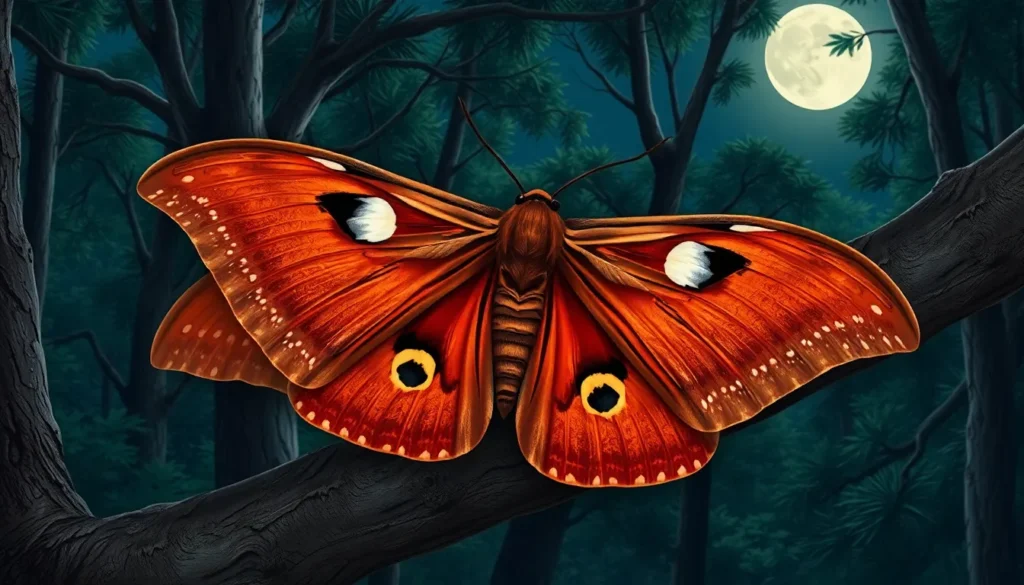
- Distinctive Coloration: Cecropia moths have striking reddish-brown wings with white, orange, and black markings, as well as transparent spots called windows on their wings.
- Short Adult Lifespan: Adult Cecropia moths do not possess functional mouthparts and live only about one to two weeks, during which their sole purpose is reproduction.
- Nocturnal Activity: They are primarily nocturnal and are attracted to light sources at night.
- Larval Host Plants: The caterpillars feed on a variety of hardwood trees and shrubs, including maple, cherry, birch, and willow.
- Metamorphosis Stages: Their life cycle includes egg, larva (caterpillar), pupa (cocoon), and adult moth stages.
- Large Caterpillars: Cecropia caterpillars can grow up to 4 inches (10 cm) long and are green with distinctive tubercles in blue, yellow, and orange.
- Defense Mechanisms: The caterpillars’ bright colors and spiny tubercles may deter predators by signaling toxicity, although they are not genuinely poisonous.
- Geographic Range: Cecropia moths are found throughout much of the United States and southern Canada, particularly in deciduous forests.
- Egg Clusters: Females lay clusters of pale yellow eggs on host plant leaves, which hatch after about two weeks.
- Single Generation Per Year: In most of their range, Cecropia moths have one generation annually, with adults emerging in late spring or early summer.
- Sexual Dimorphism: Males have larger, more feathery antennae than females, which they use to detect female pheromones for mating.
- Silent Moths: Unlike some moth species, Cecropia moths do not produce sounds or communicate acoustically.
- Cocoon Structure: Their cocoons are made of tough silk and are often attached to twigs or leaves, providing protection during the pupal stage.
- Predators and Parasites: Birds, bats, and parasitic wasps are among the natural enemies of Cecropia moths.
- Population Fluctuations: Their populations can vary widely from year to year, influenced by environmental conditions and predation.
- Indicator Species: Because they depend on healthy woodland habitats, Cecropia moths can serve as indicators of ecosystem health.
- Conservation Status: While not currently endangered, habitat loss and pesticide use may impact local populations.
- Scientific Interest: Cecropia moths have been studied extensively for insights into insect physiology, pheromone communication, and silk production.
Habitat and Behavior
Cecropia moths inhabit deciduous forests across much of the United States and southern Canada. They prefer areas with a variety of hardwood trees, which serve as host plants for their larvae. These moths are primarily nocturnal and are attracted to artificial lights at night. Their life cycle begins when females lay eggs on the leaves of suitable host plants. The larvae feed voraciously on leaves, growing rapidly and undergoing several molts before spinning a tough silk cocoon. Inside the cocoon, the pupal stage allows the transformation into an adult moth. Adult Cecropia moths do not feed and live only long enough to mate and reproduce. Males use their large, feathery antennae to detect female pheromones over considerable distances. Despite their size and vivid appearance, adult moths are relatively defenseless and rely on camouflage and nocturnal activity to avoid predators.
Why This Animal Matters
Cecropia moths play a significant ecological role as herbivores during their larval stage, contributing to the cycling of nutrients in forest ecosystems. They serve as prey for a variety of animals, including birds and bats, thus supporting local food webs. Their presence indicates healthy forest habitats, making them valuable bioindicators for environmental monitoring. Additionally, Cecropia moths have cultural importance in some regions as symbols of transformation and natural beauty. Scientifically, they are important model organisms for the study of insect metamorphosis, silk production, and pheromone-based communication. Conservation of their habitats helps maintain biodiversity and the ecological balance of forested areas.
Common Misconceptions
Misconception: Cecropia moths are dangerous or poisonous.
Correction: Cecropia moths are not poisonous to humans and do not pose any danger. Their bright colors may serve as a deterrent to predators, but they are harmless.
Misconception: Adult Cecropia moths eat during their short lifespan.
Correction: Adult Cecropia moths do not have functional mouthparts and do not feed. They rely on energy stored from the larval stage to survive and reproduce.
Misconception: Cecropia moths are pests that harm trees extensively.
Correction: While their caterpillars do feed on leaves, they rarely occur in numbers sufficient to cause significant damage to trees or forests.
Misconception: Cecropia moths are common year-round.
Correction: Cecropia moths have a distinct seasonal cycle, with adults appearing mostly in late spring to early summer, and only one generation per year in most regions.
Misconception: All large moths with bright colors are Cecropia moths.
Correction: Several large moth species share similar features; identification requires attention to specific wing patterns and size characteristic of Cecropia moths.
FAQ
How big do Cecropia moths get?
Cecropia moths are the largest native moths in North America, with wingspans that can exceed 6 inches (15 cm).
Do adult Cecropia moths eat?
No, adult Cecropia moths lack functional mouthparts and do not eat. They live only about one to two weeks to reproduce.
Where do Cecropia moths live?
They are found in deciduous forests throughout the United States and southern Canada, where host trees for their larvae are abundant.




Leave a Reply