
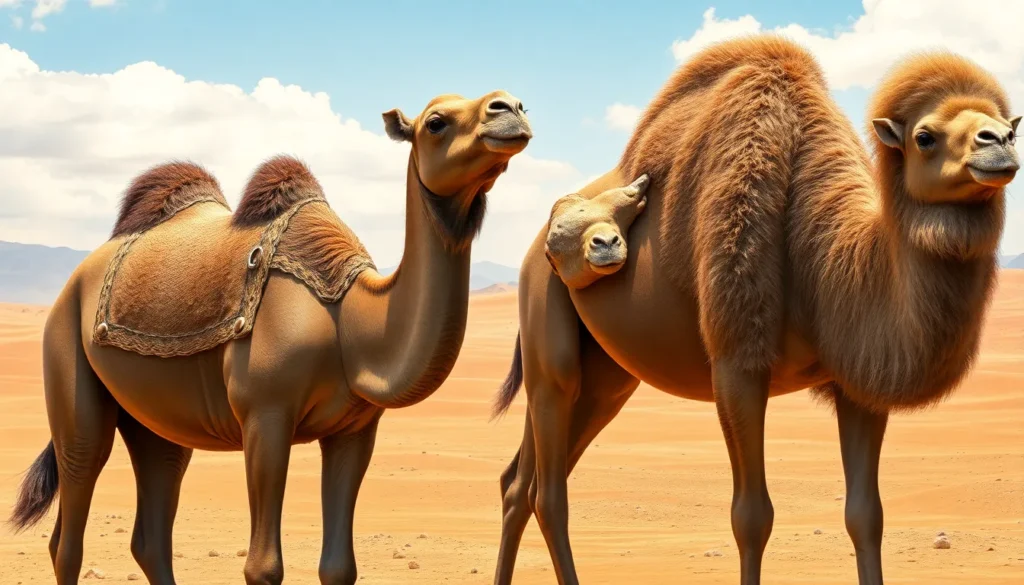
Short Answer
21 Facts About Camel Humps
- Camels store fat, not water, in their humps.
Contrary to popular belief, camel humps are composed mainly of fat tissues, which can be metabolized into energy and water when food is scarce. - The number of humps varies by species.
Dromedary camels have one hump, while Bactrian camels have two humps. - Humps help camels regulate body temperature.
The fat in the humps acts as insulation, allowing the rest of the body to dissipate heat more effectively in hot desert climates. - Humps shrink and lean over when fat is used up.
When a camel uses the fat stored in its hump for energy, the hump decreases in size and may lean to one side. - Humps can weigh up to 80 pounds (36 kg).
The size of a camel’s hump varies depending on the amount of fat stored. - Camel humps do not store water.
Water is stored throughout the camel’s bloodstream and tissues, not specifically in the humps. - Fat in the hump can be converted into both energy and water.
Through metabolic processes, fat breakdown produces energy and metabolic water, helping camels survive long periods without drinking. - Humps contribute to camels’ endurance in arid environments.
Fat reserves allow camels to survive during droughts or when food is unavailable. - Camels can drink up to 40 gallons of water in one go.
After dehydration, camels rapidly rehydrate but still rely on their fat reserves in the hump for survival. - Camels evolved their humps over millions of years.
This adaptation is critical for survival in harsh desert ecosystems. - Humps help reduce heat gain from the sun.
The raised structure reduces the surface area exposed to direct sunlight on the rest of the body. - Humps are made primarily of adipose tissue.
This specialized fat tissue differs from other body fat by being dense and localized. - Fat in humps can be metabolized into water through oxidation.
This water is released internally, helping maintain hydration. - The size and shape of humps can indicate a camel’s health.
Healthy camels typically have upright, firm humps, while malnourished camels have drooping, shrunken humps. - Camels can survive extreme temperatures partly due to their humps.
The fat stores help buffer internal body temperature fluctuations. - Humps vary in size between individual camels.
Factors like diet, age, and species affect hump size. - During rest, camels often lean their humps to one side.
This can be a sign that the fat reserves are being depleted. - Humps have a limited role in water conservation compared to other camel adaptations.
Other features like nasal passages and kidney function play bigger roles in water retention. - The hump’s fat stores are vital during long migrations.
Camels use stored fat for energy when food sources are sparse. - Camels can survive without water for up to two weeks.
The fat in their humps supplies both energy and metabolic water during this time. - Humps are unique evolutionary features found only in camels and their close relatives.
These adaptations distinguish camels from other desert mammals.
Habitat and Behavior
Camels are primarily found in arid desert regions of the Middle East, North Africa, and Central Asia. Dromedary camels inhabit hot desert climates, while Bactrian camels live in colder desert and steppe environments. Their ability to survive extreme heat, scarce water, and limited food is largely due to physiological adaptations including their humps. Camels are herbivores, feeding on dry grasses and thorny plants unavailable to many other animals. They are social animals, typically living in herds and using vocalizations and body language to communicate. Their humps enable them to endure long journeys across inhospitable terrain where food and water are rare.
Why This Animal Matters
Camels play a crucial ecological role by grazing on sparse vegetation, helping maintain desert ecosystems. They are vital to many human cultures for transportation, food, and materials such as wool and leather. Their humps symbolize endurance and survival in harsh environments and have cultural significance in folklore and art. From a conservation perspective, understanding camel biology, including the function of their humps, aids in managing domesticated and wild populations sustainably. Camels continue to be important for livelihoods in desert regions and are increasingly studied for their unique adaptations to extreme environments.
Common Misconceptions
Misconception: Camel humps store water.
Correction: Camel humps store fat, not water. Camels store water in their bloodstream and body tissues, while the fat in the humps serves as an energy reserve.
Misconception: Camels always have upright humps.
Correction: A camel’s hump can lean or shrink when fat reserves are depleted, indicating the animal has used stored energy.
FAQ
Do camel humps store water?
No, camel humps store fat which is metabolized into energy and water inside the body, but the humps themselves do not hold water.
Why do camel humps shrink and lean?
When camels use the fat stored in their humps for energy, the humps shrink and may lean to one side, indicating depletion of fat reserves.
How do camel humps help with temperature regulation?
The fat in the humps insulates the body and reduces heat gain, allowing camels to maintain a stable body temperature in hot desert conditions.






Leave a Reply