
Short Answer
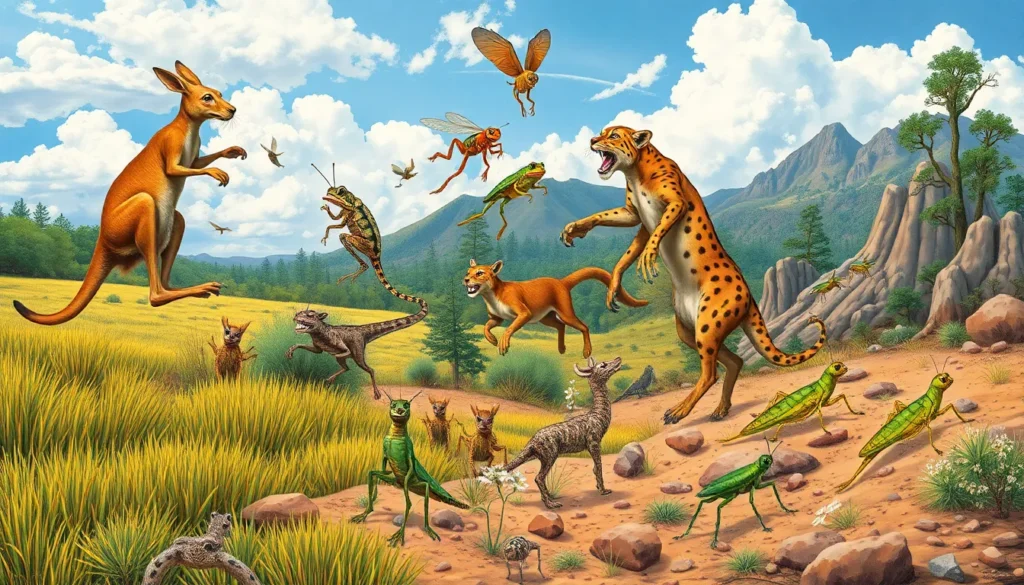
21 Facts About Animal Jumping Abilities
- The flea is one of the best jumpers relative to body size. Fleas can jump over 100 times their body length, which is equivalent to a human jumping the height of a skyscraper. This ability helps them move quickly between hosts.
- Kangaroos use powerful hind legs to hop at speeds up to 35 miles per hour. Their large, muscular legs and elastic tendons enable energy-efficient long-distance travel.
- Frogs have specialized leg muscles and webbed feet for effective jumping and swimming. Some species can leap over 20 times their body length to escape predators.
- Grasshoppers can jump distances 20 times their body length. Their hind legs act like springs, storing energy before release.
- Mountain lions can leap horizontally up to 40 feet. This ability helps them ambush prey in rugged terrain.
- Impala antelopes can jump as high as 10 feet and cover distances up to 33 feet. These leaps aid in predator evasion in open savannahs.
- Tree frogs can jump between branches to navigate forest canopies safely. This agility is crucial for avoiding ground-based predators.
- Grasshoppers’ jumping is powered by rapid extension of their tibiae. This mechanism allows sudden and high-velocity jumps.
- Spiders such as jumping spiders use hydraulic pressure to extend their legs rapidly. This unique method enables precise and agile jumps to capture prey.
- Snowshoe hares use jumping to evade predators in snowy habitats. Their large feet provide traction on snow, facilitating long leaps.
- Froghoppers are considered the best jumpers among insects by absolute height. They can jump over 100 times their own body height, powered by powerful hind legs.
- Some species of fish, like the flying fish, can leap out of water to escape predators. They extend their pectoral fins to glide over the water surface momentarily.
- Wallabies are smaller relatives of kangaroos with similar jumping capabilities. They use hopping as their primary mode of locomotion.
- Grasshoppers and locusts can travel long distances by combining jumping and flight. Their powerful jumps help initiate takeoff into flight.
- Some desert frogs can jump to reach scarce water sources quickly. Their jumping abilities are adapted to arid environments.
- Frogs’ jumping helps them avoid predators and catch prey with sudden bursts of speed. Their muscular legs are highly specialized for this purpose.
- Praying mantises can leap to capture prey or avoid threats. Their jumping is aided by strong hind legs and precise control.
- Grasshoppers have evolved jumping as a primary defense mechanism. Their sudden leaps make it difficult for predators to catch them.
- Some rodents, like jerboas, are known for their exceptional jumping and hopping abilities. They use these skills to navigate desert environments efficiently.
- Jumping abilities in animals are often linked to survival strategies such as predator evasion and hunting. Evolution has shaped these adaptations in diverse environments.
- Jumping performance varies widely among species, influenced by anatomy, muscle structure, and ecological niche. This diversity illustrates the complexity of locomotion in the animal kingdom.
Habitat and Behavior
Animals with notable jumping abilities inhabit a wide range of environments, from dense forests and grasslands to deserts and aquatic ecosystems. For example, frogs and tree frogs are commonly found in wetlands and rainforests, where jumping helps them move between plants and escape predators. Kangaroos and wallabies inhabit open grasslands and bushlands in Australia, relying on hopping for efficient movement over long distances. Desert species like jerboas and certain frogs use jumping to navigate sparse terrain and evade threats. Insects such as grasshoppers and fleas are found in diverse habitats, using their jumping skills for locomotion and survival. The mechanics of jumping are closely tied to behavioral strategies including escaping predators, catching prey, and moving efficiently within their specific environments.
Why This Animal Matters
Animals with remarkable jumping abilities play essential ecological roles in their respective ecosystems. They can act as prey or predators, influencing food web dynamics. For instance, frogs control insect populations, while predators like mountain lions use jumping to hunt effectively. Some jumping insects aid in pollination or act as indicators of environmental health. Culturally, animals such as kangaroos hold symbolic significance in Australian identity and folklore. Conservation of these species is important as habitat loss and environmental changes can affect their survival and the ecological balance they help maintain. Understanding their jumping abilities also provides insights into biomechanics and evolutionary biology.
Common Misconceptions
Misconception: All animals that jump do so using muscles alone.
Correction: Some animals, like spiders, use hydraulic pressure to extend their legs rapidly during jumps instead of relying solely on muscle contractions.
Misconception: Only large animals are capable of impressive jumps.
Correction: Many small animals, such as fleas and froghoppers, can jump extraordinary distances relative to their body size, far exceeding larger animals in proportional terms.
Misconception: Jumping is only used for escaping predators.
Correction: While predator evasion is a major reason, animals also jump for hunting, mating displays, territorial defense, and efficient locomotion.
Misconception: All animals jump in the same manner.
Correction: Jumping techniques vary widely, including muscle-driven leaps, hydraulic leg extension, and elastic energy storage, depending on the species.
Misconception: Only terrestrial animals jump.
Correction: Some aquatic species, like flying fish, leap out of water to evade predators, demonstrating that jumping is not limited to land animals.
FAQ
Which animal can jump the highest relative to its body size?
The flea is known to jump over 100 times its body length, making it one of the highest jumpers relative to body size among animals.
How do kangaroos conserve energy while hopping?
Kangaroos use elastic energy stored in their tendons to reduce the muscular effort required for hopping, allowing them to travel long distances efficiently.
Why do some insects use hydraulic pressure for jumping?
Certain insects, like jumping spiders, use hydraulic pressure to rapidly extend their legs, enabling quick and powerful jumps without relying solely on muscle contraction.




Leave a Reply