
Short Answer
21 Facts About Blue Crabs
- Scientific Name: The blue crab is scientifically known as Callinectes sapidus, which means “savory beautiful swimmer.” This name reflects both its culinary value and swimming ability.
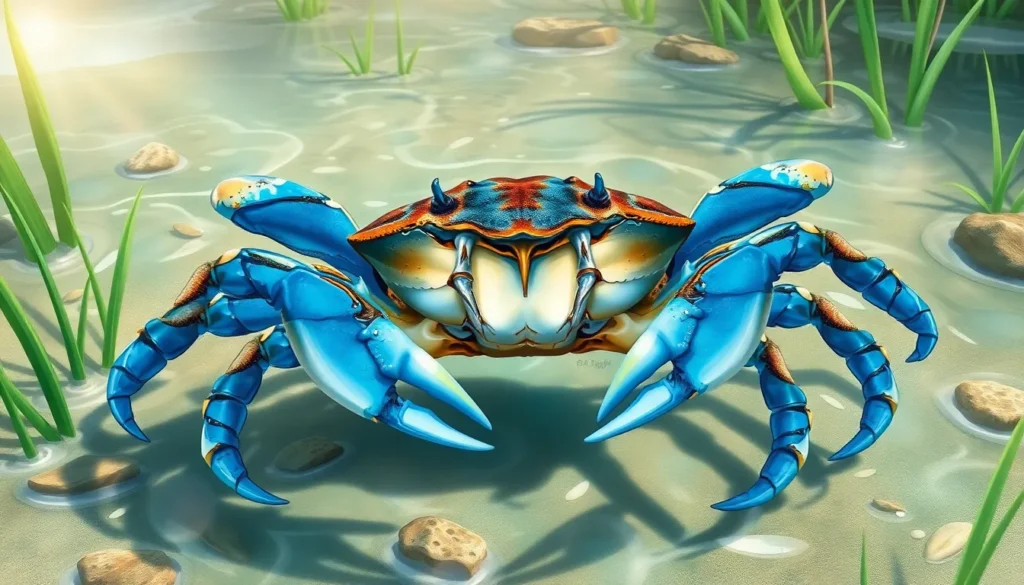
- Distinctive Coloration: Blue crabs are named for their striking blue claws, with males typically exhibiting brighter blue hues while females have red-tipped claws.
- Size Range: Adult blue crabs usually measure between 5 to 9 inches across the shell, though sizes can vary based on habitat and age.
- Habitat Range: They are native to the western Atlantic Ocean and Gulf of Mexico, inhabiting estuaries, bays, and coastal waters from Nova Scotia to Argentina.
- Swimming Ability: Blue crabs are strong swimmers, using their specially adapted hind legs, which are flattened and paddle-like, to propel themselves through water.
- Molting Process: To grow, blue crabs molt their hard exoskeletons multiple times during their life, leaving them vulnerable until a new shell hardens.
- Omnivorous Diet: Blue crabs are opportunistic feeders, consuming plants, fish, mollusks, worms, and detritus, contributing to their adaptability in various environments.
- Predators: Their predators include fish such as striped bass and red drum, birds, sea turtles, and humans, all of which impact their populations.
- Reproductive Behavior: Female blue crabs mate once in their lifetime, storing sperm to fertilize multiple batches of eggs over several spawning events.
- Egg Masses: Females carry bright orange egg masses, called sponge crabs, under their abdomen until the larvae hatch.
- Larval Development: Blue crab larvae go through several planktonic stages in the water column before settling to the bottom and developing into juveniles.
- Ecological Role: As both predator and prey, blue crabs play a key role in estuarine food webs, helping maintain ecological balance.
- Economic Importance: Blue crabs are commercially valuable, especially along the U.S. East Coast and Gulf Coast, supporting fisheries and local economies.
- Seasonal Migration: They exhibit seasonal movements, often migrating to deeper waters during winter and returning to estuaries in warmer months.
- Sexual Dimorphism: Males and females can be distinguished by the shape of their abdomen; males have a narrow, T-shaped apron while females have a wider, rounded apron.
- Lifespan: The typical lifespan of a blue crab is about 3 to 4 years in the wild, though this can vary with environmental conditions.
- Temperature Sensitivity: Blue crabs are sensitive to water temperature, with growth and reproductive cycles influenced by seasonal temperature changes.
- Adaptation to Salinity: They tolerate a wide range of salinities, thriving in brackish waters where freshwater mixes with seawater.
- Behavioral Traits: Blue crabs are known for their aggressive and territorial behavior, especially during mating and molting periods.
- Importance in Research: They are studied for their unique physiology, including their compound eyes and neural systems, which provide insights into marine biology.
- Conservation Concerns: Overfishing, habitat loss, and water pollution pose threats to blue crab populations, prompting regional conservation efforts.
Habitat and Behavior
Blue crabs inhabit estuarine and coastal waters where salinity levels vary, such as bays, tidal rivers, and marshes. Their ability to tolerate a wide range of salinities allows them to thrive in brackish environments. They spend much of their time on or near the bottom, hiding in seagrass beds or mud to avoid predators. Blue crabs are primarily nocturnal feeders, using their strong claws to catch prey or scavenge. They are also strong swimmers, using their paddle-shaped hind legs to move efficiently through water. Seasonal migrations occur as they move to deeper waters during colder months and return to shallow estuaries during warmer seasons for feeding and reproduction.
Why This Animal Matters
Blue crabs hold significant ecological, economic, and cultural importance. Ecologically, they serve as both predator and prey within estuarine food webs, helping to regulate populations of smaller organisms and providing food for larger predators. Economically, blue crabs support important commercial and recreational fisheries, particularly in the Chesapeake Bay and Gulf Coast regions, contributing to local livelihoods and economies. Culturally, blue crabs are featured in regional cuisines, festivals, and traditions, highlighting their role in community identity. Conservation of blue crab populations is critical as they are vulnerable to habitat degradation, pollution, and overharvesting, all of which can disrupt ecological balance and economic sustainability.
Common Misconceptions
Misconception: Blue crabs are always blue in color.
Correction: While their claws are typically blue, the body of a blue crab can range from greenish to brown, and females may have red highlights on their pincers.
Misconception: Blue crabs can survive indefinitely out of water.
Correction: Blue crabs require moist environments to breathe through their gills and cannot survive long periods out of water or in dry conditions.
Misconception: All blue crabs are edible regardless of age or size.
Correction: While blue crabs are edible, smaller juveniles and soft-shelled crabs are generally preferred for culinary use; regulations often dictate minimum size limits to protect populations.
Misconception: Blue crabs are solitary creatures.
Correction: Although somewhat territorial, blue crabs often aggregate in large numbers during molting or spawning seasons.
FAQ
What do blue crabs eat?
Blue crabs are omnivores that feed on a variety of plants and animals, including small fish, mollusks, worms, detritus, and algae. Their diet is adaptable depending on availability.
How can you tell male and female blue crabs apart?
Males have a narrow, T-shaped abdominal apron, while females have a broader, rounded apron. Additionally, males have bright blue claws whereas females often have red-tipped claws.
Are blue crabs good swimmers?
Yes, blue crabs are strong swimmers. Their last pair of legs are flattened and act like paddles, allowing them to swim efficiently in the water.


Leave a Reply