
Short Answer
21 Facts About Salp Chain Formation
- Salps are gelatinous zooplankton. Salps belong to the class Thaliacea and are primarily composed of a gelatinous substance, similar to jellyfish.
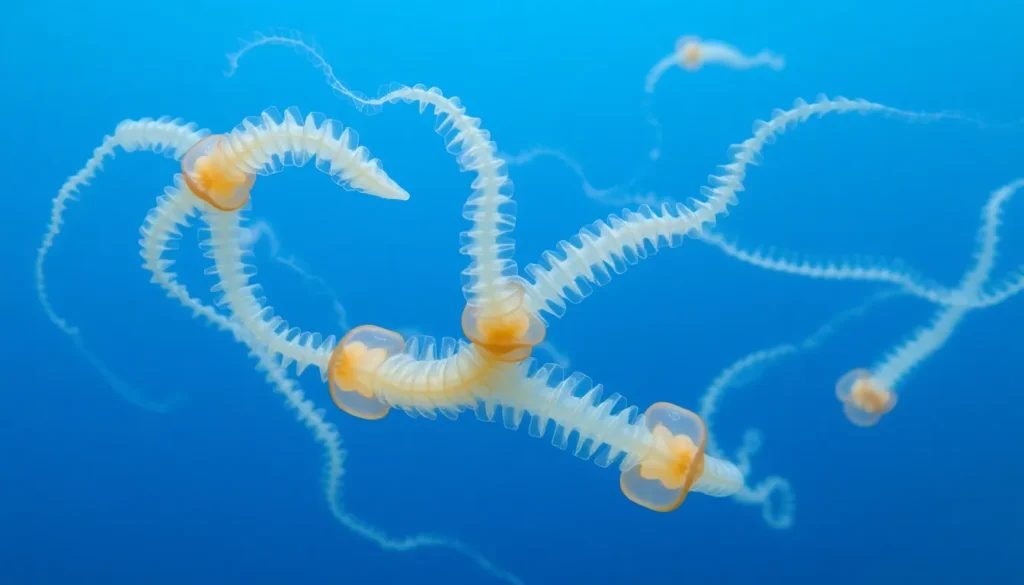
- Salp chains can form in long, interconnected strings. These chains can be several meters long and consist of multiple individual salps linked together.
- Salps reproduce asexually and sexually. They can alternate between both reproduction methods, with asexual reproduction being more common in favorable conditions.
- They are filter feeders. Salps feed by filtering phytoplankton and other small particles from the water, playing a crucial role in the marine food web.
- Salps can propel themselves through water. They do this by contracting their bodies, forcing water out, and thus moving forward.
- They can rapidly reproduce in nutrient-rich waters. When conditions are optimal, salp populations can explode, significantly impacting marine ecosystems.
- Salps contribute to carbon cycling. Their feeding process helps sequester carbon by transporting organic matter to deeper ocean layers as they excrete waste.
- They are important for marine ecosystems. Salps serve as a food source for various marine animals, including fish and whales.
- Salps can be found in all oceanic waters. They inhabit a range of marine environments, from coastal to open ocean waters.
- They have a unique life cycle. Salps exhibit a complex life cycle with both solitary and colonial forms.
- Salps can be bioluminescent. Some species of salps exhibit bioluminescence, which can be observed in dark waters.
- Salps can help monitor ocean health. Their populations are indicators of environmental changes, such as shifts in water temperature and nutrient availability.
- They can survive in low-oxygen environments. Salps are known to thrive in hypoxic (low-oxygen) waters where many other organisms cannot.
- Salps can travel long distances. Due to ocean currents, salps can be transported over large distances, affecting various marine ecosystems.
- They can affect the distribution of phytoplankton. Salp feeding can influence phytoplankton bloom dynamics by controlling their populations.
- Salps can form blooms. Under certain conditions, salps can form large blooms, which can deplete oxygen and affect local marine life.
- They have transparent bodies. The transparency of salps helps them avoid predation in the open ocean.
- Salps are often mistaken for jellyfish. Their gelatinous appearance leads to confusion, but they are distinct from jellyfish in both anatomy and behavior.
- Salps can live for several weeks. Depending on environmental conditions, individual salps may survive for weeks, contributing to food webs during that time.
- Research on salps is ongoing. Scientists continue to study salps to understand their ecological roles and responses to climate change.
- Salps have few natural predators. Most predation comes from larger marine animals, such as fish and sea turtles, although they are generally less vulnerable than other plankton.
Habitat and Behavior
Salps are primarily found in open ocean waters, where they inhabit various depths, from the surface to deeper layers. They thrive in areas with rich nutrient supplies, often found in upwelling zones. Salps exhibit a unique behavior of forming long chains, which may enhance their feeding efficiency and offer some protection from predators. They are known to migrate vertically in the water column, adjusting their depth in response to light and food availability.
Why This Animal Matters
Salps play a significant ecological role in marine environments. They act as a crucial link in the marine food web, transferring energy from primary producers (phytoplankton) to higher trophic levels, including fish and marine mammals. Additionally, their ability to sequester carbon contributes to the ocean’s carbon cycle, making them important for understanding climate change dynamics. Their sensitivity to environmental changes also makes them indicators of ocean health.
Common Misconceptions
FAQ
What are salps?
Salps are gelatinous zooplankton that play a significant role in marine ecosystems.
How do salps reproduce?
Salps can reproduce both sexually and asexually, depending on environmental conditions.
What is the ecological role of salps?
Salps serve as a food source for larger marine animals and contribute to carbon cycling in the ocean.


Leave a Reply