
Short Answer
21 Facts About Lancelet Filter Feeding (Gill Slits)
- Lancelets are primitive chordates
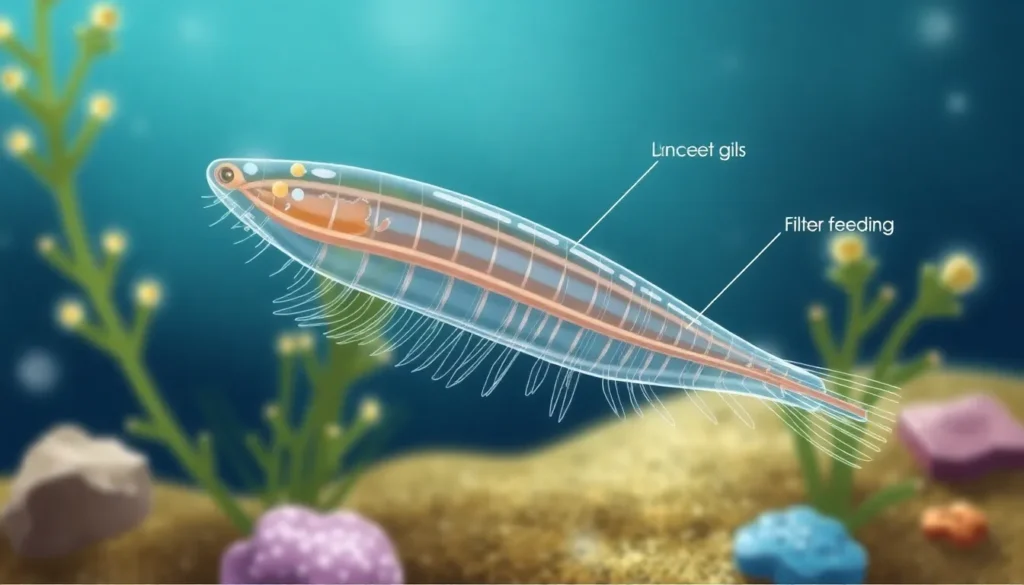
Lancelets, belonging to the subphylum Cephalochordata, are among the most ancient relatives of vertebrates, showcasing key features of chordates such as notochords and gill slits. - Filter feeding mechanism
Lancelets employ a filter feeding system using their gill slits, allowing them to extract small particles, such as plankton, from the water. - Presence of gill slits
Adult lancelets possess multiple gill slits that aid in both respiration and feeding, facilitating the flow of water through their bodies. - Water flow direction
Water enters through the mouth and exits through the gill slits, effectively trapping food particles in the process. - Role of mucus
Mucus secreted by the gill slits captures food particles, which are then transported to the digestive tract. - Size and habitat
Lancelets are typically small, measuring between 5 to 10 centimeters in length, and are often found buried in sandy or muddy substrates in shallow marine waters. - No true bones
Unlike vertebrates, lancelets do not have true bones; instead, they possess a notochord that provides structural support. - Respiration through gill slits
In addition to feeding, gill slits facilitate respiration by allowing oxygen to diffuse into their bodies from the surrounding water. - Reproductive methods
Lancelets reproduce through external fertilization, with eggs and sperm released into the water column. - Larval stage
Lancelet larvae exhibit a free-swimming stage, which is significantly different from the adult form, displaying characteristics similar to that of other chordates. - Ecological role
As filter feeders, lancelets play a vital role in aquatic ecosystems by helping to maintain water clarity and quality. - Evolutionary significance
Lancelets serve as important model organisms in evolutionary biology, providing insights into the evolution of vertebrates. - Distribution
Lancelets are distributed in marine environments worldwide, with higher concentrations in temperate and tropical regions. - Adaptations
Their body shape and gill slit arrangement are adaptations for efficient filter feeding and respiration in their benthic habitats. - Longevity
Lancelets can live for several years, although their exact lifespan can vary among species. - Diet composition
Lancelets primarily feed on small planktonic organisms, including copepods and detritus. - Symbiotic relationships
Some lancelet species may engage in symbiotic relationships with microorganisms, aiding in nutrient absorption. - Threats to populations
While lancelets are not currently endangered, habitat degradation and pollution could pose potential threats to their populations. - Research significance
Lancelets are often studied in developmental biology due to their simple anatomy and genetic similarities to vertebrates. - No distinct head
Unlike many other animals, lancelets do not have a distinct head; their bodies are elongated and lack complex sensory organs. - Behavioral patterns
Lancelets exhibit limited movement, primarily using their tails for propulsion in the water.
Habitat and Behavior
Lancelets inhabit shallow coastal waters, typically in sandy or muddy substrates where they can bury themselves. Their behavior is largely benthic, as they remain partially buried and filter feed by creating a water current through their gill slits. Lancelets are generally sedentary and rely on the flow of water to bring food particles to them for consumption.
Why This Animal Matters
Lancelets play a crucial role in their ecosystems as filter feeders. By consuming small particles and plankton, they help maintain water quality and clarity. Their presence is indicative of healthy marine environments. Additionally, lancelets are of significant interest in scientific research, particularly in the fields of evolutionary biology and developmental biology, due to their evolutionary relationship with vertebrates.
Common Misconceptions
Lancelets are fish.
Lancelets are not fish; they are primitive chordates that lack many features typical of true fish, such as bones and a distinct head.
All chordates have a backbone.
While most chordates possess a backbone, lancelets retain a notochord throughout their lives, which is a characteristic of more primitive chordates.
FAQ
What do lancelets primarily eat?
Lancelets primarily consume small planktonic organisms and organic debris through their filter feeding mechanism.
Where are lancelets commonly found?
Lancelets are typically found in sandy or muddy substrates in shallow coastal waters around the world.
How do lancelets breathe?
Lancelets breathe through their gill slits, which also play a role in their filter feeding.






Leave a Reply