
Short Answer
21 Facts About Electroreception in Platypuses
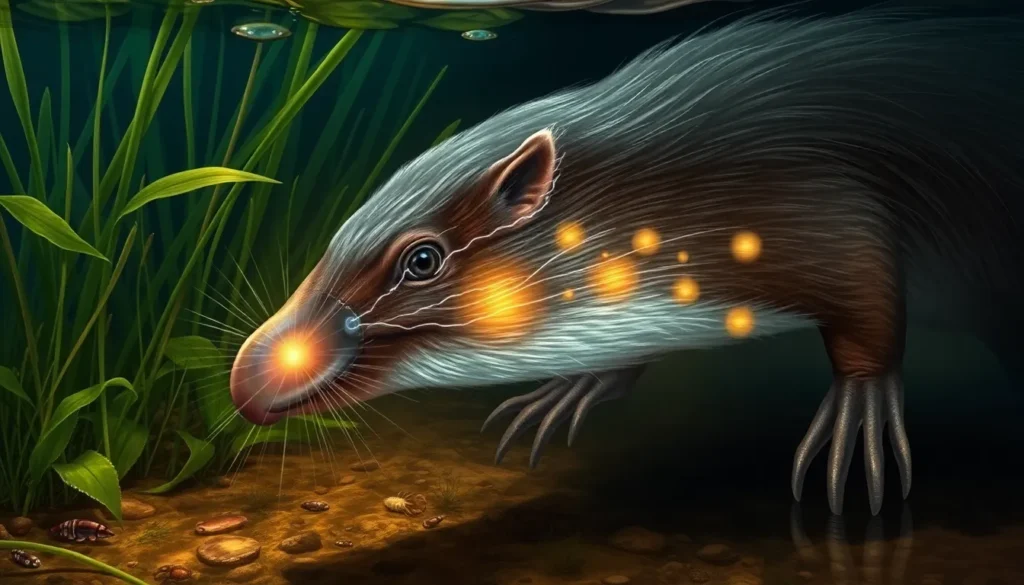
- Unique Sensory Ability: Platypuses possess electroreceptors in their bills, enabling them to detect weak electrical signals produced by the muscle contractions of their prey.
- Bill Structure: The platypus’s bill is covered with thousands of electroreceptors and mechanoreceptors, combining electrical and tactile sensing.
- Electroreception Discovery: Electroreception in platypuses was first scientifically described in the 20th century, highlighting their unusual sensory biology among mammals.
- Hunting Adaptation: Platypuses close their eyes, ears, and nostrils when underwater, relying entirely on electroreception and mechanoreception to locate food.
- Prey Detection: Electroreceptors help platypuses detect small invertebrates, insect larvae, and freshwater shrimp even in murky water conditions.
- Electroreceptor Density: The density of electroreceptors in the platypus bill is among the highest found in any vertebrate, contributing to their acute sensitivity.
- Evolutionary Significance: Electroreception in platypuses is considered a primitive trait shared with some fish and amphibians, showing evolutionary continuity.
- Neurological Processing: Signals from electroreceptors are processed in specialized brain regions, indicating a complex sensory integration system.
- Dual Sensory Input: Platypus bills integrate both electrical and mechanical stimuli, enabling nuanced environmental perception underwater.
- Environmental Adaptation: Electroreception gives platypuses an advantage in nocturnal and turbid water hunting, where vision is limited.
- Comparative Biology: Platypus electroreception is more advanced than in monotremes like echidnas, which have fewer electroreceptors and rely less on this sense.
- Signal Detection Range: Platypus electroreceptors can detect electrical signals generated by prey at close range, typically within a few centimeters.
- Electroreceptor Development: Platypus electroreceptors develop before birth, indicating their importance in survival immediately after hatching.
- Sexual Dimorphism: Both male and female platypuses have electroreceptors, but males also have venomous spurs unrelated to electroreception.
- Behavioral Studies: Experimental studies show that platypuses rely more heavily on electroreception than vision during underwater foraging.
- Evolutionary Loss in Mammals: Electroreception is rare among mammals, with platypuses being one of the few extant species retaining this trait.
- Electroreceptor Types: Platypus electroreceptors are primarily tuberous-type, which are sensitive to changes in electric fields rather than static charges.
- Impact of Water Conductivity: The effectiveness of electroreception can vary with water salinity and conductivity, influencing platypus hunting efficiency.
- Integration with Tactile Sense: Electroreception complements tactile input, allowing platypuses to identify prey size, movement, and texture.
- Scientific Importance: Studying platypus electroreception offers insights into sensory evolution and potential biomimetic applications.
- Conservation Implications: Understanding platypus sensory ecology helps inform habitat protection and water quality standards critical for their survival.
Habitat and Behavior
Platypuses inhabit freshwater rivers, streams, and lakes primarily in eastern Australia and Tasmania. They are semi-aquatic mammals that spend much of their time foraging underwater, using their electroreceptive bill to locate prey in murky waters. Platypuses are mostly nocturnal or crepuscular, reducing predation risk and competition. Their electroreception allows them to hunt efficiently with eyes, ears, and nostrils closed, detecting prey hidden in sediment or vegetation. They build burrows in riverbanks for shelter and breeding. Platypuses feed on aquatic invertebrates, small fish, and larvae, using electroreception to compensate for limited visibility and reliance on tactile information.
Why This Animal Matters
The platypus holds significant ecological roles as a predator of aquatic invertebrates, helping maintain freshwater ecosystem balance. Its unique electroreception system is a rare example of this sensory adaptation in mammals, providing valuable insights into sensory evolution and neurobiology. Culturally, the platypus is an iconic Australian species, symbolizing the continent’s distinct biodiversity. Conservation-wise, platypuses are sensitive to water pollution, habitat destruction, and climate change, making their sensory ecology important for developing protective measures. Studying their electroreception also enhances understanding of environmental health and potential bio-inspired technologies.
Common Misconceptions
Misconception: Platypuses use electroreception like sharks to detect prey from long distances.
Correction: Platypus electroreception is effective only at very close ranges, typically a few centimeters, suitable for detecting prey during underwater foraging rather than long-distance sensing.
Misconception: Electroreception is common among all mammals.
Correction: Electroreception is extremely rare in mammals; platypuses are one of the few species retaining this ancient sensory ability inherited from early vertebrates.
Misconception: Platypuses rely solely on electroreception to find food.
Correction: While electroreception is crucial, platypuses also use mechanoreceptors and tactile sensing in their bills to detect prey, integrating multiple sensory inputs.
FAQ
How does electroreception help platypuses find food?
Platypuses detect the tiny electrical signals generated by the muscle contractions of their prey, such as insects and larvae, allowing them to locate food even when visibility is poor underwater.
Are platypus electroreceptors similar to those in fish?
Yes, platypus electroreceptors share evolutionary origins with those found in some fish and amphibians, although adapted uniquely for the platypus's semi-aquatic lifestyle.
Can platypuses use electroreception on land?
No, electroreception in platypuses is primarily functional underwater, where electrical signals travel effectively; it is not used for sensing on land.

Leave a Reply