
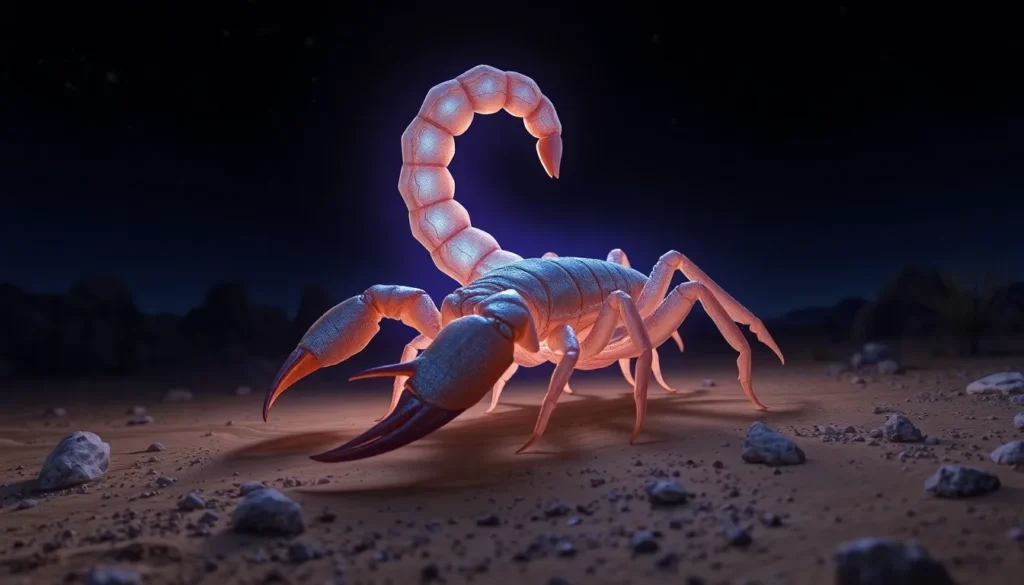
Short Answer
21 Facts About Scorpions
- Ancient Lineage
Scorpions have existed for over 430 million years, making them one of the oldest terrestrial arthropods still living today. - Distinctive Anatomy
Scorpions possess eight legs, pincers called pedipalps, and a segmented tail ending in a venomous stinger. - Venom Usage
They use venom primarily for hunting prey and self-defense, with potency varying widely among species. - Nocturnal Hunters
Most scorpions are nocturnal, hunting insects and other small animals at night. - Fluorescence Under UV Light
Their exoskeletons fluoresce a blue-green color under ultraviolet light, a feature still under scientific study. - Wide Geographic Distribution
Scorpions inhabit deserts, forests, grasslands, and caves on every continent except Antarctica. - Water Conservation
They have adaptations that allow them to survive in arid environments by conserving water efficiently. - Brooding Behavior
Female scorpions carry their young on their backs until the juveniles undergo their first molt. - Varied Sizes
Scorpion sizes range from under 2 centimeters to over 20 centimeters depending on the species. - Predatory Efficiency
They use sensory hairs and pectines to detect vibrations and chemical cues from prey. - Molting Process
Scorpions grow by molting their exoskeleton multiple times throughout their life cycle. - Reproductive Diversity
Some species reproduce sexually, while others can reproduce via parthenogenesis (asexual reproduction). - Longevity
Scorpions can live several years, with some species known to reach up to 25 years in captivity. - Low Metabolism
They can survive on minimal food and water intake due to their slow metabolism. - Defensive Posture
When threatened, scorpions raise their pincers and tail in a defensive stance to deter predators. - Venom Composition
Scorpion venom contains a complex mixture of neurotoxins, enzymes, and other compounds with varying effects. - Medical Importance
Some scorpion venoms are studied for potential pharmaceutical applications, including painkillers and antimicrobial agents. - Species Diversity
There are approximately 2,500 known scorpion species worldwide. - Role in Ecosystems
They are both predators and prey, contributing to the balance of insect populations and serving as food for larger animals. - Adaptations to Extreme Environments
Some desert scorpions have burrowing behaviors and nocturnal activity to avoid daytime heat. - Human Interaction
While scorpion stings can be painful, only a few species possess venom dangerous to humans.
Habitat and Behavior
Scorpions inhabit diverse environments, including deserts, tropical rainforests, savannas, and caves. They typically prefer sheltered locations such as under rocks, in crevices, or burrows to avoid extreme temperatures and predators. Their nocturnal activity pattern helps them conserve moisture and avoid heat during the day.
Scorpions are solitary creatures that rely on their keen sensory organs, such as pectines, to detect prey and navigate their surroundings. Hunting involves ambushing or actively stalking small insects, spiders, and occasionally small vertebrates. They use their pincers to grasp prey and their venomous stinger to immobilize or kill it.
Reproduction can vary; most species perform a mating dance where the male deposits a spermatophore that the female collects. Females exhibit parental care by carrying their offspring on their backs until the young are mature enough to survive independently.
Why This Animal Matters
Scorpions play a critical ecological role as both predators and prey. By controlling insect populations, they contribute to maintaining ecological balance. Their presence indicates healthy ecosystems, particularly in arid and semi-arid regions.
Culturally, scorpions have featured in mythology, art, and symbolism across various civilizations, often representing protection, danger, or transformation. Scientifically, their venom is of interest for developing new medical treatments, and their unique biology provides insight into arachnid evolution and adaptation.
From a conservation perspective, while many scorpion species are stable, habitat destruction and climate change pose risks to some localized populations, emphasizing the need for habitat preservation and further study.
Common Misconceptions
Misconception: All scorpions are deadly to humans.
Correction: While some species have venom potent enough to cause serious harm, most scorpion stings are comparable to bee stings and are not life-threatening to healthy adults.
Misconception: Scorpions are aggressive and will attack humans unprovoked.
Correction: Scorpions are generally shy and avoid human contact, stinging only in self-defense when threatened or accidentally disturbed.
Misconception: Scorpions can survive being crushed or stepped on because of their tough exoskeleton.
Correction: Despite their hard exoskeleton, scorpions can be injured or killed by sufficient physical force.
Misconception: Scorpions only live in deserts.
Correction: Scorpions inhabit a wide range of environments, including forests, grasslands, and caves, not exclusively deserts.
Misconception: Scorpions are insects.
Correction: Scorpions are arachnids, related to spiders and ticks, and differ from insects in having eight legs and other anatomical features.
FAQ
Are all scorpion stings dangerous to humans?
No, most scorpion stings are not dangerous to humans and cause only mild symptoms similar to a bee sting. Only a few species have venom potent enough to cause serious medical issues.
Where do scorpions typically live?
Scorpions live in a variety of habitats worldwide, including deserts, forests, grasslands, and caves, except Antarctica. They often hide under rocks or in burrows to avoid extreme conditions.
How do scorpions hunt and capture prey?
Scorpions are nocturnal predators that use sensory hairs and pectines to detect prey. They grasp prey with their pincers and immobilize it with venom delivered through their stinger.

Leave a Reply