
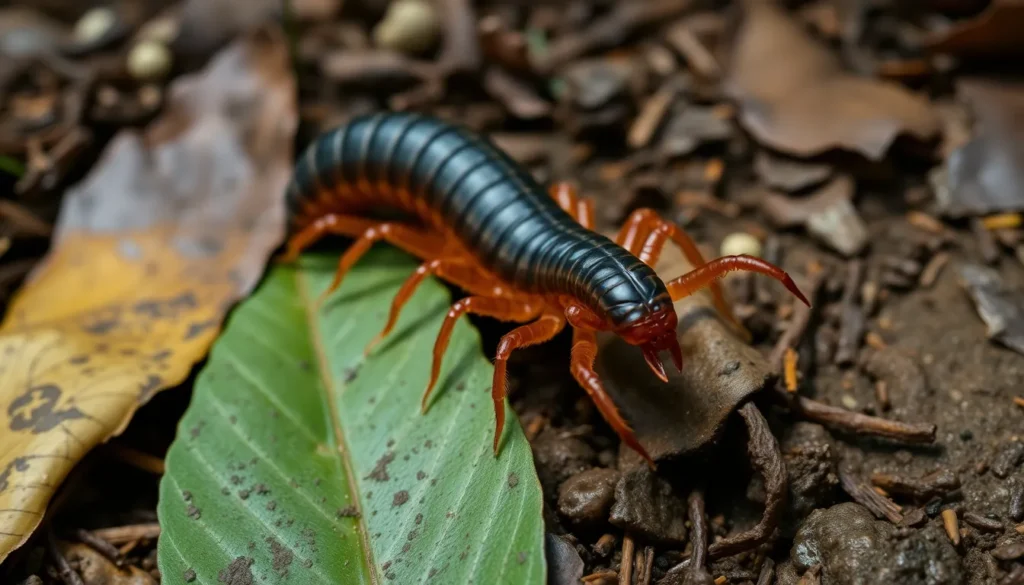
Short Answer
21 Facts About Centipedes
- Centipedes are not insects.
Centipedes belong to the class Chilopoda, which is separate from insects; they are arthropods related to millipedes and crustaceans. - Number of legs varies widely.
Depending on the species, centipedes can have anywhere from 15 to over 177 pairs of legs, but always an odd number of pairs. - Centipedes are carnivorous.
They primarily prey on insects, spiders, and sometimes small vertebrates using venomous claws called forcipules. - They possess venom.
Centipedes inject venom through their modified front legs to immobilize prey; some species’ venom can cause pain in humans but is rarely dangerous. - Centipedes move quickly.
Their many legs allow rapid movement, making them effective hunters and difficult to catch. - They are nocturnal.
Most centipedes are active at night, hiding in dark, moist places during the day to avoid predators and dehydration. - Centipedes prefer moist habitats.
They are commonly found under rocks, logs, leaf litter, and within soil, environments that prevent desiccation. - Size varies from a few millimeters to over 30 cm.
The largest known species is the Amazonian giant centipede (Scolopendra gigantea), which can grow up to 30 cm (12 inches) long. - Centipedes have a simple body plan.
The body is divided into a head and multiple similar segments, each with one pair of legs. - They have antennae for sensing.
Long antennae help centipedes navigate their environment and detect prey or threats. - Centipedes exhibit parental care.
Some species guard their eggs and young until they hatch and are capable of independent survival. - They reproduce sexually.
Centipedes lay eggs, and fertilization usually occurs through indirect sperm transfer. - Centipedes can regenerate lost legs.
They have the ability to regrow legs lost due to injury, although regeneration may take several molts to complete. - They play a role in controlling pest populations.
By preying on insects and other small invertebrates, centipedes help regulate populations of potential pests. - Centipedes have a global distribution.
They are found on every continent except Antarctica, adapting to a wide range of climates and habitats. - They do not have lungs.
Centipedes respire through spiracles connected to tracheae, small openings along their body segments. - Some species can live several years.
Centipedes typically have a lifespan ranging from 1 to 6 years depending on the species and environmental conditions. - Centipedes are fastidious hunters.
They use speed, venom, and stealth to capture prey efficiently in diverse conditions. - They have poor eyesight.
Most centipedes rely on their antennae and other senses rather than vision to detect their surroundings. - Centipedes do not cause significant harm to humans.
While bites can be painful, especially from larger species, they rarely pose serious medical risks. - Centipedes have been studied for their unique venom compounds.
Research into centipede venom has potential applications in medicine and pest control due to its complex biochemical properties.
Habitat and Behavior
Centipedes inhabit a wide range of environments, from tropical rainforests to temperate woodlands and deserts. They favor moist, sheltered areas such as under stones, logs, leaf litter, or inside soil to prevent dehydration. Being primarily nocturnal, they avoid daytime heat and predators by hiding during the day and becoming active at night to hunt. Their diet consists mainly of insects, arachnids, and occasionally small vertebrates. Centipedes use their venomous forcipules to capture and subdue prey quickly. Their many legs enable swift movement, which aids in both hunting and evasion.
Why This Animal Matters
Centipedes play an important ecological role as predators of insects and other small arthropods, helping maintain balanced ecosystems by controlling pest populations. Their presence can indicate healthy soil and leaf litter environments. Additionally, centipedes contribute to nutrient cycling by preying on decomposer species and serving as prey for larger animals. Scientifically, centipede venom is of interest for potential pharmacological uses due to its unique compounds. Culturally, centipedes appear in folklore and traditional medicine in various societies, reflecting their longstanding interaction with humans. Conservation-wise, while most centipede species are not threatened, habitat destruction can impact local populations.
Common Misconceptions
Misconception: All centipedes have exactly 100 legs.
Correction: Despite their name, centipedes do not have a fixed number of legs, and rarely have exactly 100. Their leg count varies by species and is always an odd number of pairs.
Misconception: Centipedes are insects.
Correction: Centipedes belong to the class Chilopoda, which is distinct from insects. They are arthropods but are more closely related to millipedes.
Misconception: Centipede bites are deadly to humans.
Correction: While centipede bites can be painful and cause localized swelling, they are rarely dangerous or fatal to humans.
Misconception: Centipedes are harmful household pests.
Correction: Centipedes actually help control other household pests by preying on insects and spiders.
FAQ
Are centipedes dangerous to humans?
Most centipedes are not dangerous to humans. Their bites can be painful and cause localized swelling but are rarely medically serious.
How many legs does a centipede have?
The number of legs varies depending on the species, ranging from 30 to over 350 legs, always in an odd number of pairs.
What do centipedes eat?
Centipedes are carnivores that feed on insects, spiders, and occasionally small vertebrates, using their venomous claws to capture prey.




Leave a Reply