
Short Answer
21 Facts About Scallops
- Scallops belong to the family Pectinidae. They are bivalve mollusks related to clams and oysters but distinguished by their unique shell shape and swimming ability.
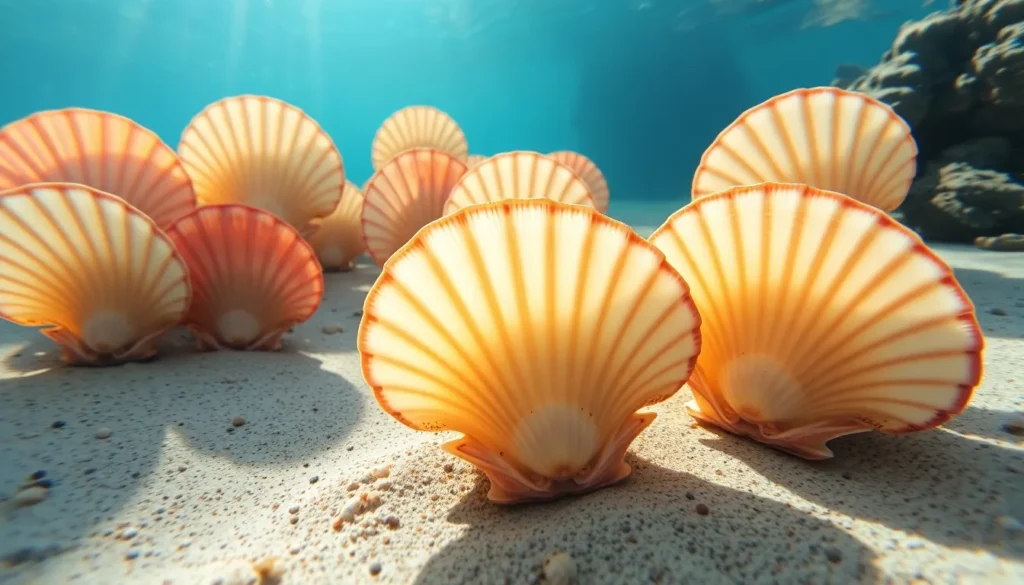
- They have fan-shaped, ridged shells. The shells are typically symmetrical and can have various colors ranging from white to orange and red.
- Scallops can swim by rapidly clapping their shells. This movement propels them away from predators and is unusual among bivalves.
- They possess numerous small, simple eyes along the edge of their mantles. These eyes help detect light and motion, aiding in predator avoidance.
- The number of eyes can vary from 20 to over 100. This extensive visual capability is unique among bivalves.
- Scallops are filter feeders. They feed by filtering plankton and other small particles from the water using their gills.
- They have a well-developed adductor muscle. This muscle is the part most commonly consumed as seafood and is responsible for closing their shells.
- Scallops have separate sexes. Most species are dioecious, meaning individuals are either male or female.
- Some species can change sex during their lifetime. This is a reproductive strategy observed in certain scallop populations.
- They are found worldwide in marine environments. Scallops inhabit coastal waters from shallow subtidal zones to deep sea floors.
- Scallops prefer sandy or gravel substrates. They often rest on or partially bury themselves in these substrates to avoid predators.
- They can swim short distances to escape threats. This swimming is powered by rapid shell clapping, unlike most bivalves, which are sessile or burrowers.
- Scallop shells have been used historically as symbols. They are associated with pilgrimage and travel, notably the scallop shell symbol of the Camino de Santiago.
- They play a significant role in marine ecosystems. By filtering water, scallops contribute to water clarity and nutrient cycling.
- Commercial scallop fisheries are important globally. They provide a valuable source of seafood in many cultures and economies.
- Scallops are sensitive to environmental changes. Pollution, habitat destruction, and ocean acidification can negatively impact their populations.
- They have a larval stage that is planktonic. Scallop larvae drift in the water column before settling to the seabed and developing into adults.
- The adductor muscle is sometimes called the “scallop eye” due to its strength and importance in movement. It is the primary muscular structure used for swimming.
- Some scallops produce pearls. Although less common and less valuable than oyster pearls, scallop pearls can form inside their shells.
- Scallops can live for several years. Lifespan varies by species, with some living up to 20 years in the wild.
- They have a complex nervous system for a bivalve. This system coordinates their swimming and sensory functions.
Habitat and Behavior
Scallops are marine bivalves found in oceans worldwide, usually in shallow coastal waters but also at greater depths. They prefer sandy or gravelly seafloors where they can rest or partially bury themselves. Unlike many bivalves, scallops are capable of swimming by rapidly clapping their shells, enabling them to evade predators such as starfish, crabs, and fish. Their mantle edge houses numerous small eyes that detect changes in light and motion, aiding in predator detection and navigation. Scallops feed by filtering microscopic plankton and organic particles from the water using their gills. Their reproductive strategy typically involves releasing eggs and sperm into the water column, where fertilization occurs externally. The larvae remain planktonic before settling to the seabed to mature.
Why This Animal Matters
Ecologically, scallops contribute to marine ecosystem health by filtering water, which helps maintain water clarity and nutrient balance. Their presence supports biodiversity by providing habitat structures and serving as prey for various marine predators. Economically, scallops are a significant seafood resource globally, with fisheries and aquaculture operations relying on them for commercial harvests. Culturally, scallop shells have symbolic meanings in human history, representing pilgrimage and travel, notably in European traditions. Conservation concerns for scallops relate to habitat degradation, pollution, and climate change impacts such as ocean acidification, which can affect their shell formation and population sustainability.
Common Misconceptions
Misconception: Scallops are stationary and cannot move.
Correction: Unlike most bivalves, scallops can swim by rapidly clapping their shells to escape predators.
Misconception: All bivalves have poor vision.
Correction: Scallops have multiple simple eyes along their mantle edge that detect light and movement effectively.
Misconception: Scallops are the same as oysters and clams.
Correction: While all are bivalve mollusks, scallops are distinct in shell shape, swimming ability, and eye structure.
FAQ
Can scallops swim?
Yes, scallops can swim by rapidly clapping their shells together, allowing them to move short distances away from predators.
How do scallops see?
Scallops have numerous simple eyes along the edges of their mantles that detect light and motion, helping them sense their environment and avoid threats.
Are all scallops edible?
Most scallops are edible and harvested for food, but the size, taste, and culinary value can vary depending on the species.



Leave a Reply