
Short Answer
21 Facts About King Crabs
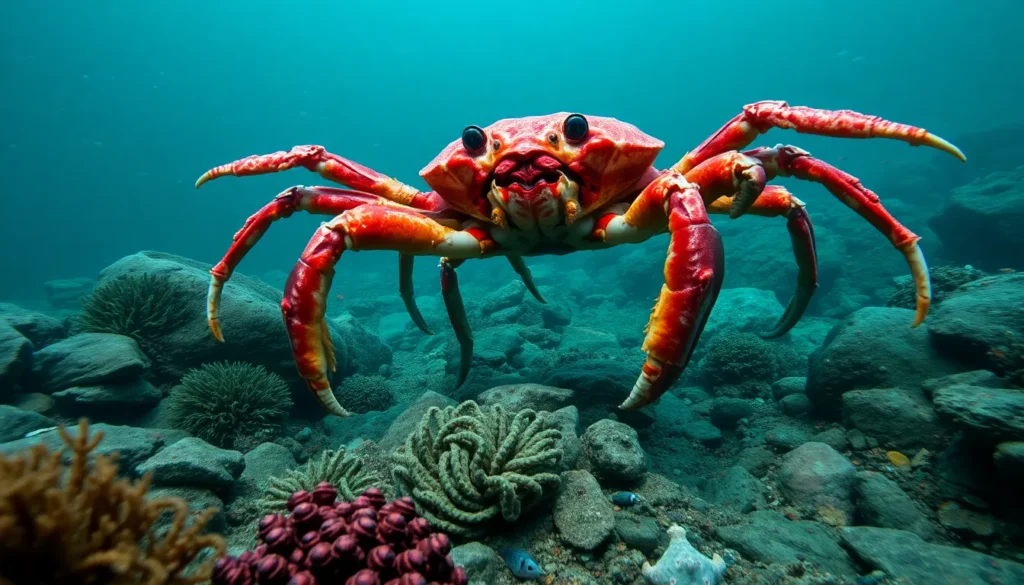
- King crabs are not true crabs. Although commonly called crabs, king crabs belong to the family Lithodidae and are more closely related to hermit crabs than true crabs.
- They are among the largest crustaceans. Some species, like the red king crab, can have leg spans up to 1.8 meters (6 feet) across.
- King crabs exhibit sexual dimorphism. Males are typically larger and have longer legs than females.
- They inhabit cold waters. King crabs are mostly found in the North Pacific Ocean, especially around Alaska and Russia.
- Many species are commercially important. The red king crab is a significant target for fisheries due to its valued meat.
- King crabs have a hard exoskeleton. This protective shell must be molted for them to grow, a vulnerable period in their life cycle.
- They are omnivores. Their diet includes algae, mollusks, worms, and smaller crustaceans.
- King crabs can live up to 20 years. Their lifespan varies depending on species and environmental conditions.
- They have powerful claws. These claws are used for defense, capturing prey, and manipulating objects.
- King crabs move sideways like true crabs. Their gait allows quick movement along the ocean floor.
- They undergo a complex larval development. Their larvae pass through several planktonic stages before settling to the ocean bottom.
- King crabs can regenerate lost limbs. This ability helps them survive predator attacks and injuries.
- They play a key role in benthic ecosystems. By scavenging and preying on smaller organisms, king crabs influence community dynamics on the seafloor.
- Some king crab species display territorial behavior. They may compete for shelter and mating opportunities.
- King crabs are prey for various marine animals. Predators include octopuses, large fish, and humans.
- The red king crab was introduced to the Barents Sea. This introduction by the Soviet Union in the 1960s aimed to establish a fishery but has ecological consequences.
- King crabs have been studied for their unique physiology. Their cold-adapted enzymes and blood pigments are of scientific interest.
- They can tolerate low oxygen environments. This adaptation allows survival in deep and cold ocean habitats.
- King crab fisheries are heavily regulated. To prevent overfishing, quotas and size limits are enforced in many regions.
- They are culturally significant in some coastal communities. King crab fishing supports local economies and traditions.
- Climate change may impact king crab populations. Changes in ocean temperature and acidity could affect their distribution and survival.
Habitat and Behavior
King crabs predominantly inhabit cold, deep ocean waters, with many species found in the North Pacific, particularly around Alaska, Siberia, and the Sea of Japan. They prefer rocky or muddy substrates on the ocean floor, where they can find shelter and food. King crabs are benthic creatures, meaning they live on or near the seabed. Their behavior includes scavenging and hunting smaller invertebrates, and they are mostly solitary outside of mating seasons. Movement is characterized by sideways walking, facilitated by their jointed legs. They molt regularly to grow, during which they are vulnerable to predation. Some species exhibit territoriality, particularly males competing for access to females. King crabs also display a larval planktonic stage, during which the young drift with ocean currents before settling to the benthic zone.
Why This Animal Matters
King crabs hold ecological significance as both predators and scavengers, helping maintain balance in benthic ecosystems by controlling populations of smaller marine organisms and recycling nutrients. Economically, they are valuable to fisheries, especially the red king crab, which supports commercial and subsistence harvesting, providing income and food in coastal regions. Culturally, king crab fishing is part of the heritage of many indigenous and coastal communities. Conservation and management of king crab populations are critical due to their importance and vulnerability to overfishing and environmental changes. Their response to climate change also serves as an indicator of broader marine ecosystem health.
Common Misconceptions
Misconception: King crabs are true crabs.
Correction: King crabs belong to the family Lithodidae and are closer relatives to hermit crabs than to true crabs, which are members of the Brachyura infraorder.
Misconception: All king crabs have the same habitat.
Correction: While many king crab species inhabit cold waters, some can be found in different ocean regions and depths, with varying habitat preferences.
Misconception: King crabs can survive indefinitely without molting.
Correction: Like other crustaceans, king crabs must molt their exoskeletons periodically to grow, and failure to molt properly can be fatal.
Misconception: King crab populations are not affected by human activity.
Correction: Overfishing, habitat disturbance, and climate change impact king crab populations, necessitating careful management and conservation efforts.
FAQ
Are king crabs true crabs?
No, king crabs belong to the family Lithodidae and are more closely related to hermit crabs than to true crabs, which are members of the infraorder Brachyura.
Where are king crabs typically found?
King crabs are mostly found in cold ocean waters such as the North Pacific, particularly around Alaska, Russia, and Japan.
Why are king crabs important to fisheries?
King crabs, especially the red king crab, are prized for their meat and support significant commercial fisheries, providing economic benefits to coastal communities.



Leave a Reply