
Short Answer
21 Facts About Echidnas
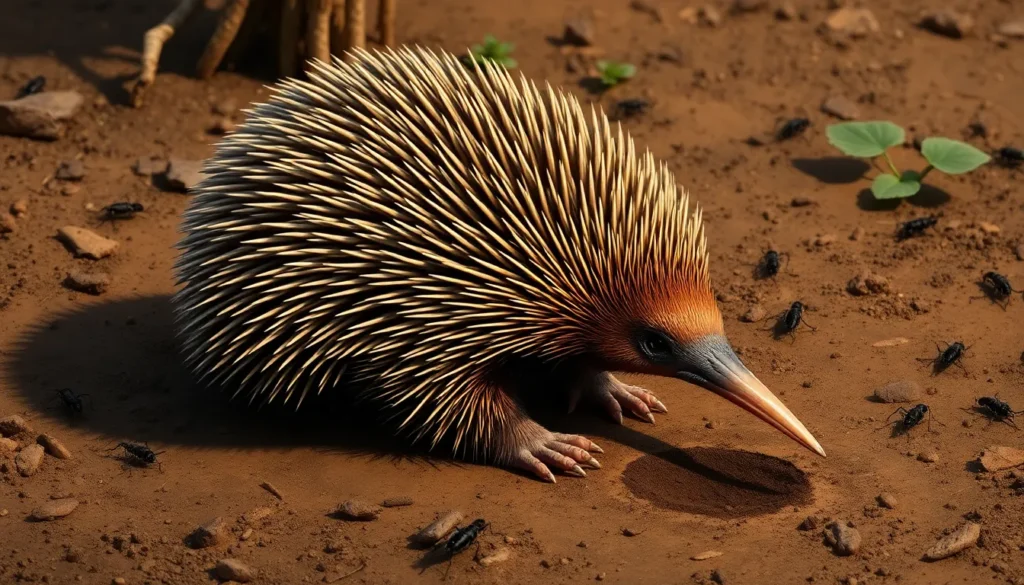
- Echidnas are monotremes. They belong to a rare group of mammals that lay eggs instead of giving birth to live young.
- There are four recognized species of echidnas. Three species inhabit Australia and one is found in New Guinea.
- They have spines for protection. Echidnas are covered in sharp spines made of keratin, similar to porcupine quills.
- Echidnas have a specialized snout. Their elongated snout functions as both a nose and mouth, equipped with electroreceptors to detect prey.
- Their diet mainly consists of ants and termites. Echidnas use their long, sticky tongue to capture insects from narrow spaces.
- Echidnas have no teeth. Instead, they grind food between the tongue and the roof of the mouth.
- They possess a low body temperature for mammals. Typically around 32°C (90°F), which is lower than most placental mammals.
- Echidnas are solitary animals. They generally live and forage alone except during the breeding season.
- They have strong limbs with powerful claws. These are used for digging burrows and foraging for insects underground.
- Echidnas have a unique reproductive cycle. Females lay a single leathery egg and incubate it in a pouch until hatching.
- The baby echidna is called a puggle. After hatching, the puggle remains in the mother’s pouch for several weeks before becoming more independent.
- Echidnas can live for over 50 years. In captivity, they have been known to live up to 50 years or more, though lifespan in the wild is less well documented.
- Echidnas have low metabolic rates. This helps them survive in environments with variable food availability.
- They can enter a state of torpor. This temporary reduction in metabolic rate helps conserve energy during cold or food-scarce periods.
- Echidnas are excellent swimmers. They can paddle across rivers and swim underwater to evade predators.
- Their spines do not detach easily. Unlike porcupines, echidna spines remain firmly attached and are not used as defensive projectiles.
- Echidnas have a four-headed penis. This unusual anatomical feature is rare among mammals and is still a subject of scientific study.
- They play an important ecological role. By consuming ants and termites, echidnas help control insect populations and contribute to soil aeration through digging.
- Echidnas are considered a symbol of Australia’s unique wildlife. Their unusual biology and ancient lineage make them a subject of cultural interest.
- They are protected by law in Australia. Hunting or disturbing echidnas is illegal, and conservation efforts focus on maintaining their habitats.
- Despite their unique features, echidnas are not endangered. However, habitat loss and introduced predators pose ongoing threats in some regions.
Habitat and Behavior
Echidnas are native to Australia and New Guinea, inhabiting a wide range of environments including forests, grasslands, and deserts. They are highly adaptable and can be found from sea level to mountainous areas. Echidnas are primarily nocturnal or crepuscular, foraging mostly at night or during dawn and dusk. Their diet consists mainly of ants and termites, which they locate using electroreceptors in their snouts. Echidnas use their strong claws to dig into insect nests and create burrows for shelter. They are solitary creatures except during the breeding season, when males may compete for females. Echidnas are also known for their ability to enter torpor, a state of reduced metabolic activity to conserve energy during adverse conditions.
Why This Animal Matters
Echidnas fulfill an important ecological role by controlling insect populations, particularly ants and termites, which can be pests. Their digging behavior helps aerate the soil, promoting healthy ecosystems. As one of the few monotremes, echidnas offer valuable insights into mammalian evolution and reproduction. Their unique biology has fascinated scientists and contributed to understanding the diversity of life. Culturally, echidnas are emblematic of Australia’s distinct fauna and hold a place in Indigenous stories and modern conservation awareness. Protecting echidnas also means preserving the habitats and biodiversity of the regions they inhabit.
Common Misconceptions
Misconception: Echidnas are related to porcupines.
Correction: Although echidnas and porcupines both have spines, they are not closely related. Echidnas are monotremes (egg-laying mammals), while porcupines are rodents.
Misconception: Echidnas are reptiles because they lay eggs.
Correction: Echidnas are mammals despite laying eggs. They produce milk and have fur (spines are modified hair), which are mammalian characteristics.
Misconception: Echidnas use their spines to shoot at predators.
Correction: Echidna spines are fixed and do not detach or shoot like porcupine quills. They rely on curling into a ball and burrowing for defense.
Misconception: Echidnas are slow-moving and defenseless.
Correction: Echidnas can move quickly when threatened and use their powerful claws to dig rapidly into the ground to escape danger.
Misconception: Echidnas can only survive in forests.
Correction: Echidnas are found in diverse habitats including deserts, grasslands, and woodlands, demonstrating significant adaptability.
FAQ
Why do echidnas lay eggs instead of giving birth to live young?
Echidnas are monotremes, an ancient lineage of mammals that lay eggs. This reproductive strategy is a primitive trait shared only with platypuses among modern mammals.
How do echidnas find their food?
Echidnas use electroreceptors in their snouts to detect electrical signals produced by the muscles and nerves of their insect prey, mainly ants and termites.
Are echidnas dangerous to humans?
No, echidnas are generally shy and non-aggressive. They use their spines as a defense against predators but pose no significant threat to people.

Leave a Reply