
Short Answer
21 Facts About Leopard Sharks
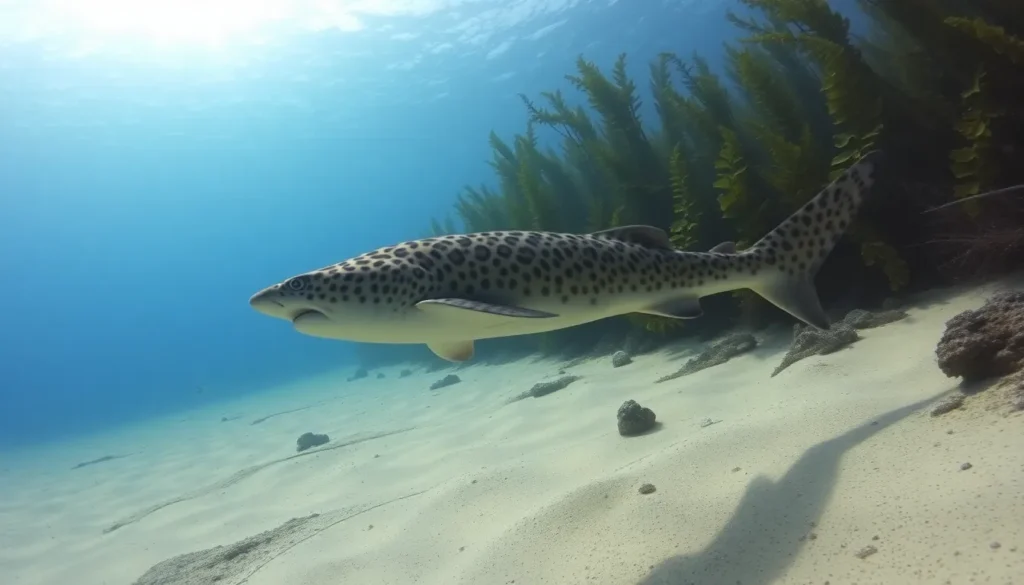
- Distinctive Spotted Pattern
Leopard sharks are named for their unique dark saddle-like markings and spots over a silvery or grayish body, which resembles the pattern of a leopard. - Scientific Classification
They belong to the family Triakidae and the genus Triakis, with the scientific name Triakis semifasciata. - Geographic Range
Leopard sharks are primarily found along the Pacific coast of North America, from Oregon to the Gulf of California. - Coastal Habitat Preference
They inhabit shallow coastal waters, including bays, estuaries, and sandy or muddy bottoms, often near kelp forests. - Size and Weight
Adults typically reach lengths of 4 to 5 feet (1.2 to 1.5 meters) and can weigh up to 45 kilograms (100 pounds). - Dietary Habits
Leopard sharks feed mainly on benthic invertebrates such as crabs, shrimp, mollusks, and small fish. - Reproduction Mode
They are ovoviviparous, meaning females give birth to live young after eggs hatch internally. - Litter Size
Females can give birth to between 4 and 33 pups per reproductive cycle. - Behavioral Traits
Leopard sharks are generally docile and tend to swim slowly, often forming schools or aggregations. - Longevity
The lifespan of leopard sharks is estimated at around 20 to 30 years in the wild. - Activity Pattern
They are mostly active during the day but can also show crepuscular (dawn and dusk) activity. - Predators
Natural predators include larger sharks, seals, and killer whales. - Role in Ecosystem
As mid-level predators, leopard sharks help regulate populations of benthic invertebrates and small fish. - Human Interaction
They are generally harmless to humans and sometimes encountered by divers and snorkelers. - Commercial Use
Leopard sharks are occasionally caught in commercial and recreational fisheries but are not a major target species. - Conservation Status
They are currently classified as Least Concern by the IUCN but face localized threats from habitat degradation and fishing. - Adaptations
Leopard sharks have electroreceptors called ampullae of Lorenzini to detect prey in murky waters. - Swimming Style
They use a side-to-side motion of their strong tail fin for propulsion, allowing for agile movements near the sea floor. - Temperature Range
These sharks tolerate a wide range of water temperatures, typically between 12 and 24 degrees Celsius. - Juvenile Habitat
Young leopard sharks often inhabit shallow nursery areas like tidal flats and estuaries to avoid predators. - Research Importance
Leopard sharks are studied for their reproductive biology, behavior, and as indicators of coastal ecosystem health.
Habitat and Behavior
Leopard sharks reside primarily in coastal environments along the eastern Pacific Ocean, favoring sandy or muddy bottoms near kelp beds, bays, and estuaries. They are often found in shallow waters, typically less than 20 meters deep, though they can venture deeper. Their behavior is characterized by relatively slow swimming and a tendency to form groups, especially during certain times of the year. These sharks feed mostly on benthic organisms and use specialized electroreceptors to locate prey hidden in sediment. Their ovoviviparous reproduction involves internal egg development and live birth, with females giving birth in sheltered nursery areas to increase juvenile survival rates.
Why This Animal Matters
Leopard sharks play a vital ecological role as mid-level predators in coastal marine ecosystems, helping to maintain balanced populations of invertebrates and small fish. Their presence is often an indicator of healthy coastal habitats, such as kelp forests and estuaries. From a conservation perspective, while currently not endangered, they are susceptible to threats like habitat loss and bycatch, making monitoring important. Additionally, their generally harmless nature and distinctive appearance make them a species of interest for environmental education and ecotourism along the Pacific coast.
Common Misconceptions
Misconception: Leopard sharks are dangerous to humans.
Correction: Leopard sharks are generally non-aggressive and pose little to no threat to humans. They rarely bite and are often curious rather than aggressive.
Misconception: Leopard sharks are solitary animals.
Correction: While they can be solitary, leopard sharks often form schools or aggregations, especially during mating seasons or in preferred feeding areas.
Misconception: Leopard sharks are found worldwide.
Correction: Leopard sharks are native specifically to the eastern Pacific coast of North America and are not distributed worldwide.
Misconception: Leopard sharks can live in freshwater.
Correction: Leopard sharks are marine species and do not inhabit freshwater environments, though they may tolerate brackish water in estuaries.
FAQ
Are leopard sharks dangerous to humans?
Leopard sharks are generally not dangerous to humans. They are docile and rarely bite unless provoked.
Where can leopard sharks be found?
Leopard sharks are found along the Pacific coast of North America, from Oregon to the Gulf of California, primarily in shallow coastal waters.
How do leopard sharks reproduce?
Leopard sharks are ovoviviparous, meaning females carry eggs inside their bodies until the young hatch and are born live, usually in sheltered nursery areas.




Leave a Reply