
Short Answer
21 Facts About Deep Sea Animals
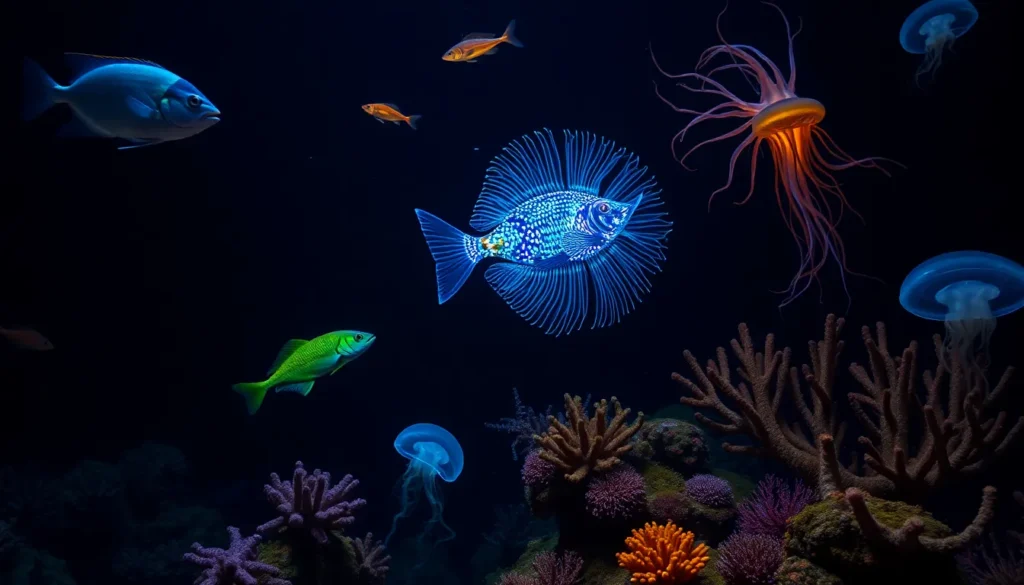
- Bioluminescence is common. Many deep sea animals produce light through chemical reactions, which helps in attracting prey, communication, and camouflage.
- Extreme pressure adaptation. Deep sea creatures have specialized cellular structures and flexible bones or no bones to withstand the immense pressure found thousands of meters below the surface.
- Low metabolism rates. To conserve energy in an environment with scarce food, many deep sea animals exhibit slower metabolisms compared to shallow water species.
- Gigantism in some species. Certain deep sea animals, like the giant squid or amphipods, exhibit unusually large sizes, a phenomenon known as deep-sea gigantism.
- Unique reproductive strategies. Many deep sea species have adapted unusual reproductive methods, such as parasitic males in anglerfish that permanently attach to females.
- Reduced or absent eyesight. Some deep sea animals have tiny eyes or are blind, relying more on other senses due to the lack of sunlight.
- Slow growth and long lifespans. Species like the Greenland shark can live for centuries and grow very slowly, a survival trait in nutrient-poor environments.
- Specialized feeding adaptations. Many deep sea animals have large mouths, extendable stomachs, and sharp teeth to capture scarce prey.
- Chemosynthesis-based ecosystems. Around hydrothermal vents, some deep sea communities rely on bacteria that convert chemicals into energy, supporting unique food webs.
- Deep sea coral and sponge communities. Unlike shallow reefs, these slow-growing communities provide habitats for many marine species in the dark ocean depths.
- Some species show transparency. To avoid detection, many deep sea animals have transparent bodies.
- Vertical migration. Some deep sea animals migrate vertically daily, moving closer to the surface at night to feed and retreating to depth during the day.
- Extreme cold tolerance. Deep sea environments often hover near freezing, requiring specialized proteins to prevent cellular damage.
- Deep sea fish diversity is vast. Despite harsh conditions, thousands of fish species inhabit the deep ocean, many yet to be discovered.
- Some animals use bioluminescent lures. For example, anglerfish use a glowing appendage to attract prey within striking distance.
- Deep sea creatures often have slow movements. This energy-efficient behavior suits an environment with limited food resources.
- Many deep sea animals are scavengers. They feed on detritus, dead animals, or falling organic material from upper ocean layers.
- Some species are hermaphrodites. This reproductive trait increases the chance of successful mating in sparse populations.
- Deep sea animals can have unusual body shapes. Examples include tube-like bodies, flattened forms, or elongated appendages to navigate their environment.
- Deep sea exploration is still limited. Much of the deep ocean remains unexplored, and new species continue to be discovered regularly.
- Climate change impacts deep sea ecosystems. Changes in ocean temperature and chemistry affect these sensitive habitats, although long-term effects are still being studied.
Habitat and Behavior
Deep sea animals inhabit ocean zones typically below 200 meters, extending down to the hadal zone, which reaches depths greater than 6,000 meters. These zones are characterized by near-freezing temperatures, perpetual darkness, and crushing pressures. To survive, deep sea animals have evolved a variety of specialized adaptations including bioluminescence for communication and hunting, flexible bodies or reduced skeletal structures to withstand pressure, and slow metabolisms to conserve energy. Their behaviors often include vertical migrations to optimize feeding opportunities and unique reproductive strategies to ensure species survival in sparsely populated environments. Many are scavengers or rely on chemosynthetic ecosystems near hydrothermal vents, where sunlight does not reach.
Why This Animal Matters
Deep sea animals play critical roles in ocean ecosystems by contributing to nutrient cycling, supporting diverse food webs, and maintaining ecological balance in one of Earth’s largest habitats. They offer insights into evolutionary biology due to their unique adaptations to extreme conditions. Furthermore, deep sea environments are increasingly important for scientific research, including studies on climate change impacts and potential biotechnological applications derived from deep sea organisms. Conservation is vital as these ecosystems are vulnerable to threats such as deep-sea mining, pollution, and ocean acidification, which can disrupt fragile communities.
Common Misconceptions
Misconception: Deep sea animals are all giant and monstrous.
Correction: While some species exhibit gigantism, many deep sea animals are small or of moderate size, adapted to conserve energy and survive scarce food availability.
Misconception: The deep sea is a lifeless, barren environment.
Correction: The deep ocean hosts a diverse array of species and complex ecosystems, including coral communities and unique chemosynthetic habitats.
Misconception: All deep sea animals are blind.
Correction: Although many have reduced eyesight or rely on other senses, some deep sea species possess functional eyes adapted to detect faint light or bioluminescence.
Misconception: Deep sea exploration is complete, and we know most species.
Correction: The deep ocean remains one of the least explored regions on Earth, with ongoing discoveries of new species and ecosystems.
FAQ
What adaptations help deep sea animals survive extreme pressure?
Deep sea animals have flexible cell membranes, reduced or no bones, and specialized proteins that prevent cellular damage, allowing them to survive the crushing pressure found at great depths.
Why do many deep sea animals produce light?
Bioluminescence helps deep sea animals attract prey, communicate with others, camouflage themselves, or deter predators in the absence of sunlight.
How do deep sea ecosystems get energy without sunlight?
Some deep sea ecosystems rely on chemosynthesis, where bacteria convert chemical energy from hydrothermal vents into organic matter, forming the base of the food web.


Leave a Reply