
Short Answer
21 Facts About Arctic Animals
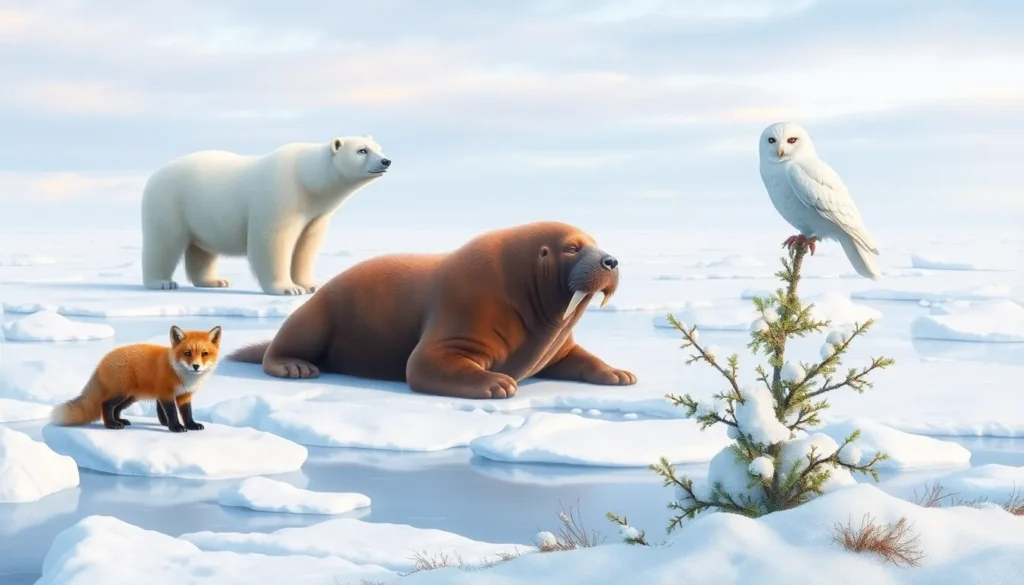
- Polar bears have black skin beneath their white fur. Their fur appears white to blend with the snow, but the skin underneath is black to absorb and retain heat from the sun.
- Arctic foxes change fur color seasonally. They have white fur in winter for camouflage in snow, and brown or gray fur in summer to blend with rocks and tundra.
- Walruses have long tusks used for multiple purposes. These tusks help in hauling out onto ice, defending against predators, and establishing dominance.
- Emperor penguins are found in Antarctica, not the Arctic. Despite popular belief, no penguin species inhabit the Arctic region.
- Arctic hares can run at speeds up to 60 km/h (37 mph). This helps them evade predators in open tundra environments.
- Snowy owls have feathered feet for insulation. This adaptation helps them maintain body heat in freezing temperatures.
- Ringed seals maintain breathing holes in sea ice using their teeth. These holes are essential for surfacing and breathing beneath the ice.
- Caribou (reindeer) are the only deer species where both males and females grow antlers. This helps them in foraging and defense during harsh winters.
- Arctic ground squirrels hibernate for up to 8 months. They lower their body temperature below freezing during hibernation to conserve energy.
- Beluga whales are known as “canaries of the sea” due to their vocalizations. They use a wide range of sounds to communicate in underwater environments.
- Many Arctic animals have a thick layer of blubber for insulation. This fat layer helps maintain body heat in icy waters and cold air.
- Some Arctic fish produce antifreeze proteins. These proteins prevent their blood from freezing in subzero temperatures.
- Arctic terns undertake the longest migration of any bird, traveling from the Arctic to the Antarctic annually. This journey can span over 70,000 kilometers (43,500 miles).
- Wolverines have large paws that act like snowshoes. This adaptation allows them to walk on deep snow without sinking.
- Many Arctic animals have counter-current heat exchange systems in their limbs. This system conserves heat by warming cold blood returning from extremities.
- Greenland sharks can live for over 400 years, possibly making them the longest-living vertebrates. They inhabit cold Arctic and North Atlantic waters.
- Arctic animals often exhibit seasonal breeding synchronized with short summers. This timing ensures offspring have the best chance of survival with ample food.
- Some Arctic birds, like the ptarmigan, change feather color seasonally. This provides camouflage against snow in winter and tundra in summer.
- Polar bears primarily hunt seals by waiting near breathing holes in sea ice. This hunting technique is energy-efficient and effective in the Arctic environment.
- Ice algae form the base of the Arctic marine food web. Many Arctic animals depend indirectly on these microscopic plants for nourishment.
- Climate change poses significant threats to Arctic animals by altering habitats and food availability. Melting ice and shifting ecosystems challenge their survival.
Habitat and Behavior
Arctic animals inhabit the polar region surrounding the North Pole, including the Arctic Ocean and surrounding landmasses like parts of Canada, Russia, Greenland, and Alaska. This environment is characterized by extreme cold, seasonal ice coverage, and limited vegetation. To survive, Arctic animals have evolved unique physical and behavioral adaptations. Many possess insulating features such as thick fur, dense feathers, or blubber. Behaviorally, species often migrate seasonally, hibernate, or alter feeding strategies to cope with limited food resources during harsh winters. Predators like polar bears rely on sea ice to hunt seals, while herbivores like caribou graze on tundra vegetation during brief summers. Social structures vary widely, from solitary animals to large migratory herds and communal bird colonies.
Why This Animal Matters
Arctic animals play crucial roles in their ecosystems, maintaining balance in food webs and nutrient cycles. As apex predators, polar bears help regulate seal populations, while herbivores influence plant community dynamics in tundra regions. Culturally, many indigenous Arctic peoples have deep connections to these animals, relying on them for subsistence and incorporating them into traditions and folklore. From a conservation perspective, Arctic species are indicators of environmental health, particularly in the face of rapid climate change. Changes in their populations can signal broader ecosystem shifts, making their study essential for understanding and mitigating the impacts of global warming.
Common Misconceptions
Misconception: Penguins live in the Arctic.
Correction: Penguins are native to the Southern Hemisphere, primarily Antarctica, and are not found in the Arctic.
Misconception: All Arctic animals hibernate during winter.
Correction: While some species like Arctic ground squirrels hibernate, many others remain active year-round, adapting through other survival strategies.
Misconception: Polar bears only eat seals.
Correction: Although seals form the bulk of their diet, polar bears also consume other foods such as bird eggs, vegetation, and carrion when available.
Misconception: Arctic animals do not face threats due to the remote environment.
Correction: Many Arctic species are vulnerable to climate change, pollution, and human activities, impacting their survival.
Misconception: All Arctic animals have white fur or feathers.
Correction: While many species have white or light-colored coats for camouflage, others exhibit seasonal color changes or different coloration entirely.
FAQ
Do penguins live in the Arctic?
No, penguins are native to the Southern Hemisphere, primarily Antarctica, and are not found in the Arctic region.
How do Arctic animals survive the extreme cold?
Arctic animals survive by having thick insulating fur or blubber, seasonal camouflage, hibernation, and specialized behaviors such as migration and burrowing.
Why are Arctic animals important to the ecosystem?
They maintain the balance of the Arctic food web, support nutrient cycles, and serve as indicators of environmental health in the face of climate change.

Leave a Reply