
Short Answer
21 Facts About Squid
- Squid belong to the class Cephalopoda. They are mollusks related to octopuses and cuttlefish, characterized by bilateral body symmetry, a mantle, and arms.
- Squid have a unique body structure. Their bodies are elongated with a distinct head, large eyes, and eight arms plus two longer tentacles used for capturing prey.
- Most squid species have an ink sac. They expel ink to create a cloud in the water, which helps them evade predators by obscuring vision.
- Squid possess complex nervous systems. Their brains are highly developed, allowing advanced behaviors such as problem-solving and learning.
- They have advanced eyes similar to vertebrates. Squid eyes are well-adapted for low-light vision and provide acute image resolution.
- Squid use jet propulsion to move. By expelling water forcefully through a siphon, they can rapidly propel themselves backward.
- Some squid species can change color. Using specialized skin cells called chromatophores, they can alter their appearance for camouflage or communication.
- Squid are carnivorous predators. They primarily feed on fish, crustaceans, and other smaller squid using their tentacles to capture prey.
- Many squid species are bioluminescent. They can emit light through chemical reactions, which may be used for communication or camouflage in deep waters.
- Squid have a short lifespan. Most live only one to two years, with some deep-sea species living longer.
- The giant squid is one of the largest invertebrates. It can grow up to about 13 meters (43 feet) in length, making it among the largest known mollusks.
- Squid reproduce by internal fertilization. Males transfer sperm packets to females using specialized arms, and females lay eggs in clusters.
- Squid are found worldwide. They inhabit a range of marine environments from shallow coastal waters to the deep ocean.
- They play a vital role in marine food webs. Squid serve as prey for many marine animals including fish, marine mammals, and seabirds.
- Squid blood uses copper-based hemocyanin. Unlike vertebrates’ iron-based hemoglobin, squid blood is blue when oxygenated.
- They can regenerate lost arms. Squid are capable of regenerating damaged or lost limbs over time.
- Squid have a closed circulatory system. Their blood circulates through vessels, which allows efficient oxygen delivery to their tissues.
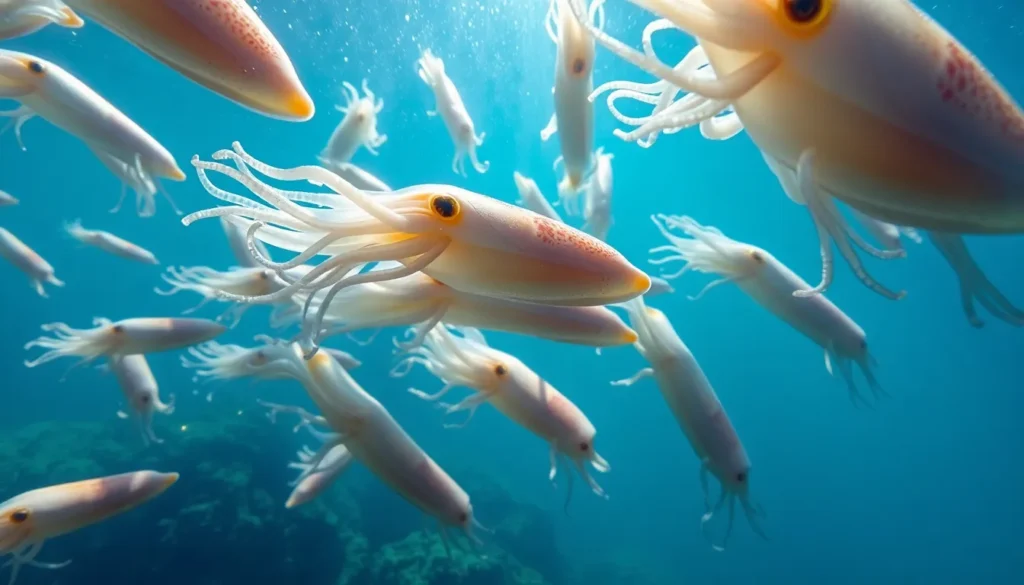
- Some squid species exhibit schooling behavior. They can form large groups, which may help in hunting or protection from predators.
- Squid ink has been historically used as pigment. It was once used as writing ink and in art, known as sepia ink.
- Squid are studied extensively for biomimicry. Their camouflage and propulsion mechanisms inspire technological innovations.
- Squid nervous systems differ from vertebrates. Their neurons are large and fast-conducting, which makes them important model organisms in neurobiology.
Habitat and Behavior
Squid are marine animals found in nearly all the world’s oceans, from surface waters to the deep sea. They inhabit diverse environments including coral reefs, open oceans, and deep abyssal plains. Their behavior varies widely among species; some are solitary while others form large schools. Squid are agile swimmers using jet propulsion for rapid movement, and many display remarkable camouflage abilities through color changes. They hunt primarily at night, preying on fish, crustaceans, and other cephalopods, while avoiding predators with their ink defense and swift escape responses. Breeding typically involves complex mating behaviors, and females lay eggs in protected areas or attach them to substrates. The short lifespan of squid means that many species grow rapidly and reproduce once before dying.
Why This Animal Matters
Squid play a critical ecological role as both predators and prey within marine ecosystems. They help regulate populations of smaller marine organisms and provide a significant food source for larger predators such as whales, sharks, and seabirds. Their rapid growth and high reproductive rates also make them important indicators of ocean health and fisheries sustainability. Culturally, squid have been part of human diets for centuries, especially in coastal communities worldwide. Scientifically, squid are valuable model organisms in neurobiology, physiology, and biomimetic research due to their unique anatomy and behaviors. Conservation concerns arise from overfishing and habitat degradation, highlighting the need for sustainable management of squid populations.
Common Misconceptions
Misconception: Squid are fish.
Correction: Squid are mollusks, not fish. Unlike fish, they have soft bodies, no backbone, and belong to the class Cephalopoda.
Misconception: All squid are giant creatures.
Correction: While some species like the giant squid are very large, most squid are small to medium-sized, often less than 60 centimeters in length.
Misconception: Squid use their ink as a weapon to harm predators.
Correction: Squid ink serves primarily as a visual smokescreen to confuse predators, not as a direct weapon.
Misconception: Squid live only in deep ocean waters.
Correction: Squid inhabit a variety of marine environments, including shallow coastal areas and open seas, not exclusively deep waters.
Misconception: Squid are slow and defenseless animals.
Correction: Squid are fast, agile swimmers with several defense mechanisms such as rapid jet propulsion, ink release, and camouflage.
FAQ
How do squid move so quickly in the water?
Squid use a form of jet propulsion by rapidly expelling water through a muscular siphon, allowing them to move quickly and with great agility to escape predators or catch prey.
Are squid intelligent animals?
Yes, squid are considered highly intelligent among invertebrates. They have complex nervous systems and exhibit behaviors such as problem-solving, learning, and communication through color changes.
What is the purpose of the squid's ink?
Squid release ink as a defense mechanism to create a dark cloud in the water, which can confuse predators and provide the squid with an opportunity to escape.


Leave a Reply