
Short Answer
21 Facts About Pyrosomes
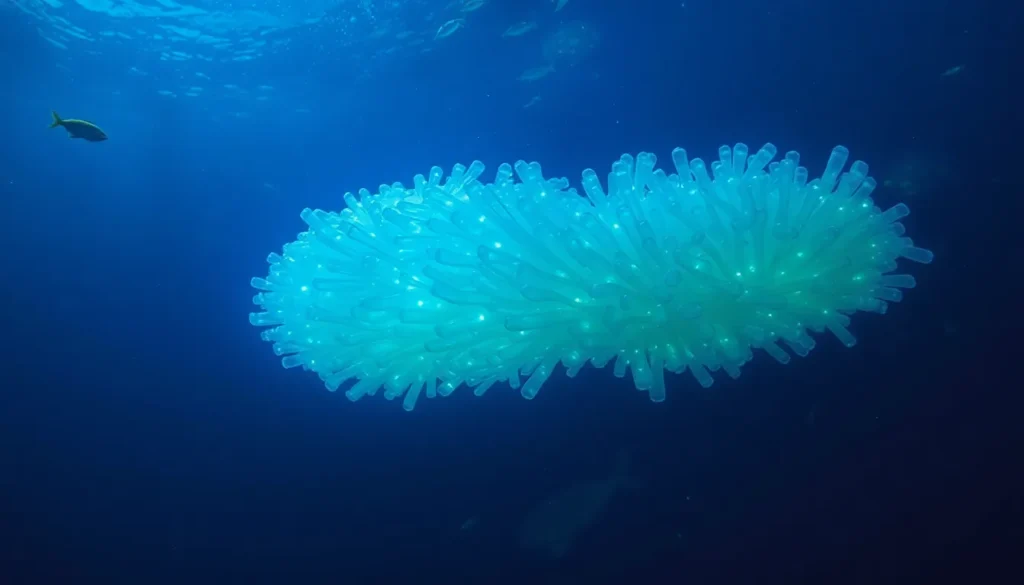
- Colonial Organisms: Pyrosomes are colonial tunicates composed of many individual zooids embedded in a gelatinous tube, working together as a single unit.
- Bioluminescence: They are known for their ability to produce light, emitting a blue-green glow that can be seen in dark ocean waters.
- Pelagic Habitat: Pyrosomes live in the open ocean, typically floating freely in the water column rather than being attached to the seafloor.
- Size Variation: Individual pyrosome colonies can vary greatly in size, from just a few centimeters up to several meters in length.
- Tube Structure: Their bodies form hollow, cylindrical tubes that are open at one end, allowing water to flow through for feeding and locomotion.
- Zooid Composition: Each zooid in the colony is a filter-feeding animal that contributes to the colony’s survival by filtering plankton from seawater.
- Jet Propulsion: Pyrosomes move by coordinated beating of cilia in zooids, expelling water through the open end of their tube to propel themselves forward.
- Filter Feeding: They primarily feed on phytoplankton and small particles suspended in seawater, playing a role in nutrient cycling.
- Wide Distribution: Pyrosomes are found in oceans worldwide, from tropical to temperate and sometimes polar waters.
- Reproduction: They reproduce both sexually and asexually; individual zooids release gametes, and the colony can grow via budding.
- Ecological Impact: Large swarms of pyrosomes can influence local marine ecosystems by consuming vast amounts of plankton and altering food web dynamics.
- Predators: Despite their gelatinous texture, pyrosomes are preyed upon by various marine animals, including fish and sea turtles.
- Scientific Interest: Due to their bioluminescence and colonial organization, pyrosomes are subjects of scientific research in marine biology and biophysics.
- Historical Records: Pyrosomes have been known to science since the 19th century but were often misunderstood due to their unusual appearance.
- Not True Jellyfish: Although gelatinous and transparent like jellyfish, pyrosomes belong to the tunicate group, which is more closely related to vertebrates.
- Light Production Mechanism: Their bioluminescence is produced by photocytes within the zooids triggered by mechanical stimulation or chemical signals.
- Swarms and Blooms: Under certain ocean conditions, pyrosomes can form large blooms that become highly visible and sometimes disrupt fishing activities.
- Role in Carbon Cycle: By filtering plankton and producing fecal pellets, pyrosomes contribute to the ocean’s biological carbon pump.
- Fragile Structure: Their gelatinous tubes are delicate, making collection and study challenging without damaging specimens.
- Interactions with Humans: Pyrosomes rarely interact directly with humans but have occasionally been sighted washing ashore or caught incidentally in fishing nets.
- Unknown Species Diversity: While several pyrosome species are described, the full diversity and distribution remain under-researched.
Habitat and Behavior
Pyrosomes inhabit open ocean waters worldwide, usually in pelagic zones from surface to moderate depths. They are free-floating and drift with ocean currents, though they can exert some controlled movement through jet propulsion by expelling water from their tubular bodies. As filter feeders, pyrosomes consume microscopic plankton, which they capture by filtering seawater passing through their colony. Their bioluminescent capabilities help them possibly deter predators or communicate within the colony. Pyrosomes tend to form dense swarms or blooms when conditions favor rapid reproduction and growth, influencing local marine ecosystems. Their delicate gelatinous structure allows them to thrive in the water column but makes them vulnerable to damage and predation.
Why This Animal Matters
Pyrosomes play a significant ecological role in marine environments by filtering large volumes of plankton, thus affecting nutrient cycles and food webs. Their contribution to the biological carbon pump helps sequester carbon in the deep ocean, which is important for global carbon cycling and climate regulation. Additionally, their bioluminescence has scientific importance, offering insights into light-producing mechanisms in marine organisms. Though not of direct commercial value, pyrosomes can impact fisheries and ocean monitoring due to their occasional blooms. Understanding pyrosomes contributes to broader marine biodiversity knowledge and ocean ecosystem health assessments.
Common Misconceptions
Misconception: Pyrosomes are a type of jellyfish.
Correction: Pyrosomes are colonial tunicates, part of the chordate phylum, and are more closely related to vertebrates than to jellyfish, which are cnidarians.
Misconception: Pyrosomes glow constantly.
Correction: Their bioluminescence is usually triggered by mechanical disturbance or chemical signals and is not continuously active.
Misconception: Pyrosomes are harmful to humans.
Correction: Pyrosomes are harmless to humans and pose no direct threat, though their blooms may interfere with fishing operations.
FAQ
What are pyrosomes?
Pyrosomes are colonial marine tunicates that form large, hollow, tubular colonies composed of many small individual animals called zooids.
How do pyrosomes move?
Pyrosomes move by jet propulsion, coordinated by the beating of cilia within their zooids that expel water through the open end of their tube-like body.
Why do pyrosomes produce light?
Pyrosomes produce bioluminescent light likely as a defense mechanism or for communication within the colony, triggered by mechanical or chemical stimuli.


Leave a Reply