
Short Answer
21 Facts About Animal Tool Use
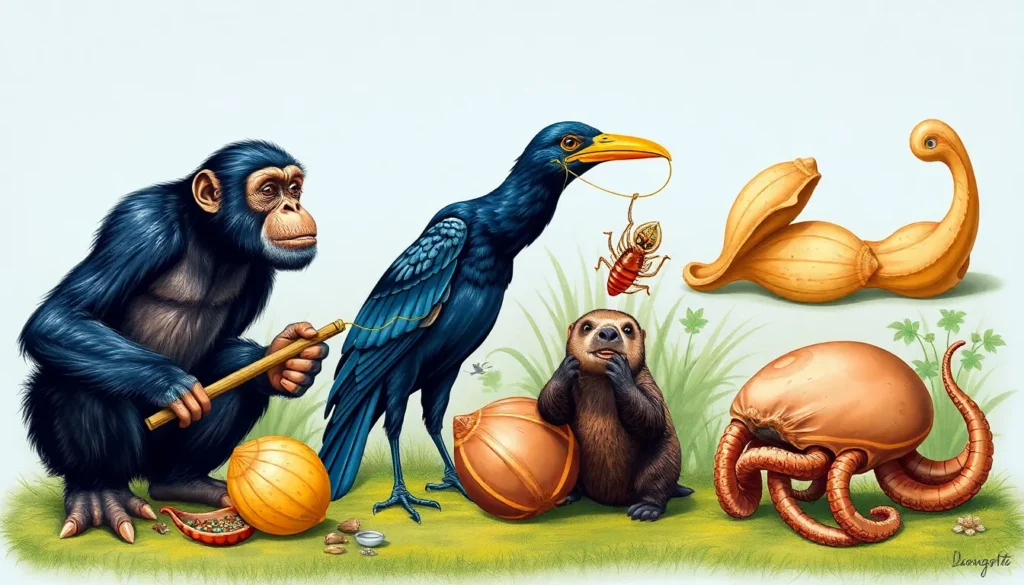
- Chimpanzees use sticks to fish for termites. Wild chimpanzees have been observed selecting and modifying sticks to extract termites from their mounds, demonstrating purposeful tool use in foraging.
- New Caledonian crows craft hooked tools. These crows are known to create and use hooked sticks to extract insects from tree bark and crevices, showcasing advanced problem-solving skills.
- Sea otters use rocks as anvils. Sea otters often use stones to crack open hard-shelled prey like sea urchins and clams, demonstrating the use of tools to access food.
- Dolphins use marine sponges as protective tools. Some dolphins cover their snouts with sea sponges to protect them while foraging on rocky seafloors.
- Elephants manipulate branches to swat flies. Elephants have been observed breaking branches and using them to scratch or swat insects, showing rudimentary tool use for comfort.
- Octopuses use coconut shells for shelter. Certain octopus species collect and assemble coconut shells as mobile shelters, an example of tool use for protection.
- Woodpecker finches use cactus spines. These finches from the Galápagos Islands use cactus spines to pry insects out of tree bark.
- Green herons drop bait to catch fish. Green herons have been seen using insects or feathers as bait to lure fish closer for capture.
- Orangutans use leaves as gloves or umbrellas. Orangutans have been documented using large leaves to protect their hands while handling spiny fruits or to shield themselves from rain.
- Capuchin monkeys crack nuts with stones. Wild capuchins use rocks to crack open hard nuts, demonstrating the use of tools to access food resources.
- Goffin’s cockatoos manufacture tools spontaneously. These birds have shown the ability to create tools for problem-solving even without prior exposure in captivity.
- Antlions use sand traps to catch prey. While not tool use in the traditional sense, antlions manipulate their environment to build funnel-shaped pits for prey capture.
- Sea urchins use debris for camouflage. Some sea urchins collect shells and algae to cover themselves, a behavior similar to tool use for protection.
- Chimpanzees modify stones to crack nuts. In certain populations, chimps select and modify stones to efficiently crack nuts, showing cultural transmission of tool use.
- Honeybees use propolis to seal hives. Bees collect resinous substances and use them to protect and maintain hive integrity.
- Ravens use tools to obtain food. Ravens have demonstrated the ability to use sticks and other objects as tools to reach food in experiments and the wild.
- Black kites drop burning sticks to start fires. Some reports suggest black kites may pick up and drop burning twigs to flush prey, although this behavior requires further study.
- Elephants create fly swatters with branches. Beyond swatting flies, elephants sometimes make tools by breaking and shaping branches for this purpose.
- Chimpanzees use leaves for drinking water. They fold leaves into containers to soak up and drink water, an example of functional tool use.
- Tool use is rare but widespread across animal groups. From insects to mammals and birds to cephalopods, tool use appears in diverse taxa, illustrating convergent evolution of intelligence.
- Tool use often involves cultural transmission. Many animals learn tool use behaviors socially, passing knowledge between generations.
Habitat and Behavior
Animals that use tools inhabit a wide variety of environments, from tropical forests and savannas to marine and freshwater ecosystems. Their behavior often involves problem-solving, learning, and social interaction. For example, chimpanzees in African forests use sticks and stones to access food, while sea otters in coastal waters use rocks to open shells. Tool use is commonly linked to foraging strategies, defense, grooming, and shelter construction. These behaviors require cognitive abilities such as memory, planning, and manual dexterity. Tool users often demonstrate social learning, where younger individuals acquire skills by observing older members of their group.
Why This Animal Matters
Understanding animal tool use provides insights into the evolution of intelligence, problem-solving, and culture in non-human species. It highlights the cognitive complexity present in diverse animals and challenges assumptions about human uniqueness. Ecologically, tool-using animals can influence their environments by modifying resources and predation dynamics. Culturally, some species, such as chimpanzees, hold symbolic significance in studies of human evolution. Conservation efforts benefit from this knowledge by emphasizing the protection of habitats that support complex behaviors and social structures. Preserving tool-using species helps maintain biodiversity and ecological balance.
Common Misconceptions
Misconception: Only primates use tools.
Correction: Tool use is observed in a wide range of animals, including birds, marine mammals, and even some invertebrates like octopuses.
Misconception: Tool use in animals is instinctive rather than learned.
Correction: Many animals learn tool use behaviors through social learning and individual trial and error, indicating cognitive flexibility.
FAQ
What animals are known for using tools?
Many animals use tools, including primates such as chimpanzees and orangutans, birds like New Caledonian crows and ravens, marine mammals such as dolphins and sea otters, and even some invertebrates like octopuses.
Is tool use in animals instinctive or learned?
Tool use behaviors are often learned through social learning and individual experience rather than being purely instinctive. Animals observe and imitate others to acquire these skills.
Why is animal tool use important to study?
Studying animal tool use helps scientists understand the evolution of intelligence, problem-solving, and culture in animals, offering insights into cognitive abilities beyond humans and informing conservation efforts.


Leave a Reply