
Short Answer
21 Facts About Autotomy (Tail Shedding) in Lizards
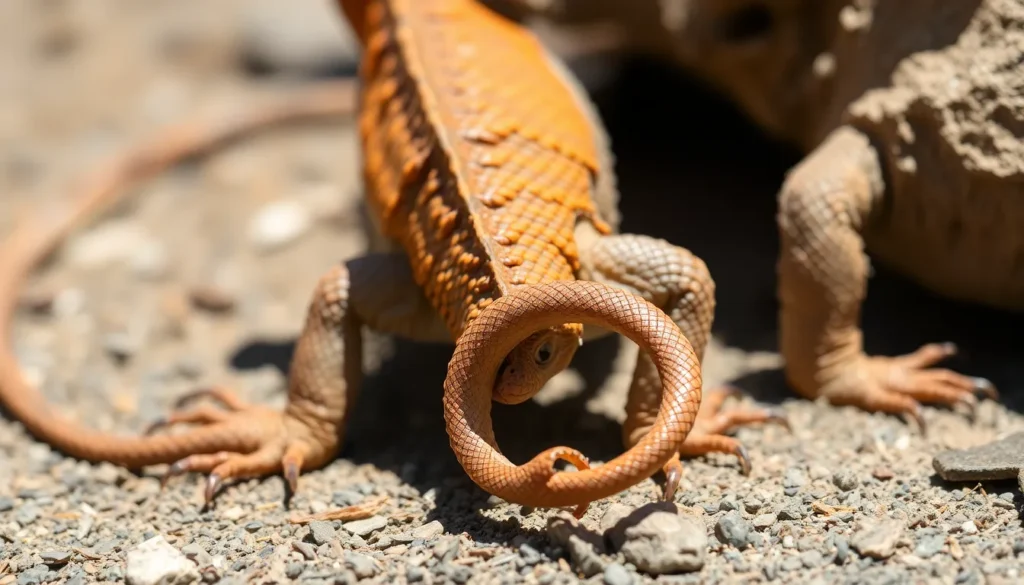
- Autotomy is a defense mechanism. Lizards can voluntarily shed their tails to evade predators, distracting the attacker with the wriggling detached tail while the lizard escapes.
- The tail regenerates over time. After shedding, most lizards can regrow their tail, although the new tail is often structurally and visually different from the original.
- Tail detachment occurs along fracture planes. Specialized fracture planes in the vertebrae allow the tail to break off easily and cleanly when necessary.
- Muscle contractions aid tail shedding. Muscles around the fracture plane contract rapidly to break the tail and minimize blood loss.
- The detached tail continues to move independently. The detached tail often writhes or twitches to distract predators, increasing the lizard’s chances of escape.
- Autotomy is energetically costly. Regenerating a tail requires significant metabolic resources, which can affect growth and reproduction.
- Not all lizard species can autotomize their tails. Some species lack the anatomical adaptations for tail autotomy.
- Regenerated tails lack vertebrae. Instead of bone, regenerated tails often contain a cartilaginous rod, which is less flexible and structurally different.
- Tail shedding can be triggered by stress or injury. Lizards may shed their tail not only from predator attacks but also due to handling or accidental damage.
- Temperature affects tail regeneration speed. Warmer temperatures typically accelerate the healing and regeneration processes.
- Autotomy can impact locomotion. Losing a tail may temporarily impair balance and agility, affecting the lizard’s ability to move efficiently.
- Some lizards use their tails for fat storage. Tail loss can thus reduce energy reserves, impacting survival during scarce conditions.
- Tail color and pattern often differ between original and regenerated tails. The new tail may be less camouflaged or brightly colored, potentially affecting predation risk.
- Autotomy is an ancient evolutionary adaptation. This mechanism has been observed in fossilized lizards, indicating its long-standing presence in reptile evolution.
- Shedding a tail is a last-resort defense. Lizards typically only autotomize their tails when escape by other means is impossible.
- Predators sometimes learn to target autotomized tails. Some predators may ignore the lizard and focus on the detached tail, which sometimes reduces further attacks.
- Tail autotomy can influence social interactions. In some species, tail loss may affect dominance status or mating success.
- Autotomy is often controlled neurologically. Lizards voluntarily initiate tail shedding through neural signals.
- Environmental factors influence autotomy frequency. Lizards in high-predation habitats tend to autotomize tails more often.
- Research into autotomy informs regenerative medicine. Understanding tail regeneration provides insights into tissue and limb regrowth in vertebrates.
- Autotomy is not exclusive to lizards. Some amphibians, arthropods, and other reptiles also exhibit similar self-amputation as a defense strategy.
Habitat and Behavior
Lizards that exhibit autotomy inhabit diverse environments worldwide, including deserts, forests, grasslands, and urban areas. Their ability to shed tails enhances survival in habitats with high predator presence. Autotomy is integrated into their behavioral repertoire, typically triggered when the lizard perceives imminent capture. Post-autotomy, lizards often seek shelter to recover and regenerate their tails. Their behavior balances risk management with energetic costs, as tail loss affects mobility, fat storage, and social interactions. Many species display territoriality or complex mating behaviors that can be influenced by tail condition.
Why This Animal Matters
Lizards play important ecological roles as both predators and prey in their environments. Autotomy contributes to their survival and thus influences ecosystem dynamics. By escaping predators, lizards help maintain insect populations and serve as prey for higher-level animals. The phenomenon of tail shedding also has scientific significance: it provides a natural model for studying regeneration, wound healing, and evolutionary biology. Additionally, lizards hold cultural importance in many societies, often symbolizing adaptability and renewal, partly due to their ability to regenerate lost tails.
Common Misconceptions
Misconception: Lizards can drop their tails multiple times without any negative consequences.
Correction: While many lizards can autotomize their tails more than once, repeated tail loss depletes energy reserves and can impair survival and reproduction.
Misconception: The regenerated tail is identical to the original.
Correction: Regenerated tails differ anatomically and visually from original tails, often lacking vertebrae and having different coloration and texture.
Misconception: Tail autotomy is a reflex that happens automatically whenever a predator grabs the tail.
Correction: Tail shedding is a voluntary process controlled by the lizard’s nervous system and usually occurs only under extreme threat.
Misconception: Only lizards can autotomize their tails.
Correction: Autotomy occurs in other animals, including some amphibians and arthropods, as a defense strategy.
Misconception: Losing a tail does not affect the lizard’s health or behavior.
Correction: Tail loss impacts balance, energy storage, social status, and vulnerability to predators, influencing overall fitness.
FAQ
Why do lizards shed their tails?
Lizards shed their tails primarily as a defense mechanism to escape predators. The detached tail distracts the attacker, allowing the lizard to flee.
Can lizards regrow their tails after shedding?
Yes, most lizards can regenerate their tails after autotomy, although the new tail structure is usually different from the original.
Does tail shedding harm lizards?
While autotomy helps survival, it is energetically costly and can temporarily impair mobility and social interactions.

Leave a Reply